TL;DR
- Employer of Record (EOR) software lets you convert international contractors to full-time employees without opening a legal entity in their country.
- Converting a contractor incorrectly is one of the most common triggers for misclassification penalties and permanent establishment risk once a company operates in more than one country.
- Good EOR software builds local employment law into the conversion workflow itself — it blocks non-compliant contract terms automatically rather than relying on someone knowing the rules for each jurisdiction.
- For startup and mid-market tech companies, this turns a multi-country legal exercise into a workflow: draft a compliant contract, translate pay and benefits, and onboard, tracked in one place, with a named team backing up the software.
- Emerald’s platform employs contractors as compliant staff across 150+ countries, with country-specific legal minimums enforced at the point of data entry, not discovered after the fact.
What is Employer of Record software?
Employer of Record software is the platform layer behind an Employer of Record (EOR) service: it is what lets a company generate compliant local employment contracts, run payroll, and manage onboarding for staff in countries where it has no legal entity, without doing each step manually through local counsel and payroll vendors in every market.
The EOR itself — not the client company — becomes the legal employer in each country. It carries the statutory obligations: employment contracts, payroll, tax withholding, and termination rules. The client keeps full day-to-day control of the person’s work. The software is what makes this operational at volume: instead of a lawyer drafting one contract per country per hire, the platform generates the contract, applies the correct local terms, and tracks the process from offer through onboarding. Explore the EOR solution for the full service behind the software.
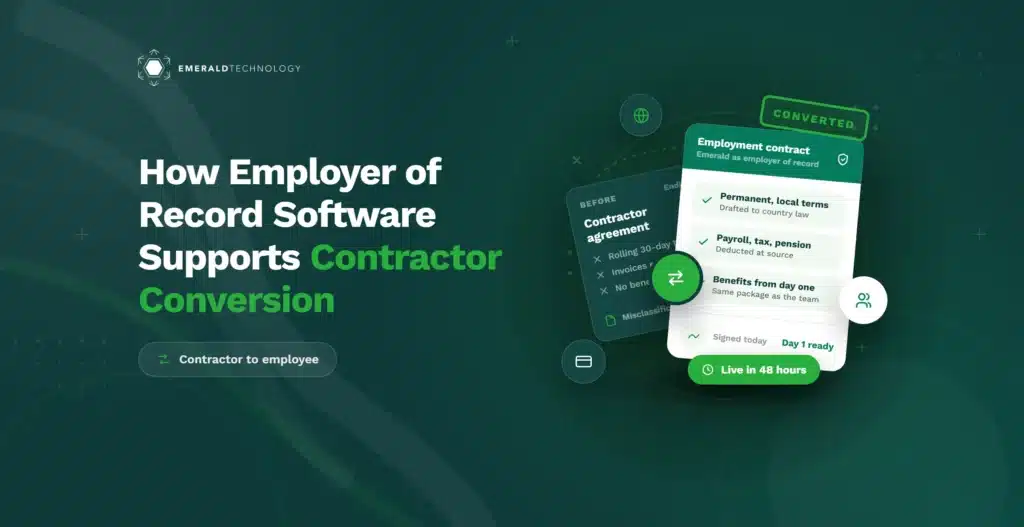
For a startup or mid-market technology company converting an international contractor to an employee, this distinction matters more than it looks. A contractor conversion is not a copy-paste of an existing contract with a new job title. It is a new employment relationship, subject to a different jurisdiction’s rules on notice periods, probation, statutory benefits, and termination, from day one.
Why converting contractors to employees gets risky across borders
Most companies start hiring internationally through contractors because it is fast: no entity, no payroll setup, no employment law to navigate. The risk shows up later, once a contractor starts looking like an employee in practice — fixed hours, ongoing work, direction from a manager, use of company equipment. At that point, several governments will consider the relationship misclassified, regardless of what the contract says.
Misclassification is not a paperwork technicality. If a government finds that a contractor has been functioning as an employee, the company can be liable for back pay, unpaid statutory benefits, and fines, sometimes going back years and applied per worker. See what employee misclassification is and the risks it carries for a fuller breakdown.
Converting the contractor to a proper employee is the correct fix. It is also where multi-country hiring risk concentrates, for three reasons:
- Every country defines the employee relationship differently. Notice periods, probation length, and mandatory contributions vary by jurisdiction, and getting one wrong creates legal liability, not just an administrative error.
- Conversion often happens under time pressure. The contractor is already doing the work, so the business wants the transition done quickly, which is exactly when compliance steps get skipped.
- Multi-country hiring compounds the exposure. A company converting contractors in three or four countries at once is running three or four separate compliance exercises in parallel, each with its own legal minimums and paperwork.
This is also where permanent establishment risk enters the picture. Permanent establishment is a tax status: a government decides a company has a taxable presence in its country, triggered by ongoing local activity such as a contractor negotiating deals or working consistently like embedded staff, whether or not the company has formally hired anyone there. Converting that person through a compliant Employer of Record structure is one of the more direct ways to manage that exposure, because the EOR, not the client, sits as the registered legal employer.
How Employer of Record software reduces contractor-to-employee transition risk
This is where the software layer earns its place, rather than just the EOR service on its own, and it is the piece of overseas hiring risk management that is easiest to overlook.
A well-built platform reduces contractor-to-employee transition risk in three concrete ways:
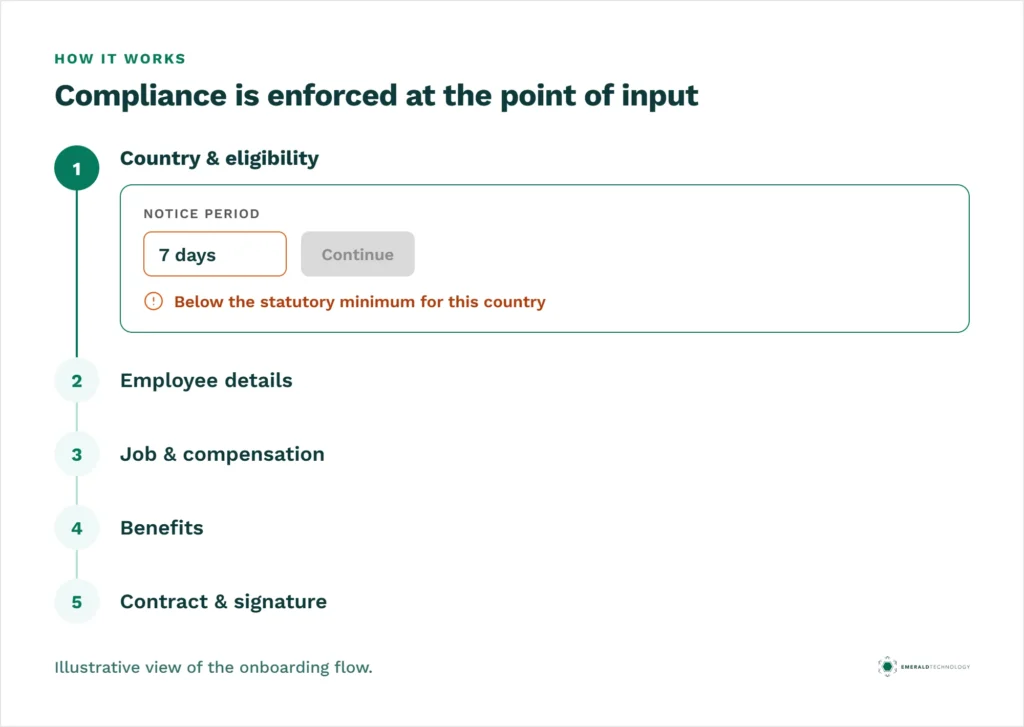
- It enforces local law at the point of input, not after the fact. Instead of a hiring manager guessing at a notice period or probation length, the system surfaces the correct legal minimum for that country automatically and blocks a non-compliant entry before the contract is generated.
- It centralizes documentation so nothing gets missed. Contracts, background checks, benefits elections, and signed onboarding forms live in one record per employee, instead of scattered across email threads, a payroll vendor’s portal, and a local law firm’s files.
- It gives finance and legal visibility before problems compound. A cost breakdown by country and employee means a CFO can see the real cost of a conversion, including local statutory contributions, before signing off, rather than discovering it in next month’s invoice.
Emerald’s contractor conversion services are built around exactly this workflow, pairing the platform’s compliance checks with a team that manages the parts a form can’t.
None of the current top-ranking content on this topic connects contractor conversion specifically to overseas hiring risk management across multiple countries at once. Most either explain Employer of Record in general terms or explain contractor conversion as a one-off legal exercise. The software mechanics of how that risk actually gets reduced, at the point where a hiring manager is filling in a form, are largely missing from the current field, and it is worth noting that the software is only half the answer: it removes guesswork, but a named specialist reviewing the conversion is what catches the judgment calls a form cannot.
What happens inside the platform when you convert a contractor
Emerald’s platform runs contractor conversion through the same onboarding workflow used for any new international hire, verified against Emerald’s platform documentation:
- Country and eligibility. The admin selects the employment country and start date. The platform automatically surfaces that country’s minimum notice period, probation length, and mandatory contributions, and enforces them. As Emerald’s own platform walkthrough puts it: “If you try to set a notice period that is too short, it will not let you continue.”
- Employee details. The former contractor’s personal details, nationality, and residential address are entered once and reused to populate every subsequent document, so there is no re-keying between systems.
- Job and compensation details. Job title, salary, paid time off, termination and probation terms, and invoicing currency are set here, with the same local-minimum enforcement applied to termination and probation periods.
- Benefits. Health insurance, pension, and other benefit providers are selected from the platform’s built-in options, or added as free text for anything non-standard, such as a car allowance.
- Contract generation and signature. The offer letter and employment contract are generated automatically from the data already entered and sent for signature through DocuSign, with status tracked in real time.
Where the previous relationship needs verifying, a background check can be triggered with a single toggle during this process. The provider, Veremark, contacts the person directly, and results load back into the platform automatically, so onboarding resumes without a manual handoff.
Once the contract is signed, the newly converted employee shows up in the same payroll and analytics dashboard as every other employee in that country, with employment costs broken down by category, month by month, matching the client’s invoice line for line. For a look at this same process from the other side, see how one contractor-to-employee conversion happened in 24 hours end to end.
This is also where having a named account team matters as much as the software: the platform enforces the legal minimums, but a person on Emerald’s side is the one a client calls when a conversion involves something the form does not cover, such as negotiating a converted contractor’s pay into a new country’s structure. Netcracker used this same compliance architecture to switch EOR providers across 13 countries with zero disruption, and Human Security ran across 11 countries with zero compliance remediation required, evidence that it holds up at multi-country scale, not only for a single conversion.
Employer of Record software compared with handling conversion manually
The comparison is straightforward once the steps above are laid out side by side.
| Manual conversion | Employer of Record software | |
|---|---|---|
| Local law research | Local counsel, per country, per conversion | Built into the platform, applied automatically |
| Contract drafting | Custom-drafted, subject to review delays | Auto-generated from onboarding data |
| Background checks | Separate vendor, manual handoff | Triggered in-platform, results loaded automatically |
| Payroll setup | New vendor or manual registration per country | Existing infrastructure, no new setup |
| Cost visibility | Estimated, confirmed after the fact | Broken down by employee and category before conversion |
| Compliance risk | Depends on who is doing the checking | Enforced by the system before submission |
The trade-off is not speed against compliance — it is who carries the compliance burden: a person checking rules manually across several jurisdictions, or a system that has those rules built in and will not let a non-compliant entry through.
What this means for global hiring compliance and international payroll
Contractor conversion rarely happens in isolation. A startup with contractors in three countries is usually also running international payroll across those same three countries, each with its own tax calendar, statutory deductions, and reporting requirements.
This is where global hiring compliance and international payroll intersect directly with the software question — see our guide to EOR compliance regulations for the regulatory detail behind it. A platform that converts a contractor compliantly but leaves payroll as a separate, manual process has only solved half the problem. Emerald’s platform keeps the converted employee’s payroll, benefits, expenses, and analytics in the same system used for every other employee in that country, with a monthly cost breakdown designed to reconcile directly against the invoice, so finance is not reconciling one system for existing staff and a spreadsheet for newly converted ones.
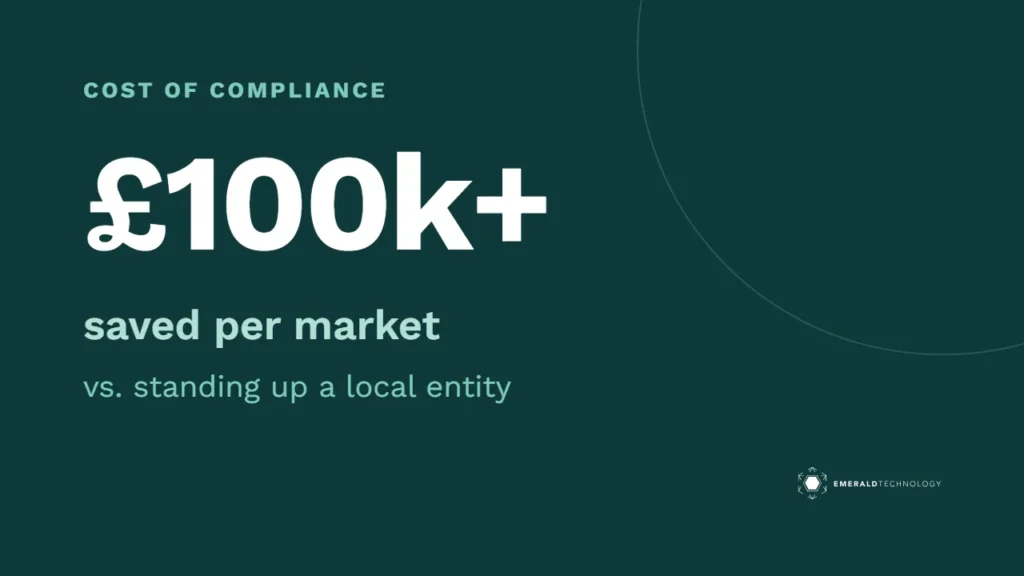
Avoiding entity setup entirely is also a direct cost lever: Emerald’s data shows companies typically save more than £100k per market by using an Employer of Record instead of standing up a local entity, a saving that applies whether the hire is new or a converted contractor.
Choosing Employer of Record software for startup and mid-market hiring
Startup and mid-market hiring has a different risk profile than enterprise hiring, mainly because there is no dedicated legal or compliance team catching mistakes before they happen. A Series A or Series B company converting its first few international contractors is usually relying on whoever owns HR, sometimes the founder, to get every jurisdiction’s rules right without local expertise to check the work.
For this profile, four things matter most when evaluating Employer of Record software for contractor conversion specifically:
- Does it enforce compliance automatically, or only document it after the fact? A platform that blocks a non-compliant notice period before the contract is generated is a meaningfully different safeguard than one that simply stores the contract once someone else has drafted it.
- Does it cover the countries you are actually converting contractors in? Coverage across 150+ countries only matters if it includes the specific markets your contractors are based in — check Emerald’s country hiring guides for the markets you need.
- Is pricing transparent before you commit to a conversion? Look for all-in pricing with no separate conversion fee, no hidden onboarding or offboarding charges, and no currency conversion markup buried in the payroll cycle.
- Is there a named person behind the software, not just a support queue? A hiring manager converting their first contractor in an unfamiliar country needs someone to ask, not only a dashboard that flags an error after the fact.
Frequently asked questions
Is converting a contractor through an EOR different from hiring a new employee through one?
The onboarding mechanics are the same — country selection, employee details, compensation, benefits, and contract signature — but conversion carries an added step: translating the contractor’s existing pay and working pattern into a compliant salary, benefits package, and notice period for that country, rather than negotiating those terms from scratch.
Does converting a contractor reduce permanent establishment risk?
It can. Converting a contractor to an employee under a compliant Employer of Record structure means the EOR, not the client company, is the registered legal employer in that country, which is one of the more direct ways to manage exposure. It does not eliminate every trigger — a senior person running local sales negotiations, for example, can still create exposure regardless of how they are employed — so it is worth treating as one part of a broader approach, not a complete fix on its own.
How long does a contractor-to-employee conversion typically take?
This varies by country, since local requirements differ and the platform’s compliance checks are what determine the exact steps for each jurisdiction. What most affects the timeline within that is how complete the information provided is upfront: accurate salary, benefits, and start date details from the outset avoid the back-and-forth that slows a conversion down.
What happens to the contractor’s tenure and benefits when they convert?
That is a negotiation the client company controls, not something the software imposes. Employer of Record software should support carrying over an agreed start date or service history into the new contract’s terms, but the decision of what to honor sits with the hiring company.
Book a demo of Emerald’s Employer of Record platform