TL;DR
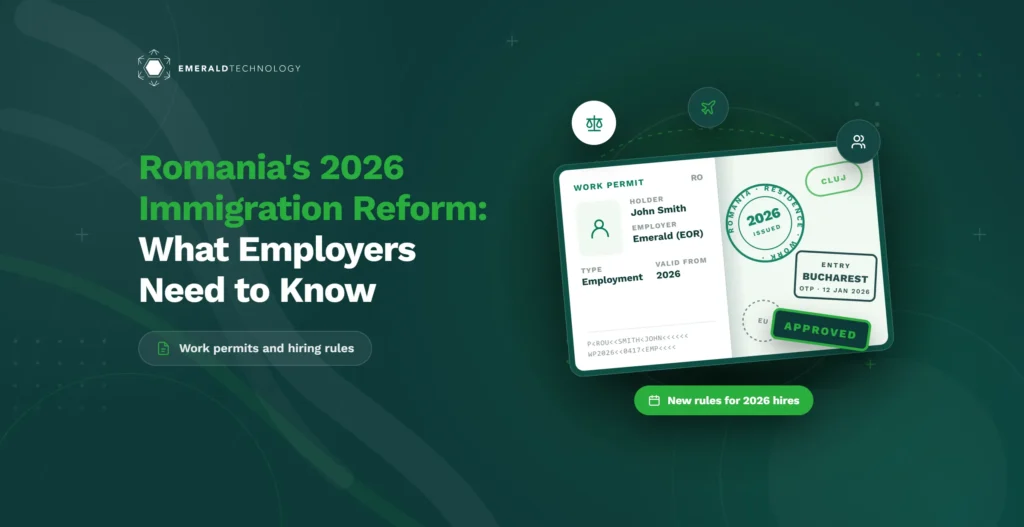
- On 27 April 2026, Romania published Government Emergency Ordinance (GEO) no. 32/2026, a major reform of its employment immigration framework.
- Employers intending to hire foreign nationals under the new framework must first register on WorkInRomania.gov.ro, so immigration compliance now starts before a candidate is chosen.
- Two new visa routes, D/AM1 and D/AM2, set who files the application, and which one applies determines whether a placement agency is required.
- Foreign-worker placement agencies are now a specifically authorised and supervised activity, with financial guarantees, mandatory contracts, and monitoring duties that run for two years after a worker starts.
- Employers take on broader obligations too, including Romanian-language courses for the foreign workers they employ, and a company with no Romanian presence can’t register or file as the employer itself.
What is Romania’s 2026 immigration reform?
Romania’s 2026 immigration reform is Government Emergency Ordinance (GEO) no. 32/2026, known in Romanian as OUG no. 32/2026. It was adopted on 23 April 2026 and published in the Official Gazette on 27 April 2026. It changes the procedure for obtaining work-related immigration status, and it changes how Romanian employers hire, employ, and monitor non-EU workers. It also introduces a new regulated regime for foreign-worker placement agencies.
A foreign-worker placement agency is an authorised intermediary that arranges the placement of foreign workers with Romanian employers. It isn’t the worker’s employer: the employment relationship is directly between the Romanian employer and the worker.
At the centre of the reform are the WorkInRomania.gov.ro platform, two new employment visa categories, D/AM1 and D/AM2, and new registration, authorisation, and ongoing compliance obligations. For any company that employs, or is planning to hire, non-EU nationals in Romania, the rules need to be understood before the next hire is made, not after.
What is changing under Romania’s 2026 immigration reform?
GEO no. 32/2026 replaces the previous employment framework for foreign nationals with a platform-based process, and repeals Title I of Government Ordinance no. 25/2014, the old regime (art. 55). The main changes are:
| Area | What’s changing |
|---|---|
| Process | The previous work-authorisation process, followed by separate immigration stages, is replaced by one single application on WorkInRomania |
| Starting point | Employers register, or are authorised, on WorkInRomania before hiring a foreign national, so the immigration analysis moves ahead of candidate selection |
| Visa routes | Two new routes: D/AM1, filed by the employer, and D/AM2, filed by a placement agency or an Authorised Employer |
| Placement agencies | The ordinance’s preamble notes that placement activity had no specific regulatory framework. It is now authorised by ANOFM, backed by a financial guarantee, and supervised |
| Contracts and language | Mandatory framework models for placement contracts, and employment contracts in Romanian plus the worker’s language of origin or another international language the worker understands |
| After hiring | Duties that were spread across several acts are consolidated: notifications, document retention, complaint access, and Romanian-language courses |
| Changing employer | Six months before a D/AM2 worker can initiate a change, then through the placement agency until two years have passed |
| Enforcement | New fines of up to RON 40,000 per breach tier, and suspension or removal of registrations and authorisations |
What are the key dates for Romania’s immigration reform?
| Date | What it means |
|---|---|
| 23 April 2026 | GEO no. 32/2026 adopted |
| 27 April 2026 | Published in the Official Gazette, Part I, issue no. 335 |
| 7 August 2026 | Last day of the interim period, during which the new platform rules applied only to employer registration, agency authorisation, and platform testing |
| 8 August 2026 | WorkInRomania becomes the sole interface for the employment process, and foreign nationals with a temporary right of stay for work granted under the previous rules can change employer under the new procedure (art. 51(1)) |
WorkInRomania: the new central platform for employment immigration
WorkInRomania.gov.ro is the electronic platform through which the new employment immigration procedures are managed. To hire foreign nationals under the new framework, employers must first register on it or, where applicable, be authorised on it. The platform also connects Romanian employers, authorised placement agencies, and the competent Romanian authorities through three registers:
- the Register of Employers of Foreign Nationals (R.A.S.)
- the Register of Authorised Employers (R.A.A.)
- the Register of Foreign-Worker Placement Agencies (R.A.P.S.)
Registration isn’t automatic. The National Employment Agency (ANOFM) approves or rejects each application within 30 working days. Legal-entity employers must have no outstanding obligations to the state budget and, except for D/AM1 hires, at least one year of actual activity in a field compatible with the shortage occupations. The duty to register doesn’t apply to employers hiring foreign nationals who already hold certain statuses, such as long-term residents, students, and beneficiaries of international protection.
The reform moves immigration compliance further upstream. Employers need to determine their eligibility and hiring model before hiring a particular foreign candidate, rather than starting the immigration analysis once a candidate has been selected.
Can a company with no Romanian entity hire a non-EU worker in Romania?
Not by filing the application itself. The GEO defines the employer for these hires as a business with its registered office, work point, or domicile in Romania, or the Romanian branch of a foreign company (art. 45 pt. 2, inserting art. 2(aa) into GEO no. 194/2002). Registration on WorkInRomania follows the same logic, and immigration lawyers read the platform as aimed at employers based in Romania. A foreign company with no Romanian presence therefore has two practical routes:
- set up a Romanian entity or branch, which then has to meet the registration conditions above before it can hire
- employ the worker through a provider that already employs people in Romania
An Employer of Record (EOR) is the legal mechanism that lets a company employ someone in a country where it has no entity. The EOR becomes the legal employer, and the person works for your company day to day. Because the reform puts the filing duties on the employer, confirm before you engage any provider that it is registered on WorkInRomania for the route you need and, for D/AM2, whether it hires through a placement agency or holds Authorised Employer status. For the wider choice between the two routes, see our comparison of an EOR vs a local entity.
D/AM1 vs D/AM2: the two new employment visa routes
The reform introduces two employment visa categories. The distinction between them is fundamental: it determines who files the application and whether a placement agency is needed.
D/AM1: employer-filed, no placement agency
D/AM1 is primarily intended for highly qualified workers and several other categories specifically provided for by law: staff carrying out projects requested by central public authorities, teaching and research staff in state higher education institutions, professional athletes, and citizens of Moldova, Ukraine, and Serbia employed full time. The Romanian employer submits the single application directly through WorkInRomania, so an authorised placement agency is not mandatory.
D/AM2: placement agency or Authorised Employer
D/AM2 applies to permanent, seasonal, and cross-border workers who fall under the corresponding statutory conditions. The occupation must be on Romania’s List of Shortage Occupations. D/AM2 visas are also subject to an annual quota of newly admitted foreign workers, and a visa is issued only while the quota isn’t exhausted. The 2026 quota is set by Government Decision no. 1.169/2025 (art. 53), and Romanian media report it at 90,000 workers, 10,000 fewer than in 2025.
How a D/AM2 hire works depends on the employer’s status. A Registered Employer, meaning an employer registered on WorkInRomania and entered in R.A.S., must use an authorised foreign-worker placement agency. An Authorised Employer, meaning a legal entity that has obtained additional authorisation and met extra eligibility, operational, and compliance requirements, including a financial guarantee for the workers covered, can hire D/AM2 workers directly without a placement services agreement.
| D/AM1 | D/AM2 | |
|---|---|---|
| Typical scope | Highly qualified workers and other categories specifically provided by law | Permanent, seasonal, and cross-border workers |
| Who submits the application | The employer | An authorised placement agency for a Registered Employer, or the Authorised Employer directly |
| Placement agency mandatory | No | Yes for a Registered Employer; no for an Authorised Employer |
| Shortage occupation list | Not a condition for the route | Required |
Companies expecting significant volumes of D/AM2 hiring need to decide whether to remain a Registered Employer and hire through an authorised placement agency, or meet the additional requirements to become an Authorised Employer and hire directly.
Which visa route applies to your hire?
Work through these questions in order:
- Is the worker highly qualified, or in another category specifically provided for by law? If yes, the D/AM1 route applies. Your company registers on WorkInRomania and submits the single application directly, and no placement agency is needed.
- Is the worker a permanent, seasonal, or cross-border worker? If yes, the D/AM2 route applies. Check that the occupation is on the List of Shortage Occupations and that the annual quota isn’t exhausted.
- For D/AM2, is your company an Authorised Employer? If yes, you can hire the worker directly. If you are a Registered Employer, you must use an authorised placement agency.
How does Romania’s immigration reform affect your business?
What changes for you depends on who you are and what you hire:
| If you… | What changes for you | Read next |
|---|---|---|
| Hire highly qualified workers, or another D/AM1 category | You register on WorkInRomania and file the single application yourself. No placement agency is needed | D/AM1: employer-filed, no placement agency |
| Hire permanent, seasonal, or cross-border workers (D/AM2) | You choose between being a Registered Employer that uses an authorised agency, or becoming an Authorised Employer. The shortage occupation list and the annual quota apply | What does it take to become an Authorised Employer? |
| Already employ non-EU workers in Romania | New ongoing duties apply: bilingual contracts, Romanian-language courses, notifications, and five-year document retention. Workers with a temporary right of stay for work granted under the previous rules can change employer from 8 August 2026 | What ongoing obligations do employers have? |
| Have no Romanian entity | You can’t register or file as the employer yourself | Can a company with no Romanian entity hire a non-EU worker? |
| Provide placement services | You need ANOFM authorisation and a financial guarantee from EUR 75,000, and you take on monitoring duties for two years | How are placement agencies regulated? |
One single application replaces a fragmented process
The reform introduces the single application, known as the “cererea unică”. Instead of following the previous work-authorisation process and then moving separately through the later immigration stages, the new framework consolidates key information and documentation into one electronic process through WorkInRomania.
The aim is to simplify administration, but it means more employment, immigration, and compliance information must be prepared correctly at the start. If a single application doesn’t meet the admissibility conditions, it is rejected without the remaining conditions being checked, and that rejection can’t be contested.
What does it take to become an Authorised Employer?
An Authorised Employer is a legal entity authorised by ANOFM to hire D/AM2 workers directly, without a services contract with an authorised placement agency. To qualify, the employer must meet all of the following conditions:
- no outstanding obligations to the state budget, and no tax, accounting, customs, or financial-discipline offences in the fiscal record
- at least 24 months of uninterrupted, actual business activity in a field compatible with the shortage occupation concerned
- an average of at least 50 employees in the year before the application
- no more than 20% of the foreign workers employed in the previous year without a valid right of stay or long-stay visa at the time of application
- no health and safety fines or undeclared-work sanctions in the previous 24 months
- no relevant final convictions for the employer or its representatives, and no national security or money-laundering risk flags
- a financial guarantee covering the number of foreign workers for which authorisation is requested
The guarantee is EUR 1,000 per foreign worker, calculated in lei at the National Bank of Romania exchange rate, and is lodged with the State Treasury or provided as a bank guarantee letter from a Romanian bank. It covers return costs and the cost of accommodating, feeding, caring for, or supporting workers in vulnerable situations, and it can be used to pay unpaid fines. If it is drawn on, the employer must restore it within 30 days, or its authorisation can be suspended.
ANOFM decides on applications within 15 working days. An Authorised Employer can hire only for shortage-list occupations, can’t hire foreign workers for the benefit of other employers, and is fully responsible for the lawfulness of the hiring process, including the ban on charging workers commissions, fees, or deposits.
How are placement agencies regulated under the new rules?
GEO no. 32/2026 introduces a comprehensive authorisation framework for companies providing foreign-worker placement services in Romania. It matters particularly for the D/AM2 route, and it doesn’t mean placement agencies are required for every Romanian employment immigration case.
The purpose of the placement relationship is to establish a direct employment relationship between the Romanian employer and the foreign worker. The agency is an intermediary and compliance participant, and it doesn’t become the worker’s employer.
Authorisation and financial guarantees
A placement agency needs specific authorisation from ANOFM. It can provide placement services only for occupations on the List of Shortage Occupations, based on firm job offers from Registered Employers. Those employers must have at least one year of actual activity in a compatible field.
Agencies must establish a financial guarantee before they are authorised, as a deposit with the State Treasury or a bank guarantee letter from a Romanian bank:
- EUR 75,000 for up to 250 foreign workers placed
- an additional EUR 50,000 for each additional group of 250 workers
Authorisation is valid for two years and can be renewed for successive two-year periods, subject to continued compliance with the statutory requirements.
Worker protections and mandatory contracts
Foreign workers must not bear the agency’s placement costs. The Romanian employer pays for placement services. The agency can’t charge placed workers commissions, placement or hiring fees, or other charges for these services, and can’t ask them for a guarantee or deposit in connection with the placement. The ban covers placement and hiring fees; visa, travel, and accommodation costs fall on the worker unless the employer’s firm job offer provides otherwise.
Under Ministerial Order no. 655/2026, published in the Official Gazette on 11 June 2026, mandatory framework models were adopted for the contracts used in foreign-worker placement:
- a services contract between the placement agency and the Romanian employer
- a placement contract involving the agency, the employer, and the foreign worker
- the individual employment contract between the Romanian employer and the foreign worker
The contracts must contain the mandatory elements set by law. The placement contract must also give the worker the contact details of the Labour Inspectorate, the General Inspectorate for Immigration, the Police, the National Agency against Trafficking in Persons, and ANOFM. Documents involving the foreign worker must be prepared in Romanian and, as applicable, in the worker’s language of origin or another international language the worker understands.
Responsibilities after placement
An agency’s role doesn’t end when the worker arrives in Romania or starts work. For two years from the start of the worker’s activity in Romania, as recorded in the general register of employee records (REGES-ONLINE), the agency must notify the authorities of any breach of the conditions for the worker’s right of stay and work, within three working days, and report unjustified absences of more than three consecutive working days. It must also confirm the worker holds the required documents before arrival, organise transport, and give the worker advice on returning home.
If a D/AM2 employment relationship ends in the circumstances the law sets out, the placement agency must make diligent efforts to present the foreign worker with at least two alternative job offers in shortage occupations, during the 90-day period in which the person may remain legally in Romania. If no new employer is found within that period, the agency bears the cost of the worker’s return to the country of origin where its efforts didn’t succeed.
An Authorised Employer that hired the worker directly has a different duty: it must identify the worker and put them in contact with a placement agency so they can be employed by another employer. If the worker refuses, the refusal is recorded in writing and the employer notifies the General Inspectorate for Immigration and ANOFM. If no new employer is found within the 90 days, the Authorised Employer bears the return costs (art. 40(6)(b) and (7)).
Changing employer
For D/AM2 workers, a change of employer can’t be initiated during the first six months from the start of activity in Romania, except where the employer has committed serious breaches of the contract or the conditions of employment. After that, a worker placed through an agency can change employer only through the agency that is party to the placement contract, until two years have passed from the start of activity. If the agency’s authorisation is withdrawn or ends, the worker can change employer under the general rules for permit holders.
What ongoing obligations do employers have for non-EU workers in Romania?
The reform doesn’t regulate only hiring. It substantially increases employers’ responsibilities during the employment relationship. The table shows who carries each duty under the GEO, and when.
| Obligation | Who it falls on | Timing | Article |
|---|---|---|---|
| Pay salary into the worker’s bank account | Employer | Ongoing | Art. 7(1)(a) |
| Conclude the employment contract in Romanian and in the worker’s language of origin or another international language the worker understands | Employer | At hiring | Art. 7(1)(b) |
| Provide health and safety training in a language the worker understands, and supply protective equipment | Employer | Before and during work | Art. 7(1)(d) |
| Notify the placement agency and the General Inspectorate for Immigration of an unjustified absence of more than three consecutive working days, the end of the contract, or a worker in danger or being exploited | Employer | Within five working days | Art. 7(1)(e) |
| Make employment documents, payment records, and contracts available to inspectors | Employer | On request | Art. 7(1)(f) |
| Provide Romanian-language courses with cultural and social integration elements | Employer | At least six months, at least six hours a week | Art. 7(1)(g) |
| Give workers confidential access to complaint and abuse-reporting procedures, including through the platform | Employer | Ongoing | Art. 7(1)(h) |
| Keep a copy of the travel document or residence permit, and proof of compliance with these duties | Employer | At least five years after employment ends | Art. 7(1)(i) |
| Notify the authorities of any breach of the conditions for the worker’s right of stay and work | Placement agency | Within three working days | Art. 39(1)(j) |
| Present at least two alternative job offers when a D/AM2 employment ends | Placement agency | Within the 90-day period | Art. 40(6)(a) |
| Identify the worker and put them in contact with a placement agency when a D/AM2 employment ends, and notify the General Inspectorate for Immigration and ANOFM if the worker refuses | Authorised Employer | Within the 90-day period | Art. 40(6)(b) |
| Bear the worker’s return costs if no new employer is found | Placement agency, or the Authorised Employer where it hired directly | After the 90-day period | Art. 40(7) |
| Restore the financial guarantee after it is drawn on | Placement agency or Authorised Employer | Within 30 days | Art. 14(8), art. 26(9) |
For D/AM2 placements, several of the employer’s duties also involve ongoing communication with the placement agency.
Where the employer provides accommodation and charges rent, the rent can’t exceed 25% of the worker’s net pay.
Employers must also ensure that the foreign workers they employ receive Romanian-language courses that include cultural and social integration elements. The courses must run for at least six months from the start of activity in Romania as recorded in REGES-ONLINE, and for at least six hours per week. The employer can organise them directly, through accredited providers, or in collaboration with public institutions, non-governmental organisations, international organisations, or educational institutions. For companies employing significant numbers of non-EU nationals, integration training becomes part of immigration and employment compliance rather than an optional employee benefit.
Immigration compliance can no longer be viewed simply as obtaining permission for an individual to enter and work in Romania. It becomes an ongoing human resources (HR) and compliance responsibility throughout the employment relationship.
What are the penalties for non-compliance?
GEO no. 32/2026 sets administrative fines and adds enforcement measures that go beyond fines. For finance and legal teams, the exposure sits in three places: the financial guarantee (EUR 1,000 per worker for an Authorised Employer, and from EUR 75,000 for an agency), the fines below, and the loss of the ability to hire while a registration or authorisation is suspended. The main fines are:
| Fine | Breach |
|---|---|
| RON 5,000–10,000 per placed foreign worker, as applicable | Failing duties on salary payment, bilingual contracts, health and safety training, Romanian-language courses, or complaint access |
| RON 15,000–20,000 | Hiring foreign nationals without being registered or authorised |
| RON 15,000–30,000 | Failing to notify absences, terminations, or danger within five working days; failing to give inspectors documents; failing to retain documents |
| RON 25,000–40,000 | Charging workers fees or deposits, or carrying out placement without authorisation |
| RON 6,000 per contract | An employment contract with a foreign employee concluded only in Romanian |
Enforcement measures include a six-month suspension of an employer’s registration, during which it can’t upload new firm job offers and its pending single applications are paused. Authorised Employers can lose the right to apply for a new authorisation for periods from six to 36 months, and for an indefinite period where workers were exploited. Placement agencies face suspension and withdrawal of authorisation, and their guarantee can be paid to the state budget in the cases the law sets out.
Registration, suspension, and removal decisions can be contested with ANOFM within 30 days of being notified. ANOFM must resolve the contestation within 45 days of registering it, and the decision can then be challenged in the administrative courts. A court action doesn’t automatically suspend the measure.
What should you ask an Employer of Record about hiring non-EU workers in Romania?
The GEO has no separate provisions for Employers of Record, so the position depends on the status of the legal employer: the entity that registers on WorkInRomania, files the application, and carries the duties in the tables above. If you plan to hire through an EOR, ask the provider:
- whether the entity that will employ your worker is registered on WorkInRomania, and for which route, D/AM1 or D/AM2
- for D/AM2, whether it hires through an authorised placement agency or holds Authorised Employer status, and which agency it uses
- whether the occupation is on the List of Shortage Occupations, and how the annual quota affects the timing of your hire
- who lodges and maintains the financial guarantee, and who bears any fines
- who delivers the notifications, document retention, and Romanian-language courses, and where the agreement says so
- who carries the return and re-placement obligations if a D/AM2 employment ends
- what happens to your hire if the provider’s registration or authorisation is suspended, given that pending single applications are paused during a suspension
Emerald acts as the legal employer in 150+ countries and carries liability for its compliance obligations, covering payroll, tax, statutory contracts, and termination, under the terms of its agreement. To see how those terms apply to the new Romanian immigration duties, talk to an Emerald EOR specialist about hiring in Romania.
Frequently asked questions
Can a company with no Romanian entity hire a non-EU worker in Romania?
Not by filing the application itself. The employer for these hires must have its registered office, work point, or domicile in Romania, or be the Romanian branch of a foreign company. A company without a Romanian presence can set up an entity or branch, or employ the worker through a provider that already employs people in Romania and is registered on WorkInRomania for the route required.
What is the 2026 quota for non-EU workers in Romania?
D/AM2 visas are issued only while the annual quota of newly admitted foreign workers isn’t exhausted. The 2026 quota is set by Government Decision no. 1.169/2025, and Romanian media report it at 90,000 workers.
Do I need a placement agency for a D/AM1 visa?
No. D/AM1 applications are submitted directly by the Romanian employer through WorkInRomania, so an authorised placement agency is not mandatory.
Do I need a placement agency for a D/AM2 visa?
It depends on your status. A Registered Employer must use an authorised placement agency. An Authorised Employer can hire D/AM2 workers directly.
What is the “cererea unică”?
It is the single application: one electronic process through WorkInRomania that consolidates employment, immigration, and compliance information. It replaces the previous work-authorisation process followed by separate immigration stages.
Can a placement agency charge the worker a fee?
No. The Romanian employer pays for placement services. The agency can’t charge the worker commissions, placement or hiring fees, or other charges, or ask for a guarantee or deposit in connection with the placement.
Can a D/AM2 worker change employer?
Not during the first six months from the start of activity in Romania, except where the employer has committed serious breaches. After that, a worker placed through an agency can change employer only through that agency until two years have passed.
What happens if a D/AM2 worker’s employment ends?
The placement agency must make diligent efforts to present the worker with at least two alternative job offers in shortage occupations during the 90-day period. An Authorised Employer that hired the worker directly must instead put them in contact with a placement agency. If no new employer is found, the agency, or the Authorised Employer, bears the worker’s return costs.
Do employers have to provide Romanian-language courses?
Yes. The courses must include cultural and social integration elements, run for at least six months from the start of activity as recorded in REGES-ONLINE, and total at least six hours per week.
How do employers appeal a decision under the new system?
Contest it with ANOFM within 30 days of being notified. ANOFM must resolve the contestation within 45 days, and the decision can then be challenged in the administrative courts.
What should employers check before hiring non-EU workers in Romania?
Before hiring a non-EU worker under the new framework, confirm:
- Whether your company is correctly registered on WorkInRomania
- Whether the candidate falls under D/AM1 or D/AM2
- For D/AM2, whether you will use an authorised placement agency or seek Authorised Employer status
- Whether the occupation is on the List of Shortage Occupations, where the route requires it
- Whether your contracts and internal HR procedures meet the new standards
- Whether you are prepared to comply with the new notification, monitoring, and integration obligations
- Whether any hiring partners involved in the process meet the requirements of the new regulatory framework
We’ve expanded these checks into a free one-page Romania employer readiness checklist you can use with your HR and legal teams.
Download the Romania employer readiness checklist →
For wider background on hiring in the country, read our Romania hiring guide. To see how immigration and visa support works alongside an EOR, explore Emerald’s immigration and visa services.
This article provides a general overview of the Romanian immigration framework as set out in GEO no. 32/2026 as published on 27 April 2026, and is intended for general information purposes only. It does not constitute legal advice. Individual cases should be assessed based on the applicable immigration category, employer status, and circumstances of the foreign national.
Sources: OUG no. 32/2026 – Romanian legislation portal · WorkInRomania – official platform · Ministerial Order no. 655/2026 of the Minister of Labour, Official Gazette, Part I, no. 484 of 11 June 2026 · Kinstellar on the new conditions for hiring foreign workers · Europa Liberă on the 2026 quota · France Immigration on WorkInRomania