Published August 2026
Quick summary
US tech companies expanding internationally hit a wall that domestic hiring frameworks don’t prepare them for: the 1099/W-2 classification model doesn’t apply once someone’s employed abroad, and the legal liability for getting it wrong lands somewhere, and the question is where. We compared six employer of record (EOR) platforms: Emerald Technology, Deel, Remote, Oyster, Papaya Global, and Rippling, on pricing transparency, country coverage, compliance enforcement, liability transfer, and contractor-to-employee conversion support. All pricing, country coverage, ratings, and provider claims in this guide were checked and validated directly against each provider’s own site and G2 review data in August 2026. Where a data point isn’t publicly disclosed by a provider, that’s stated plainly rather than estimated. Our top three picks:
| Tool | Best For |
|---|---|
| Emerald Technology (your product) | For companies scaling globally: no hidden fees, no ticket queues, just a dedicated team who knows your business |
| Deel | One published rate at scale, so buyers get a number without a sales call |
| Remote | Every market run through Remote’s own entity, backed by unlimited indemnity |
Finding the best EOR software for US tech companies
Most EOR comparison content treats every buyer the same regardless of where the hiring company is based, but three things are genuinely different if you’re US-based, and they matter more at this stage of the decision than headline pricing or country count.
What is the 1099/W-2 classification model?
In the US, when a company pays someone to do work for it, that person is classified as one of two things.
W-2 employee
- A regular employee, similar to a standard full-time job
- The company automatically withholds taxes, provides benefits such as health insurance and paid leave, and has significant control over how, when, and where the person works
- Named after Form W-2, the tax document used for this classification
1099 contractor
- A freelancer or independent contractor, brought in for a specific project rather than as permanent staff
- Responsible for their own taxes, without company-provided benefits, and with more freedom over how the work gets done
- Named after Form 1099, the tax document used for this classification instead
This distinction matters a lot in the US, because misclassifying someone (calling them a “contractor” when they’re really functioning as an employee) can expose a company to legal trouble, fines, and back taxes. Outside the US, this system doesn’t apply at all. The 1099/W-2 framework is a purely American tax concept. Each country instead runs its own separate test for deciding whether someone counts as an employee or an independent contractor, and those tests can look completely different from the American ones. A US company can’t assume it can hire someone in, say, Germany or Brazil as a “1099 contractor” just because that’s the familiar category at home. It has to check what that specific country’s test says, since getting it wrong there carries its own separate risk of fines and back taxes. Sending a US citizen abroad doesn’t end their US tax filing obligation either, since the US taxes citizens on worldwide income regardless of who employs them. And EOR isn’t the same product as a US professional employer organisation (PEO). Some providers on this list sell both, and it’s easy to end up comparing quotes for the wrong one. EOR platforms close these gaps by becoming the legal employer of record in-country, absorbing the compliance and liability exposure that a US company has no domestic framework for handling. The six platforms below were assessed on how well, and how transparently, each one actually does that. In this guide, we review the six best EOR platforms for US tech companies in 2026, compared on pricing transparency, country coverage, compliance enforcement, liability transfer, and contractor-to-employee conversion support.
Why trust us?
Figures for Emerald in this guide come directly from our own product documentation and platform walkthroughs. Figures for competitors were taken directly from each provider’s own pricing or product pages, not third-party comparison sites, checked in August 2026.
“Efficient, friendly and trustworthy service across all offerings” ⭐⭐⭐⭐⭐ 5.0/5 Verified User, Computer & Network Security, Mid-Market (51–1000 employees), November 30, 2022 The reviewer pointed to Emerald’s availability and responsiveness, saying it comes with “a personal touch.” They specifically credited Emerald with acting as employer of record in countries where their company had no legal entity, while also handling talent acquisition and supporting finance and human resources (HR) functions. This reflects the combined-team story Emerald leads with.
Emerald holds a 4.5/5.0 average rating on G2, as of August 2026.
The 6 best EOR platforms for US tech companies: full comparison table
| Tool | Best For | Entity Model | Rating | Pricing |
|---|---|---|---|---|
| Emerald Technology | For companies scaling globally: no hidden fees, no ticket queues, just a dedicated team who knows your business | Owned + partner network (150+ countries) | ⭐ 4.5/5 (G2) | From £500/mo (Entry), £750/mo (Growth), custom (Enterprise) |
| Deel | One published rate at scale, so buyers get a number without a sales call | Not publicly known. Not disclosed on Deel’s site, G2 listing, or reviews; would need 1-2-1 confirmation with Deel (130+ countries) | ⭐ 4.8/5 (G2) | $599/mo (platform fee only) |
| Remote | Every market run through Remote’s own entity, backed by unlimited indemnity | 100% owned entities (90+ countries) | ⭐ 4.5/5 (G2) | $699/mo |
| Oyster | B Corp-certified EOR with no separate setup, onboarding, or termination fees | Mixed: owned entities plus local partners in some countries (G2 lists 180+ countries; Oyster’s own pricing page says 120+) | ⭐ 4.4/5 (G2) | $699/mo (setup/onboarding/termination included) |
| Papaya Global | Payroll analytics built for finance teams running 10 or more countries | Mixed: owned coverage plus local/third-party partners in some regions (G2 lists 180+ countries; Papaya’s own site says 160+) | ⭐ 4.5/5 (G2) | Exact rate not publicly known. Papaya confirms pricing is quote-only; would need 1-2-1 confirmation with Papaya. Third-party estimates of ~$500–770/mo circulate online but are unconfirmed by Papaya itself. |
| Rippling | EOR folded into the same system already running your domestic HR and IT | Not publicly known. Not disclosed on Rippling’s site, G2 listing, or reviews; would need 1-2-1 confirmation with Rippling | ⭐ 4.8/5 (G2) | EOR rate and country count not publicly known. Would need 1-2-1 confirmation with Rippling. The ~$8/mo figure that circulates is for the separate domestic Unity HR platform, not EOR. |
1. Emerald Technology
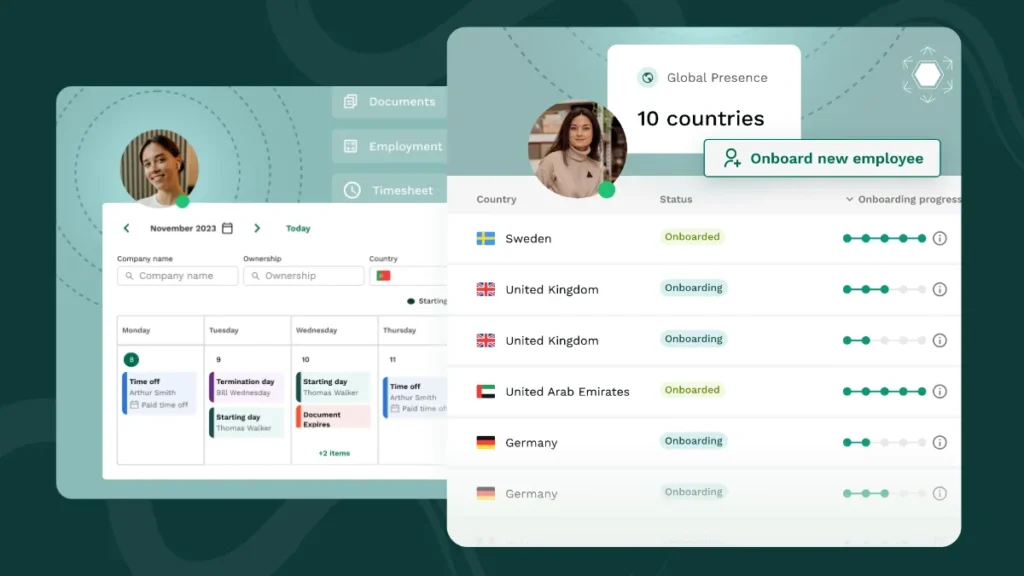 Emerald Technology is an EOR platform built specifically for high-growth, venture-backed and private equity (PE)-backed tech companies expanding across multiple markets at once, not a generalist HR tool with EOR bolted on. It covers employment law, payroll, tax, and compliance in 150+ countries, and it’s structured around full cost visibility per employee rather than one opaque monthly line. Want deeper insights? See the contractor-to-employee conversion solution and the Human Security case study, where EOR employment ran across 11 countries with zero compliance remediation required. Emerald states it’s trusted by 500+ organisations, with a 25-year track record placing technology talent and a 48-hour contract turnaround. See our guides on switching EOR providers and hiring in Mexico and Colombia, the two most common first markets for US tech companies expanding for business-hours overlap.
Key features
- Full employment cost breakdown per employee: gross salary, local employment taxes, social contributions, pension, and Emerald’s service fee
- Compliance enforced at onboarding: the five-step onboarding form blocks non-compliant notice periods, probation lengths, and mandatory contributions rather than just flagging them
- Employer cost calculator for side-by-side country comparison before you commit to a market
- Background checks (Veremark) triggered by a single toggle in onboarding, with results loaded back automatically
- HR system sync: no duplicate source of truth between Emerald and your internal human resources information system (HRIS)
- Built-in artificial intelligence (AI) tools provide country-specific hiring guides directly inside the platform
Pros
- Full per-category cost transparency, useful for finance teams reconciling invoices monthly
- Compliance is enforced automatically at the point of data entry, not caught after the fact
- Syncs with external HR systems, so client teams don’t have to maintain a duplicate source of employee data
Cons
- Enterprise pricing, which includes visa services and a dedicated customer success manager (CSM), isn’t published and requires a direct conversation
- Visa support is only available on the Enterprise plan; Entry and Growth tiers don’t include it
- At 150+ countries, coverage is narrower than some competitors on this list, such as Papaya Global (160+) or Oyster (up to 180+ per G2)
- Emerald does not provide full liability or indemnification coverage in every country; confirm the specific scope of liability transfer directly with Emerald before signing, and get it in writing
Pricing
Entry starts at £500/month per employee, Growth at £750/month per employee, and Enterprise pricing is calculated individually. Plans can be changed after sign-up, and a “decide plan later” option is available during initial onboarding.
Rating
⭐ 4.5/5 on G2, as of August 2026
2. Deel
 Deel’s own pricing page lists Employer of Record at $599 per employee per month, covering full legal employment in 130+ countries. Deel states it has processed more than $20 billion in global payroll for over 40,000 customers, making it one of the largest platforms on this list by scale.
Key features
- Published flat EOR rate: $599/employee/month
- 130+ country coverage
- Large processed-payroll volume across 40,000+ customers
Pros
- Single clearly published rate, with no sales call required to get a baseline number
- Large processed-payroll scale ($20 billion-plus, 40,000+ customers) signals platform maturity and stability
- High G2 rating (4.8/5), among the strongest of the platforms compared here
Cons
- The $599 figure is the platform service fee only. Gross salary, employer statutory costs, and FX spreads sit on top and aren’t itemised on Deel’s pricing page
- Indemnification and liability terms are not publicly stated on Deel’s site or G2 listing. This isn’t publicly known and would need 1-2-1 confirmation with Deel before signing
- Entity model (whether Deel operates through owned entities or third-party partners) also isn’t publicly disclosed, so this is worth confirming for your specific target markets directly with Deel
Pricing
$599 per employee per month (platform fee only; additional employer costs apply on top and are not published).
Rating
⭐ 4.8/5 on G2, as of August 2026
3. Remote
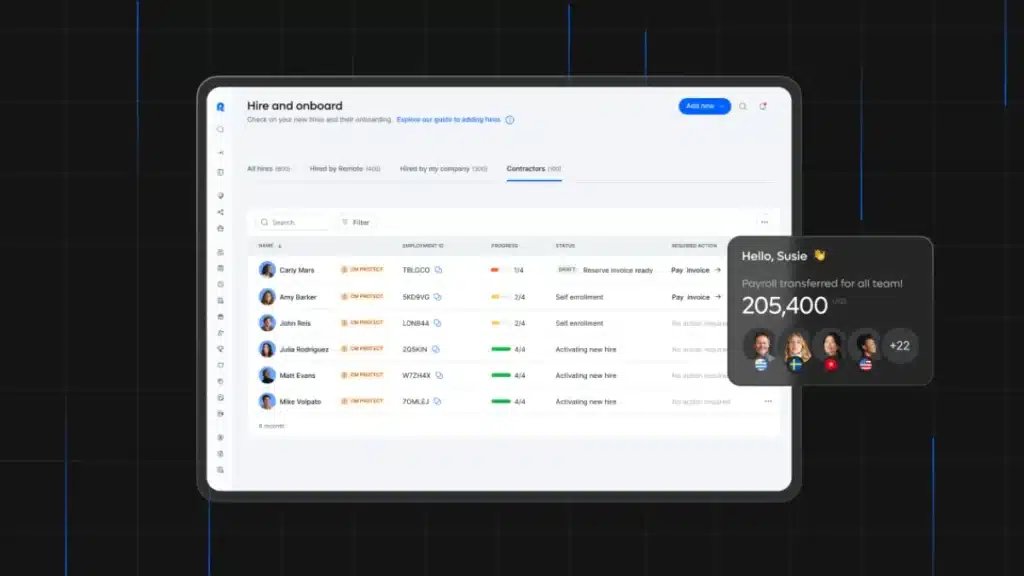 Remote’s own site confirms it hires without opening a local entity in 90+ countries, and that it owns and operates 100% of its own entities rather than working through third-party partners. Its published EOR rate is $699 per employee per month, and Remote offers unlimited indemnity coverage to EOR customers.
Key features
- 100% owned-entity compliance chain (no third-party partners)
- Unlimited indemnity coverage on EOR contracts
- Published flat rate: $699/employee/month
Pros
- Owned-entity model generally means a cleaner, more direct compliance chain
- Unlimited indemnity is a strong, explicit liability commitment
- Leads with intellectual property (IP) protection as a differentiator, which appeals to engineering-heavy tech companies
Cons
- At 90+ countries, coverage is narrower than most other providers on this list. Confirm your specific target markets are covered before committing
- “Unlimited indemnity” is stated as a headline commitment, but the specific contractual caps or exclusions aren’t detailed on Remote’s public site, so request the full terms before assuming blanket coverage
- On G2, Remote’s rating and reviews cover its broader HR/payroll platform, not EOR specifically, since Remote is listed under “Global Employment Platforms (GEP)” rather than a dedicated EOR category
Pricing
$699 per employee per month.
Rating
⭐ 4.5/5 on G2, as of August 2026. Note: on G2, Remote is listed under “Global Employment Platforms (GEP)” rather than the “Employer of Record (EOR) Software” category Emerald and Oyster are listed under. This is consistent with Remote positioning itself as a broader HR/payroll platform with EOR as one service among several.
4. Oyster
 Oyster’s own pricing page lists Employer of Record at $699 per employee per month, with compliant employment in 120+ countries. Oyster is also a certified B Corporation (B Corp), verified independently by B Lab with an Impact Assessment score of 96.5 against a median of 50.9 for assessed businesses generally. Oyster states it does not charge separately for setup, onboarding, or termination processing.
Key features
- B Corp certification with an independently verified Impact score
- Setup, onboarding, and termination included in the subscription fee (not billed separately)
- 120+ country coverage
Pros
- No hidden setup/termination fees layered on top of the published rate
- Strong, independently verified ethical/impact credential for mission-driven buyers
- Among the largest country counts on this list, depending on source (G2 lists 180+ countries; Oyster’s own site states 120+)
Cons
- At $699, Oyster shares the highest published starting price on this list among providers that publish a rate at all
- Multiple G2 reviewers report Oyster uses local third-party partners rather than its own entity in some countries (one reviewer specifically flagged issues with Oyster’s local partner in Costa Rica). Confirm Oyster’s entity status for your specific target markets directly with Oyster, since this isn’t broken out publicly by country
- Liability/indemnification terms are not publicly stated on Oyster’s site or G2 listing. Not publicly known; would need 1-2-1 confirmation with Oyster
Pricing
$699 per employee per month, inclusive of setup, onboarding, and termination processing.
Rating
⭐ 4.4/5 on G2, as of August 2026
5. Papaya Global
 Papaya Global positions its platform around payroll technology and workforce analytics as much as EOR itself, with coverage across 160+ countries. Papaya does not publish a fixed EOR rate. Its own marketplace listing states pricing is provided through a custom quote, and that any publicly quoted figure is for marketing purposes only, not a binding rate.
Key features
- 160+ country coverage
- Enterprise-grade payroll analytics and workforce reporting
- Custom-quoted EOR pricing
Pros
- Strong fit for finance-led organisations already managing payroll across 10 or more countries
- Wide country coverage matching the largest providers on this list
- Positions itself around payroll analytics and workforce reporting specifically, which may suit organisations wanting deeper financial reporting than a pure EOR tool provides
Cons
- Exact EOR rate is not publicly known. Papaya confirms pricing is quote-only. Third-party listings estimate roughly $500–770/employee/month, but this is unconfirmed by Papaya itself; get the real number via 1-2-1 with Papaya
- Multiple G2 reviewers note Papaya relies on local third-party partners in some regions rather than owned entities everywhere. Confirm coverage type for your specific markets directly with Papaya
- Liability/indemnification terms are not publicly stated on Papaya’s site or G2 listing. Not publicly known; would need 1-2-1 confirmation with Papaya
Pricing
Exact rate not publicly known: quote-only. Get it in writing directly from Papaya before comparing against providers with a published price.
Rating
⭐ 4.5/5 on G2, as of August 2026
6. Rippling
 Rippling started as a domestic HR and information technology (IT) platform and later added EOR as one module inside it. Rippling’s own EOR page does not publish a price or a specific country count for the service; both require a sales conversation. Its base Unity HR platform, which EOR sits on top of, is independently and consistently reported at $8 per employee per month plus a separate monthly base fee, though that’s the domestic HR product, not the EOR add-on.
Key features
- EOR bundled as a module within a broader HR + IT platform
- Single system for domestic HR, device/IT management, and international EOR (for existing Rippling customers)
- Extends beyond EOR into broader HR, IT, and finance functions, appealing to companies wanting one unified system
Pros
- Strong fit for companies already running domestic HR and device management through Rippling
- One vendor relationship instead of a separate EOR-only tool
- Highest G2 rating on this list alongside Deel (4.8/5), reflecting strong satisfaction with the platform overall
Cons
- Neither EOR pricing nor exact EOR country coverage nor entity model is publicly known. None of this is disclosed on Rippling’s site, G2 listing, or reviews, and all of it would need 1-2-1 confirmation with Rippling before you compare it against providers who do publish this
- Liability/indemnification terms are likewise not publicly stated. Not publicly known; would need 1-2-1 confirmation with Rippling
- Rippling’s G2 rating and reviews reflect the whole Core HR platform, not the EOR module specifically, since Rippling is categorised under “Core HR Software” on G2 rather than an EOR-specific category
Pricing
EOR rate not publicly known. The base Unity HR platform is reported at approximately $8/employee/month plus a separate base fee. This is the domestic HR product, not the EOR service itself.
Rating
⭐ 4.8/5 on G2, as of August 2026. Note: this rating is for Rippling’s overall platform. Rippling is listed on G2 under “Core HR Software,” not “Employer of Record (EOR) Software,” which supports the framing above that EOR is one module within a broader HR/IT product rather than Rippling’s core offering.
Frequently asked questions
What does EOR software typically cost?
Among the platforms here that publish a fixed rate, fees run from $599 to $699 per employee per month, before gross salary and employer statutory costs are added on top. Papaya Global and Rippling require a custom quote instead.
Is EOR software the same as a professional employer organisation (PEO)?
No. An EOR becomes the sole legal employer in a country where you have no entity. A PEO requires you to already have a legal entity and is used for domestic multi-state co-employment. For a US company, that’s a different problem than hiring abroad.
Who’s actually liable if the EOR makes a compliance mistake?
This varies by provider and should be confirmed in writing rather than assumed. Remote states an explicit liability/indemnity commitment (unlimited indemnity) publicly. Emerald does not provide full liability or indemnification coverage in every country, so confirm the specific scope directly with Emerald. For Deel, Oyster, Papaya Global, and Rippling, no public commitment either way is stated on their sites or G2 listings. This isn’t publicly known and would need direct, 1-2-1 confirmation with each provider before signing.
How many countries do these platforms cover?
Coverage ranges from 90+ (Remote, via 100% owned entities) to 160+ (Papaya Global). Emerald Technology covers 150+ countries. Always check the provider’s specific country list against your hiring map rather than relying on the headline number alone.
The bottom line
For a US tech company comparing named EOR providers at this stage, Emerald Technology’s employer of record platform combines the broadest cost transparency on this list with compliance that’s enforced automatically at onboarding. Deel and Remote are strong alternatives if a single published rate or entity ownership is the deciding factor; Papaya Global and Rippling suit companies that already need enterprise payroll analytics or a unified HR and IT stack and are comfortable negotiating a custom rate. Ready to compare your specific hiring plan against what you’ve read here? Book a demo.