TL;DR
- Most unexpected international payroll issues in Europe in 2026 come from rules that changed faster than payroll settings, not from calculation mistakes. Pay transparency in the European Union (EU), day-one statutory sick pay (SSP) in the United Kingdom (UK), Poland’s new length-of-service rules, and Ireland’s pension auto-enrolment all reached live payroll this year.
- The EU missed its own deadline. Only four of the 27 member states fully turned the Pay Transparency Directive into national law by 7 June 2026, so employers are running payroll against a patchwork of finished laws, partial laws, and drafts.
- Every cross-border payroll error traces back to one of five root causes: a rule change, a bad input, a classification problem, an ownership gap, or a payment failure. Each has a different owner and a different fix.
- An Employer of Record (EOR) is a company that legally employs people on your behalf in countries where you don’t have your own entity, and runs their payroll, tax, and compliance. It reduces compliance and payment risk when you’re employing small teams across several countries, converting contractors, or entering a market mid-reform. It doesn’t fix late or inaccurate information from your own team.
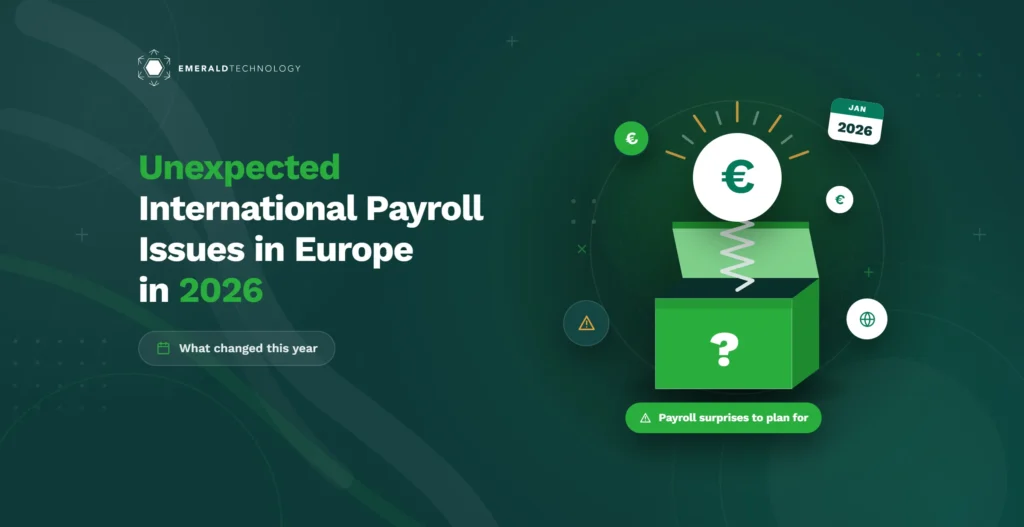
If your international payroll ran cleanly in 2025, don’t assume it will in 2026. This is the year several major employment reforms moved from announcement to live payroll obligation at the same time, and they landed on different dates, in different countries, with different levels of official guidance.
For human resources (HR) and People Ops leaders at tech companies scaling across Europe, that creates a specific problem. The payroll error that surfaces in October was often caused by a rule that changed in January or April, and nobody updated the setting. This guide explains what changed across Europe in 2026, how to trace a cross-border payroll error back to its root cause, and when an Employer of Record (EOR) takes that risk off your team.
What causes unexpected international payroll issues in Europe in 2026?
Unexpected international payroll issues in Europe in 2026 have five root causes: legislation that changed mid-cycle, pay data that doesn’t fit the new rules, workers who are classified incorrectly, unclear ownership between HR, finance, and local vendors, and payment failures at the point of transfer. The first cause is the one that’s different this year.
International payroll is the process of paying employees in more than one country accurately and on time, while meeting each country’s tax, social security, and employment law. Every country runs it on its own calendar, with its own thresholds, filings, and statutory payments. A process that works perfectly in one market says nothing about whether it works in the next.
In a normal year, most international payroll problems start upstream: a start date agreed after the payroll cut-off (the last day changes can make that month’s pay run), a bonus nobody told payroll about, an employee who quietly relocated. Those triggers haven’t gone away. What 2026 adds is a layer of risk your team didn’t create. The rules moved underneath a payroll that was set up correctly, and the setup is now wrong.
Why 2026 is a harder year for global payroll compliance in Europe
Three things make 2026 different from a typical year of payroll updates.
- Major reforms landed in the same 12 months. The EU pay transparency deadline, the UK’s sick pay overhaul, Poland’s length-of-service reform, and Ireland’s first national auto-enrolment scheme all hit payroll between January and June 2026.
- Several reforms are incomplete. The EU deadline passed with most countries still drafting. Employers have to plan payroll data for obligations that aren’t fully defined in the countries where they employ people.
- Enforcement is getting sharper. The UK established a new Fair Work Agency in April 2026, and the Dutch tax authority can now fine companies for deliberate or grossly negligent contractor misclassification.
Only four EU member states (Slovakia, Italy, Lithuania, and Malta) fully turned the Pay Transparency Directive into national law by the 7 June 2026 deadline. The other 23 are at various stages, from partial laws to no published draft at all.
Six 2026 changes behind cross-border payroll issues in Europe
These are the changes most likely to cause unexpected international payroll problems for tech companies employing people across Europe this year. Each one comes with the specific payroll symptom to watch for.
EU pay transparency: a deadline passed, a patchwork arrived
The EU Pay Transparency Directive introduces obligations that run from the job advert through the full employment relationship, including pay range disclosure, employees’ right to information about pay levels, and gender pay gap reporting. Member states were meant to turn it into national law by 7 June 2026. Most didn’t. Germany, Spain, and Sweden were among those with no draft published at the deadline, and Sweden formally paused its transposition work in March 2026 to push for renegotiation at EU level. Poland, by contrast, already had pay-scale disclosure rules in force from December 2025.
The payroll problem is less obvious than the legal one. Employers with 250 or more employees must report annually from 7 June 2027, and those first reports use 2026 pay data. Employers with 150 to 249 employees report every three years from the same date. Your 2026 international payroll data is the raw material for those reports.
The unexpected issue: if a bonus is coded as an allowance in one country and as variable pay in another, your pay gap figures won’t reconcile, and you can’t fix a year’s worth of inconsistent coding after the year has closed. Check now that pay components are named, categorised, and linked to job levels consistently across every EU country you employ in.
UK day-one statutory sick pay and the Fair Work Agency
Statutory sick pay is the minimum sick pay UK employers are legally required to pay. From 6 April 2026, under the Employment Rights Act 2025, SSP is payable from the first day of sickness absence rather than the fourth. The lower earnings limit has also gone. That was the minimum weekly pay an employee needed to qualify, so lower-paid and part-time staff who were previously excluded are now eligible. SSP is paid at whichever is lower: £123.25 a week or 80% of the employee’s average weekly earnings. The Fair Work Agency, a new body that brings enforcement of statutory payments and minimum wage under one roof, was established on 7 April 2026.
The unexpected issue: a payroll still configured with three waiting days will underpay every short absence, and part-time staff who were previously excluded will be missed entirely. Company sick pay policies that mirror the old rules are now out of date too. If your international payroll runs through a local UK provider, confirm the change was made. Don’t assume it was.
Poland’s new length-of-service rules
Poland has changed how length of service is calculated. Periods of self-employment, including business-to-business (B2B) contracts where the worker invoices as their own business, as well as mandate contracts (a common Polish civil law contract for services), and agency work now count towards an employee’s service record, as long as pension and disability contributions were paid. The rules applied to public sector employers from 1 January 2026 and to private employers from 1 May 2026. Employees have two years to submit proof, usually a certificate from the Zakład Ubezpieczeń Społecznych (ZUS), Poland’s social insurance institution.
Length of service drives several pay-related entitlements in Poland: annual leave, notice periods, severance pay, and long-service awards where workplace rules provide them. Employees with 10 years of service get 26 days of annual leave instead of 20. Poland’s minimum wage also rose to 4,806 Polish złoty (PLN) gross a month on 1 January 2026.
The unexpected issue: Polish tech teams often start as B2B contractors before moving onto employment contracts. Someone with three years on a civil law contract and one year as an employee can now qualify for a three-month notice period instead of one month. Leave balances, notice periods, and exit costs can change the moment an employee submits a certificate, and that can happen at any point in the two-year window.
Ireland’s pension auto-enrolment went live
Ireland launched My Future Fund, its first national auto-enrolment pension scheme, on 1 January 2026. Employees aged 23 to 60 who earn more than €20,000 and aren’t already paying into a pension through payroll are enrolled automatically. Employee and employer each contribute 1.5% of gross pay, with a 0.5% top-up from the state. Rates rise every three years until employer and employee contributions reach 6% in year 10. Employer contributions are capped at €80,000 of annual salary.
The unexpected issue: contributions were due from the first payroll of 2026 whether or not the employer had registered on the portal. A missed registration doesn’t pause the liability. It creates a backlog of unpaid contributions. If you have employees in Ireland without a qualifying company pension, check that your international payroll has been taking deductions and employer contributions since January.
The Netherlands tightened contractor enforcement
Contractor misclassification, treating someone as self-employed when the law sees them as an employee, quickly turns into a payroll problem. If a contractor is reclassified as an employee, the tax authority corrects the payroll tax position retroactively. In the Netherlands, the long-running pause on enforcing the Wet DBA (the Dutch law governing when self-employment is genuine) has ended. The government extended a partial “soft landing” through 2026, so standard default penalties aren’t being issued this year, but fines of 10% to 100% of the additional tax assessment are now possible where there’s evidence of intent or gross negligence. Full enforcement returns on 1 January 2027.
A separate law adopted by the Dutch Senate on 16 June 2026 creates a legal presumption of employment for self-employed professionals earning €38 an hour or less.
The unexpected issue: a long-standing Dutch contractor who works like an employee (fixed hours, one client, managed day to day) is now a live payroll tax exposure. If you’ve had warnings from the tax authority and ignored them, that’s exactly the evidence of gross negligence that can trigger a fine. Our contractor conversion service moves contractors onto compliant employment contracts.
The 1 January reset you didn’t budget for
Some 2026 payroll issues are simply thresholds that moved. Germany’s statutory minimum wage rose 8.42% to €13.90 an hour on 1 January 2026, with a second step to €14.60 scheduled for 1 January 2027. The mini-job earnings limit (the monthly cap for small part-time jobs with reduced tax and social security), which is linked to the minimum wage, moved to €603 a month.
Most of your engineers earn far above these levels. Interns, working students, and part-time support staff often don’t. The broader lesson applies to every country in your international payroll: contribution ceilings, tax bands, and statutory rates reset on their own schedule, usually on 1 January or at the start of the local tax year, and each one needs checking.
How to diagnose the root cause of a cross-border payroll error
When an international payroll error surfaces, fixing the individual payslip is the easy part. Preventing the next one depends on finding the root cause. Work through these five checks in order.
- Check the effective date. Did a rule change between when this employee’s pay was set up and the pay date? Compare the error against the 2026 changes above before assuming anyone made a mistake.
- Check the input. Was the information payroll received correct, complete, and on time? Start dates, salary changes, bonuses, leave, and expenses all feed the calculation.
- Check the classification. Is this person an employee on paper and in practice? Contractors who work like employees create payroll tax liabilities that surface months or years later.
- Check the owner. Who was responsible for catching this: HR, finance, talent acquisition, the line manager, or the local vendor? If the answer is unclear, that’s the root cause.
- Check the payment. If the calculation was right but the money arrived late, short, or not at all, the problem sits in bank details, foreign exchange (FX) conversion, or the payment cut-off.
The table below maps common 2026 international payroll symptoms to their likely root cause and owner.
| Symptom | Likely root cause | Who fixes it |
|---|---|---|
| A UK employee is underpaid for a two-day sick absence | Payroll still applies SSP waiting days | Employer and payroll provider |
| A Polish employee’s notice period or leave balance jumps unexpectedly | Earlier B2B or mandate contract periods now count towards length of service | HR and finance |
| An Irish employee’s payslip has no pension deduction | Employee not auto-enrolled in My Future Fund | Employer |
| Pay data won’t reconcile across EU countries | Pay components coded inconsistently by country | HR operations |
| A tax assessment arrives for a Dutch contractor | Misclassification under the Wet DBA | Legal, HR, and finance |
| Salary lands late or short in local currency | FX conversion or payment cut-off missed | Finance and payroll |
Who owns global payroll compliance under each model?
Who carries the risk depends on how you employ people in each country. Scaling tech companies usually choose between two models.
The first is a local entity: your own registered company in that country, running payroll itself or through a local payroll provider. The second is an EOR. An EOR already has its own legal entity in the country, becomes the legal employer of your staff there, and handles their contracts, payroll, tax filings, and statutory contributions. You still choose the people, set their work, and manage them day to day. It’s how most companies hire in a new country without setting up a company there first.
| Responsibility | Your own entity and local payroll provider | EOR |
|---|---|---|
| Legal employer | Your company | The EOR |
| Tracking local rule changes | Your team, with the provider’s support | The EOR |
| Tax filings and statutory contributions | Your company, usually processed by the provider | The EOR |
| Employment contracts meeting local law | Your company and local counsel | The EOR |
| Accuracy and timing of pay inputs | Your company | Your company |
| Day-to-day management of the employee | Your company | Your company |
The last two rows matter most. Under any model, your team still owns the information that feeds international payroll. An EOR carries the legal employer’s obligations, but it can only pay a bonus it knows about.
When do Employer of Record tools reduce international payroll risk?
EOR tools reduce international payroll risk when the problem is local expertise, legal liability, or fragmented systems, rather than your own internal processes. The clearest situations are:
- You have no entity and no local payroll expertise in the country. This matters most in markets with a reform in progress, such as Poland, Ireland, or any EU country still finalising its pay transparency law.
- You employ small teams across several countries. When no single market justifies in-house payroll expertise, tracking every country’s 2026 changes yourself is expensive and easy to get wrong.
- You’re converting long-term contractors. Tighter enforcement in markets like the Netherlands makes delayed conversions more costly each quarter.
- Your finance team can’t reconcile employment costs. If nobody can see cost by country, employee, and category each month, errors hide in the invoices.
- You’re preparing for a funding round, acquisition, or listing. Due diligence needs complete, consistent international employment records.
An EOR isn’t always the right answer. If you have a large, stable team in one country, a local entity becomes more cost-effective, and our comparison of EOR vs setting up a local entity covers where that line usually falls. And no EOR fixes late or inaccurate information from your own team. It takes on the legal and local complexity, but it can’t replace good internal process.
How Emerald’s EOR platform handles international payroll management
Emerald Technology acts as the legal employer in 150+ countries and handles payroll, tax, and compliance obligations locally, while you keep full day-to-day management of your employees. As legal employer, Emerald carries the liability for those obligations under the terms of your agreement, and you work with a named contact who knows your account. The platform is built around the root causes above.
Country rules enforced at onboarding
When you onboard a new employee, the platform surfaces the legal requirements for the employment country, including notice periods, probation length, and mandatory contributions, and blocks inputs that don’t comply. If you try to set a notice period that’s shorter than the legal minimum, the form won’t let you continue.
One route in for pay inputs
Bonuses, commissions, and one-off allowances are submitted as additional payroll requests on the employee’s profile, with the amount, currency, and a description. Emerald’s finance team is notified to include each request in the next payroll cycle, and every request carries a visible status. Expenses follow a report-based approval flow with a submission deadline of the 15th of each month, and managers must give a written reason to decline a report.
Employment costs you can reconcile
Every employee’s employment costs are broken down by category, including salary, local employment taxes, pension, service fee, and expenses. The payroll breakdown dashboard shows costs per country, per employee, and per category, month by month, and is designed to match Emerald’s invoices line for line. A raw invoices tab supports direct reconciliation.
One source of employee data
The platform acts as a single source of truth for the employment lifecycle and syncs with your HR system, so your team doesn’t maintain two versions of employee data.
Cost planning before the offer
The employer cost calculator compares the full cost of employment in two countries side by side, including local taxes and contributions. In one comparison for an €80,000 salary, employment costs in Portugal added a 25% uplift on top of gross salary, against around 17% in Spain.
The model holds up across many markets at once. Human Security employs people through Emerald in 11 countries without a single compliance issue needing to be fixed after the fact, and Netcracker switched 13 countries to Emerald with zero disruption to its employees.
Frequently asked questions about international payroll in Europe in 2026
What are the biggest international payroll changes in Europe in 2026?
The changes with the widest payroll impact in Europe in 2026 are the EU Pay Transparency Directive deadline on 7 June 2026, day-one SSP in the UK from 6 April 2026, Poland’s length-of-service rules for private employers from 1 May 2026, and Ireland’s My Future Fund auto-enrolment from 1 January 2026. Contractor enforcement in the Netherlands and Germany’s minimum wage increase add further risk.
Does the EU Pay Transparency Directive affect payroll if a country hasn’t transposed it yet?
Yes, in practice. Your specific legal obligations come from each country’s national law, so timing and detail vary. But the first gender pay gap reports for employers with 250 or more employees are due on 7 June 2027 and draw on 2026 pay data. The payroll data you record this year is the data you’ll report on.
Does an EOR remove all payroll risk?
No. An EOR takes on the legal employer’s obligations in each country, including payroll, tax filings, statutory contributions, and compliant contracts. Your company still owns the accuracy and timing of the information that feeds payroll, such as salary changes, bonuses, and leave.
When should a tech company use an EOR instead of its own entity?
An EOR is the better fit when you’re entering a new market, employing small teams across several countries, converting contractors, or need to hire faster than an entity setup allows. A local entity makes more sense once you have a large, stable team in one country and the internal capability to manage local payroll and compliance.
Get ahead of international payroll issues before 2027
The 2026 changes aren’t the end of it. Germany’s minimum wage rises again on 1 January 2027, full Dutch contractor enforcement returns the same day, and the first EU gender pay gap reports are due in June 2027. The companies that avoid unexpected international payroll issues next year are the ones fixing their data, classification, and ownership now.
If you’re employing people in European markets where the rules moved this year, Emerald takes on the legal employer’s obligations so your team can focus on the people. Explore the EOR solution or book a demo of the Emerald platform to see how it handles payroll in the countries you’re hiring in.