TL;DR
- Employee misclassification happens when a business treats a worker as an independent contractor even though the working relationship meets the legal tests for employment.
- Regulators use control, financial risk, and the nature of the relationship to decide worker status — not what the contract calls someone.
- Penalties stack fast: unpaid taxes, back wages, interest, and in willful cases, a felony charge carrying up to 10,000 dollars in fines and up to five years in prison.
- Real cases show the scale of the risk: Uber paid 100 million dollars over misclassified drivers, and FedEx settled for 228 million dollars.
- An Employer of Record (EOR) removes the risk entirely by becoming the legal employer, and can convert existing contractors into compliant employees.
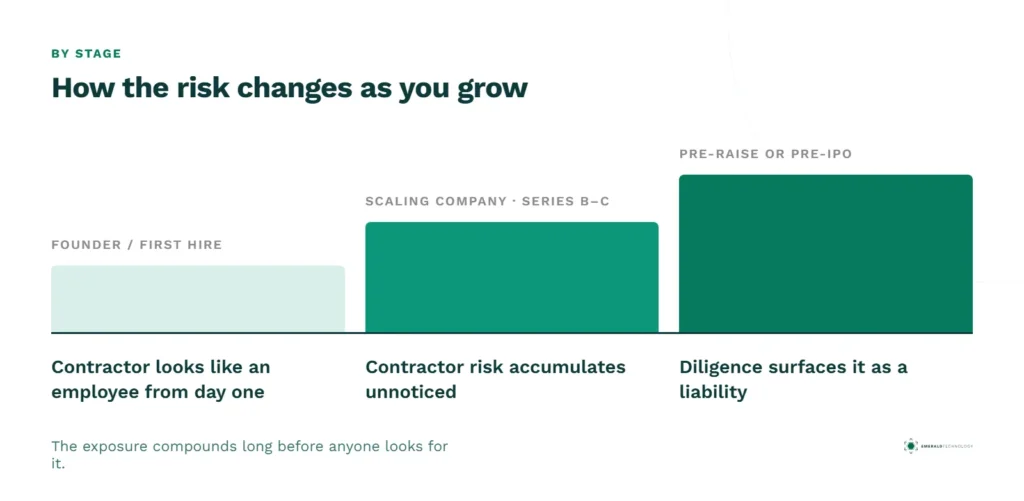
- The risk looks different at each stage: founders hiring their first international contractor, scaling companies accumulating contractor risk without noticing, and later-stage companies who need clean records for a raise or an IPO.
What is employee misclassification?
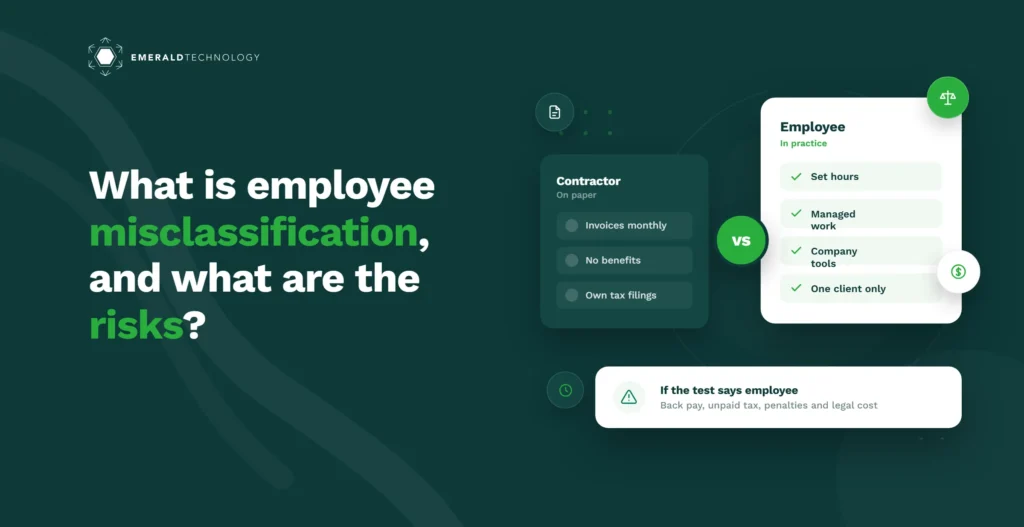
Employee misclassification happens when a business classifies a worker as an independent contractor, when the actual working relationship meets the legal definition of employment. It is not about what the contract says. Regulators look at how the work actually happens day to day, and if that looks like an employment relationship, the label on the paperwork will not protect you.
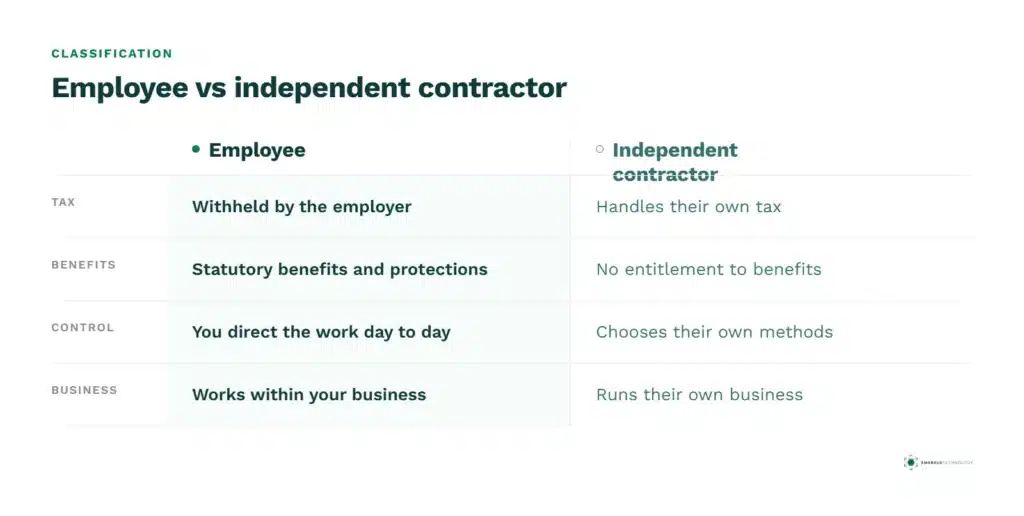
The distinction matters because employees and independent contractors are treated completely differently under tax and employment law. Employers withhold income tax and pay employer contributions for employees. They provide benefits, minimum wage protections, and overtime pay where applicable. None of that applies to a genuine independent contractor, who is running their own business and is responsible for their own tax and benefits.
That gap in cost and obligation is exactly why misclassification happens, and exactly why governments are so focused on catching it. It is also why a growing number of HR leaders now hire internationally through an Employer of Record (EOR) rather than a contractor agreement from day one — it removes the classification question entirely, rather than managing around it.
Why regulators are cracking down on worker misclassification
Worker misclassification has been a growing enforcement priority for close to a decade, driven by the rise of gig and contractor-based hiring. High-profile cases involving companies like Uber and FedEx put the issue in the news, but the underlying driver is simpler: lost tax revenue.
When a worker is classified as a contractor instead of an employee, the government collects less in payroll tax, Social Security, and Medicare contributions. Multiply that across a growing contractor workforce, and the numbers become significant enough that tax authorities have made misclassification enforcement a standing priority rather than a one-off crackdown.
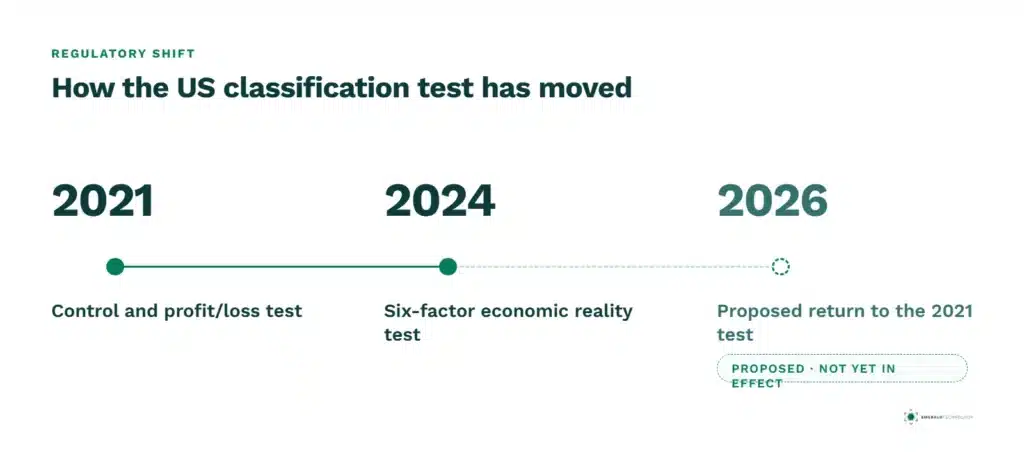
In the United States, the applicable test has shifted more than once in the past few years, and it is worth tracking closely if you hire contractors there:
- 2021 — The Department of Labor (DOL) introduced an independent contractor rule built around two core factors: the degree of control over the work, and the worker’s opportunity for profit or loss.
- 2024 — A new DOL rule replaced this with a six-factor “totality of the circumstances” test, weighing each factor equally rather than prioritising control and profit/loss.
- 2026 — The DOL proposed rescinding the 2024 rule and returning to the two-core-factor approach from 2021. The proposal was published on February 27, 2026, with a public comment period that closed on April 28, 2026.
As of today, the 2024 rule remains the one in effect for federal enforcement, since the 2026 proposal has not yet been finalised. This matters for one practical reason: the rules employers are tested against can change while a contractor relationship is still running. A classification that was defensible under one test is not automatically defensible under the next one. State-level rules add another layer — California and Massachusetts, for example, apply a stricter “ABC test” that is harder for a contractor relationship to pass than the federal standard.
Outside the United States, the direction of travel is the same. HM Revenue & Customs (HMRC) in the United Kingdom has increased scrutiny of contractor arrangements as more UK firms lean on contingent workforces, and most major hiring markets now have some version of an employment test that looks past the contract to the substance of the relationship.
Employee vs independent contractor: the tests regulators actually use
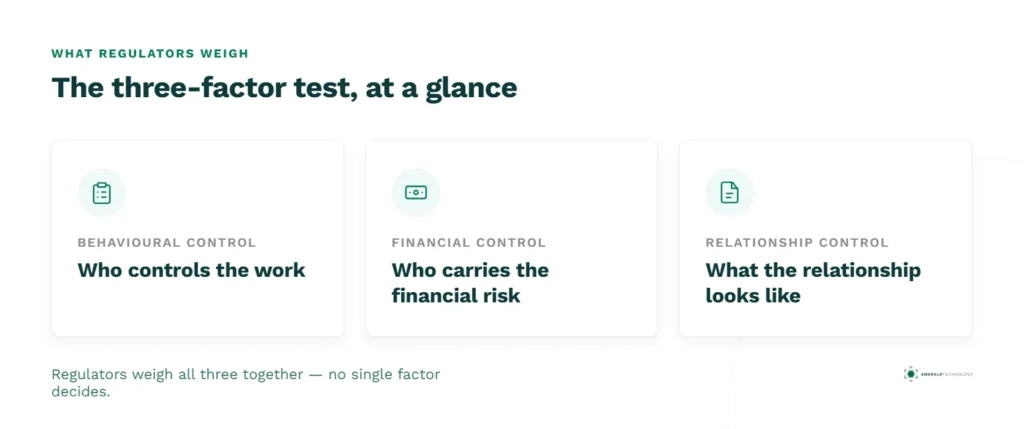
Full multi-factor legal tests run to dozens of questions, but in practice, auditors tend to start with three areas. If your contractor relationships look like this, you are in employee territory, whatever the contract says.
Behavioral control
- Did you train the worker to do the job, or did they arrive with the skills and simply do the work? Training is a strong signal of employment.
- Do you control how, when, and where the work gets done — even if you never wrote those instructions down? Controlling the process, not just the output, is a marker of an employment relationship.
Financial control
- Does the worker supply their own tools, equipment, or workspace? Genuine contractors typically invest in what they need to do the job.
- Can the worker make a profit or take a loss on the engagement? Most employees have no exposure to loss beyond, at most, a sales commission structure.
- Does the worker have ongoing costs that exist whether or not they are actively working, such as hired equipment? That is a contractor signal, not an employee one.
Relationship control
- Do you provide benefits such as health insurance, sick pay, paid time off, or a pension? These are hallmarks of employment.
- Is there a written agreement, and does it reflect an ongoing, indefinite relationship rather than a defined project with an end date?
No single factor decides the outcome on its own. Regulators weigh the whole picture, and a contractor relationship that fails on two or three of these points is the kind of case that gets flagged for a deeper audit.
Misclassification penalties: the real cost of getting it wrong
The financial exposure from misclassification is not a flat fine — it compounds across several categories at once, and the totals can be severe.
Unintentional misclassification, where a Form 1099 was filed
Under Internal Revenue Code (IRC) Section 3509, employers who made a genuine mistake but still filed a 1099 for the worker get reduced rates:
- Income tax that should have been withheld: 1.5% of wages paid
- Employee’s share of Social Security and Medicare: 20% of what should have been withheld
- Employer’s share of Social Security and Medicare: 100% of what was owed, with no reduction available — this part is never discounted
Unintentional misclassification, where no 1099 was filed
If the business did not file any information return for the worker, the same relief applies at double the rate:
- Income tax that should have been withheld: 3% of wages paid
- Employee’s share of Social Security and Medicare: 40% of what should have been withheld
- A separate penalty also applies for the missing information return itself, starting at 50 dollars per worker if corrected within 30 days and rising to 250 dollars per worker if filed after August 1, with no upper limit if the failure is judged intentional
Willful misclassification
Section 3509’s reduced rates do not apply at all if the misclassification is found to be willful. Instead, the employer is liable for the full, uncapped amount of income tax that should have been withheld, plus the full employee and employer share of Social Security and Medicare. On top of the tax liability itself, IRC Section 7202 makes willfully failing to collect or pay over these taxes a federal felony, carrying a fine of up to 10,000 dollars and up to five years in prison.
Back pay and state penalties
- Up to three years of unpaid overtime and wages under federal law, and liquidated damages can double that figure
- State-level penalties add further exposure — California, for example, imposes fines of 5,000 to 25,000 dollars per willful violation under its own labor code
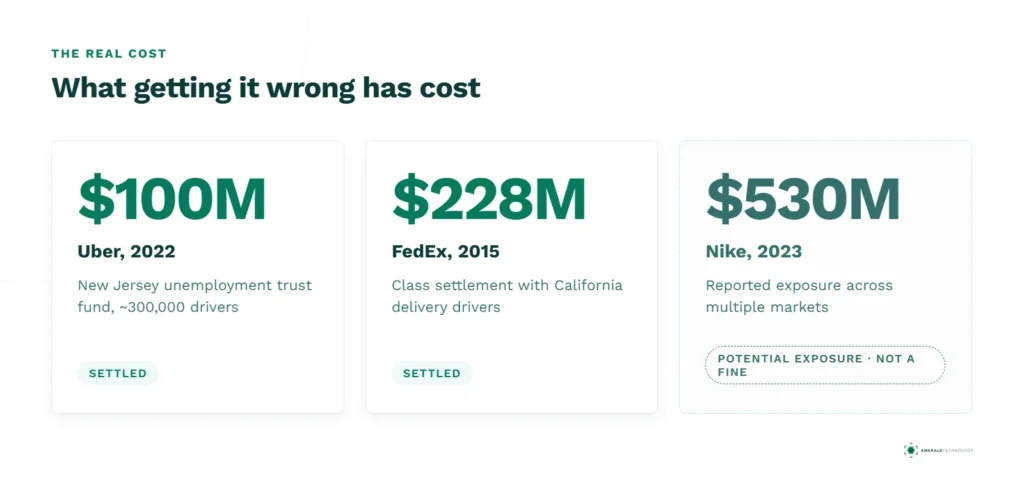
These are not theoretical numbers. Uber paid 100 million dollars to New Jersey’s unemployment trust fund in 2022, following an audit covering nearly 300,000 drivers over a five-year period. FedEx settled a California case for 228 million dollars in 2015, covering 2,300 drivers. Nike was reported in 2023 to be facing potential tax fines exceeding 530 million dollars over temporary worker misclassification — a reported exposure rather than a fine actually paid, but a clear illustration of how large the number gets before a case is even resolved. Whatever the size of your business, the same enforcement logic applies at a scale relative to your workforce, and the legal and reputational cost of an audit can outlast the fine itself.
How to spot misclassification risk before regulators do
Run through this list against your current contractor base. Any one of these on its own is not automatically a problem, but the more that apply, the higher your exposure.
- The contractor works exclusively for you, with no other clients, and has done so for an extended period.
- You set their working hours, require attendance at specific times, or dictate where the work is done.
- They use your equipment, your email address, or your internal systems in the same way an employee would.
- Their role is indistinguishable from a role held by a full-time employee on your team.
- You provide any form of paid time off, sick leave, or benefits, even informally.
- The relationship has continued well past the original project scope, with no clear end date.
- You manage their day-to-day priorities the way you would manage a direct report.
If several of these describe a contractor relationship you currently have, it is worth addressing before an audit forces the issue — correcting misclassification voluntarily is treated far more favorably than being caught.
How misclassification risk shows up differently at each stage of growth
Misclassification is not a single moment of risk — it looks different depending on where your company is in its growth.
Founders making the first international hire
You need someone in a new market fast, and a contractor agreement feels like the quicker, cheaper option compared with figuring out local employment law from scratch. The problem shows up when that first hire starts behaving like an employee in every way that matters — fixed hours, exclusive to you, managed the same way you would manage anyone on your core team. At this stage, the fix is not more paperwork on the contractor agreement. It is starting the hire on an EOR from day one, so the classification question never has to be revisited later.
Scaling companies carrying risk they have not noticed yet
By Series B or C, most companies have accumulated 10 or more contractors across several countries, often hired quickly to support a specific project or market entry. Nobody owns an ongoing review of those relationships, so a contractor who was genuinely independent in month one can drift into looking like an employee by month 18, without a single decision being made along the way. This is the exact pattern behind converting contractors into full-time employees once the risk is spotted, rather than discovering it during an audit.
Later-stage companies preparing for a raise or an IPO
Once a company is heading into a Series C round, a growth round, or pre-IPO due diligence, employment records get scrutinised in a way they never have been before. Investors’ legal and finance teams review the full contractor base as part of standard diligence, and a pattern of misclassified workers reads as an undisclosed liability — the kind of finding that slows a round down or knocks value off a term sheet. This sits alongside other structural risks reviewers look for, such as permanent establishment exposure, and it is far cheaper to fix before diligence starts than during it.
How Emerald’s platform keeps you compliant from day one
The safest way to avoid misclassification is to remove the ambiguity from the start, and this is precisely what an Employer of Record (EOR) is built to do. Emerald becomes the legal employer of your international hires, taking on full responsibility for local employment law, payroll, tax, and compliance across more than 160 countries, while you keep full day-to-day management of the person’s work.
This protection is built directly into how new hires are set up. When you onboard someone through Emerald’s platform, the system automatically applies the correct legal requirements for that employment country — including minimum notice periods and probation lengths — and blocks any input that falls short of them. In practice, that means the platform will not let you set a notice period that is too short for the country in question, closing off one of the most common ways misclassification and non-compliant contracts happen in the first place.
Already have contractors who look like employees? Fix it with contractor conversion
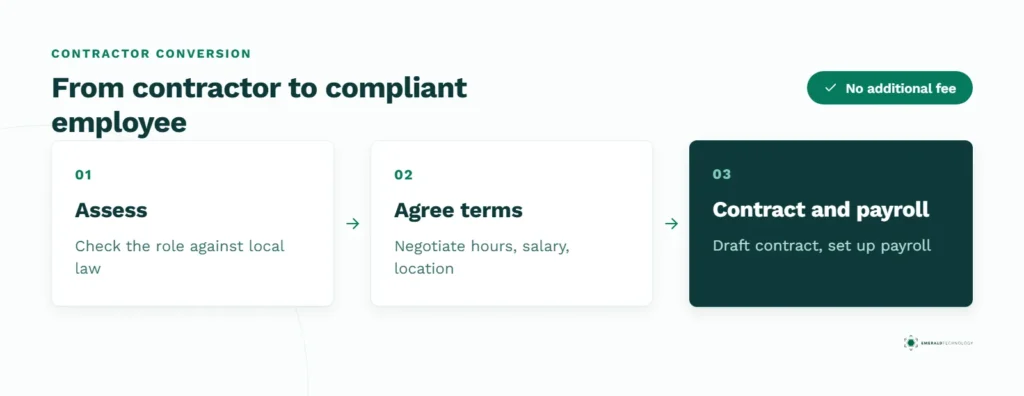
If you have read this far and recognised some of your own contractor relationships in the red flags above, the fix does not have to mean losing the working relationship or starting from scratch. Emerald’s contractor conversion service moves an existing contractor into compliant employment, with no additional fee for the conversion itself.
The process runs in three stages. First, Emerald assesses the existing arrangement against the legal requirements of the worker’s country to confirm they are a viable employee. Second, Emerald works directly with the contractor to agree the practical terms of employment — working hours, salary, location, and expenses — with a personalised approach to the negotiation rather than a standard template. Third, Emerald drafts the formal employment contract and handles payroll onboarding, so the person moves onto compliant employment without disruption to the work they are already doing for you.
This is the practical middle ground between “do nothing and hope an audit does not happen” and “end a working relationship that is actually working.” You keep the person and the continuity, and Emerald removes the legal exposure.
Employee misclassification FAQs
Is filing a 1099 the same as correctly classifying someone as a contractor?
No. Filing Form 1099-NEC records a payment to a contractor, but it does not determine classification on its own. If the underlying relationship meets the tests for employment, filing a 1099 instead of a W-2 does not protect the business from an audit finding of misclassification.
Can a contractor become an employee without losing the relationship?
Yes. Converting a contractor to an employee is a routine process, not a disruption. Emerald’s contractor conversion service handles the legal assessment, the negotiation of new terms, and the contract and payroll setup, so the working relationship continues without a gap.
What is the difference between the IRS test and the DOL test?
The Internal Revenue Service (IRS) test focuses on tax treatment and uses a 20-factor framework, condensed in practice to three areas: behavioral control, financial control, and the relationship between the parties. The Department of Labor (DOL) test focuses on wage and hour protections under the Fair Labor Standards Act (FLSA) and currently applies a six-factor economic reality test, though a 2026 proposal would narrow this back to two core factors. The two tests can produce different answers for the same worker, which is part of what makes classification genuinely difficult to get right without expert input.
Does hiring through an Employer of Record eliminate misclassification risk?
Yes, for the workers hired through it. Since Emerald is the legal employer of record, Emerald carries the compliance obligation and the classification risk for that hire, not your business.
Worried about the classification status of your current team, or planning to hire internationally without adding legal risk? Talk to an Employer of Record specialist and get a clear read on where you stand, or explore the EOR solution to see how it removes the risk from day one.