A company’s first international hire is usually simple: one contract, one country, easy to keep in your head. By employee thirty, spread across ten countries, that same process can quietly turn into a legal and financial problem nobody signed up for.
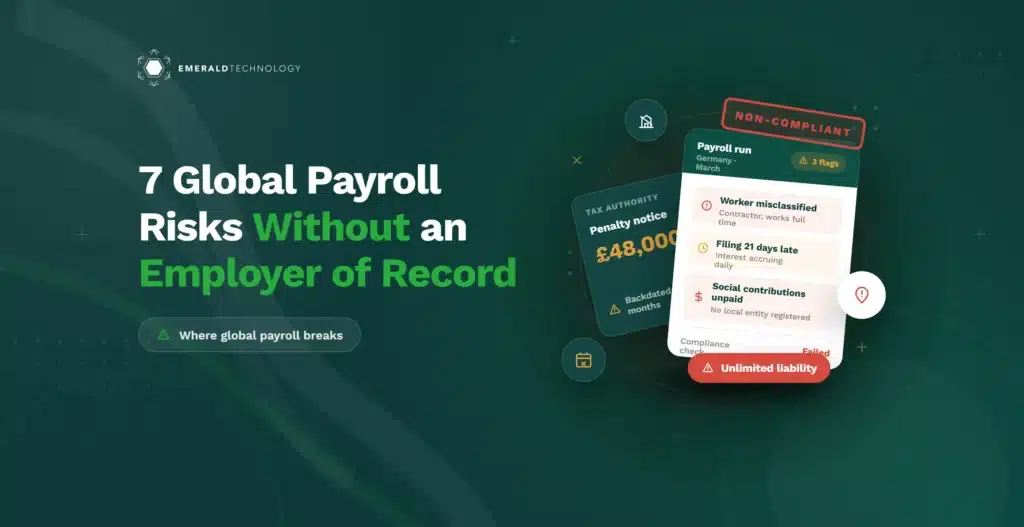
Employer of Record (EOR) software exists to prevent that. It lets you legally employ someone in another country without opening your own office there, and hands the compliance responsibility to a specialist instead of leaving it with your own team. Skip it, and seven risks build up quietly: misclassification, missed statutory minimums, manual payroll and tax errors, inconsistent benefits, background check delays, hidden costs, and no clean record for your next round of due diligence.
Who this is for: companies at Series B to E (past the first couple of funding rounds and actively scaling) or backed by private equity (PE), already hiring across multiple countries, where a People/HR leader is building the internal case and Finance is being asked to sign off on it. If that’s you, the risks below map directly onto the buying committee you already have in the room.
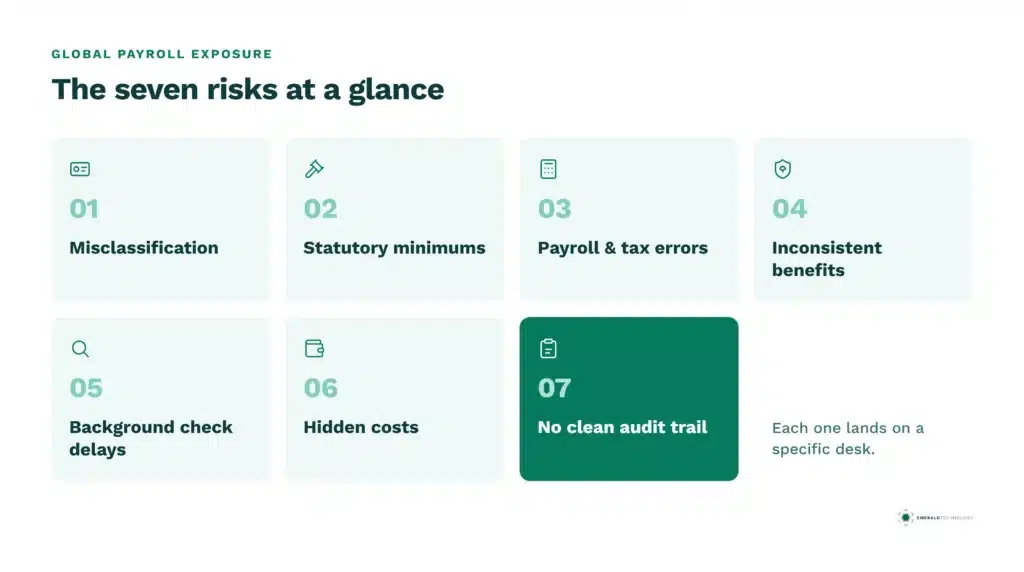
Each risk gets worse as headcount and country count grow: what’s manageable with five international employees becomes unmanageable at 50.
What is Employer of Record software?
In practice, the EOR becomes the legal employer on paper in each country: it issues the contract, runs payroll, files the taxes, and stays on top of local employment law. You keep full day-to-day management of the person, including what they work on and who they report to. The EOR just carries the legal and administrative weight that would otherwise sit with you. Emerald’s Employer of Record solution, for example, covers the whole employment lifecycle (contract generation, onboarding, payroll reporting, and offboarding) across 150+ countries from a single dashboard, backed by a named account team rather than a self-serve portal alone.
Where this risk actually sits: your buying committee
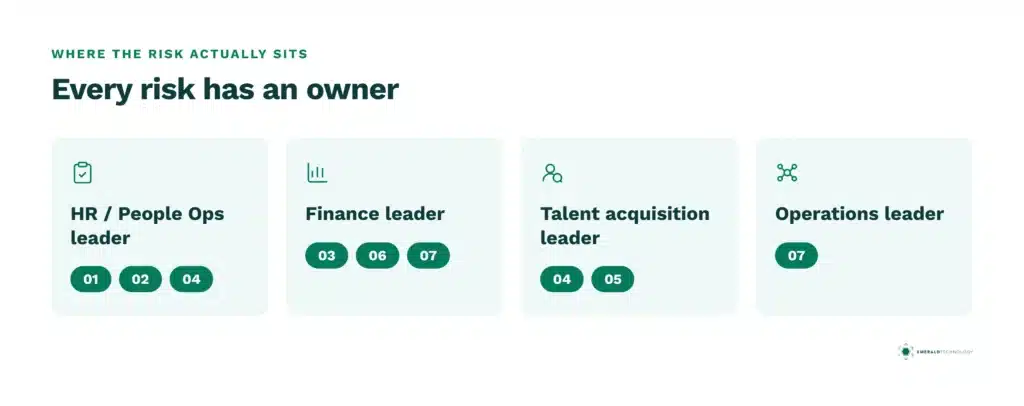
By the time a company reaches Series B–E, or takes on private equity investment, this usually isn’t one person’s call anymore. A few people end up involved, each for a different reason:
- HR/People Ops Leader: usually the first to notice. They own onboarding and the day-to-day employee experience, so they’re the one who ends up saying, out loud, that manual, country-by-country compliance can’t keep pace with the hiring plan everyone already agreed to.
- Finance Leader: holds the budget. They sign off on the plan, and they’re the one asking whether the “cheaper-looking” manual approach is actually cheaper once you count the errors, the rework, and the entity costs nobody put in the original spreadsheet.
- Talent Acquisition Leader: feels it indirectly. Compliance friction slows hiring down, and that shows up in their numbers as stalled offers and candidates who accept somewhere else while the paperwork catches up.
- Operations Leader: wants this to stop being reinvented every time. They own making the process repeatable, so opening country number six doesn’t mean re-solving the same problems as country number one.
If you’re a PE operating partner (someone managing performance across a private equity firm’s portfolio companies) evaluating this pattern across several businesses at once, or a founder at an earlier stage weighing this up solo, the same seven risks apply. The mechanics just look a little different without a formal committee in place yet. But the detail below is written for the group above, since that’s where this decision most often actually gets made.
1. Employee misclassification exposes you to fines and back pay
Classifying someone as a contractor when local law says they’re an employee is one of the most common and most expensive global payroll management mistakes. Misclassification rules differ by country, and getting them wrong can trigger back pay, unpaid tax contributions, and fines, sometimes retroactively across the full length of the relationship.
This risk grows quietly. A company hires its first international contractor with the best intentions, the relationship becomes more employee-like over time (fixed hours, exclusivity, managed work), and nobody revisits the classification until a tax authority does. For a closer look at how this plays out country to country, see this breakdown of employee misclassification and the risks.
Who owns this: HR/People Ops is usually the one who surfaces it, since they own the employee relationship day to day. Where an in-house Legal or Compliance function exists (increasingly common from Series C onward), they’re the one who has to sign off on the exposure.
Employer of Record software addresses this at the point of hire: the employee is engaged directly through the EOR under a compliant local contract, so the classification question doesn’t arise in the first place. As the legal employer, Emerald owns payroll, tax, contracts, and termination compliance in every country it operates in, and tracks every change in local employment law so your team doesn’t have to.
2. Missing local statutory minimums breaks employment law before you know it
Notice periods, probation lengths, termination pay, and mandatory pension contributions all vary by country, and most HR teams don’t have every country’s minimums memorised. Set a notice period or probation length below the legal minimum and the contract itself is non-compliant, a problem that often only surfaces at termination, when it’s hardest and most expensive to fix.
Who owns this: HR/People Ops Leader. This is the point where standardising onboarding across a growing number of countries stops being manageable by memory or a generic template, and the team needs software to do the checking instead.
On Emerald’s platform, the onboarding form automatically surfaces each country’s minimum notice period, probation length, and mandatory contributions, and blocks non-compliant inputs before the contract can be generated. If an admin tries to set a notice period that’s too short, the system won’t let the process continue. This is one part of Emerald’s broader approach to compliance across markets.
3. Manual payroll calculations create costly tax and currency errors
Global payroll management by spreadsheet means recalculating gross-to-net pay (what an employee actually takes home after tax and deductions), local tax withholding, and currency conversion for every employee, every cycle, in every country, by hand or across a patchwork of local providers who don’t talk to each other. Small errors compound fast: an incorrect tax withholding in one country can trigger penalties, while inconsistent currency handling makes it nearly impossible for finance to reconcile what was actually paid against what was invoiced.
Who owns this: Finance. This is the moment a Chief Financial Officer (CFO) or Finance Director starts asking why payroll reporting doesn’t tie back cleanly to what’s being invoiced, usually once headcount is spread across more countries than one person can reconcile by hand.
Employer of Record software centralises this. Emerald’s payroll breakdown dashboard shows full employer cost per country, per employee, and per cost category (salary, local employment taxes, pension, service fee, and expenses), broken down month by month, matched directly against invoices, with raw invoice data available for reconciliation.
4. Inconsistent benefits and contributions damage retention and compliance
Health insurance, pension contributions, and statutory leave entitlements aren’t optional extras: in most countries they’re legally mandated, and getting them wrong is both a compliance risk and a retention problem. Companies managing benefits manually across markets often end up with gaps: an employee in one country under-enrolled in a mandatory scheme, or a benefit promised at hire that never actually gets set up.
Who owns this: HR/People Ops owns the compliance exposure; Talent Acquisition feels the downstream effect when inconsistent benefits become a reason a candidate turns down an offer or a new hire disengages early.
Emerald’s onboarding flow includes a defined set of benefit providers per country, covering health insurance, pension, life insurance, and income protection, selected during the same five-step process that generates the employment contract, so benefits are configured correctly from day one rather than bolted on afterward.
5. Fragmented background checks slow down hiring and create audit gaps
Background checks for international hires typically involve a separate vendor, a manual handoff, and a wait, during which the candidate’s start date slips and nobody has full visibility into where the check actually stands. When the results do land, they often arrive disconnected from the employment record itself, which becomes a problem the first time someone needs to prove the check happened.
Who owns this: Talent Acquisition Leader. This risk shows up directly in the metrics a TA leader is measured on: offer-to-start delays and candidate drop-off.
Emerald’s platform runs background checks through a single toggle in the onboarding form, via its Veremark integration: the employee is contacted directly by the verification partner, and results load automatically back into the platform, with onboarding resuming without manual intervention. The check and the employment record live in the same place, which matters as much for audit-readiness as it does for speed.
6. Hidden costs erode the budget you set for global expansion
The headline cost of hiring in a new country is rarely the real cost. Entity setup, local legal advice, ongoing compliance monitoring, and the internal hours spent chasing all of it add up to far more than the number in the original business case. Because these costs are spread across multiple invoices and providers, finance often doesn’t see the full picture until well after the budget’s been spent.
Who owns this: Finance Leader, directly. This is the risk that shows up as a board-approved expansion plan needing cost modelling before anyone signs off, arguably the single most common reason a Finance Leader reads a piece like this in the first place.
Employer of Record software makes the real cost visible before you commit. Emerald’s employer cost calculator lets a client input a salary and country and see the full employment cost breakdown, including local taxes and contributions, with side-by-side comparison across two countries. In one platform walkthrough comparing an €80,000 salary in Portugal versus Spain, the total employment cost uplift was 25% in Portugal against 17% in Spain, an 8-point difference that changes the economics of where you base a hire, and one you’d otherwise only discover after the fact. Across Emerald’s customer base, this kind of visibility has translated to £100k+ saved per market versus standing up a legal entity outright. For a broader look at this category of risk, see this guide to global risk management.
7. No clean record leaves you exposed at your next round or PE review
For Series B–E companies, employment records get scrutinised again at every subsequent funding round: investors want to see complete, consistent documentation for every international hire before they commit more capital. For PE-backed companies, the same records are pulled into ongoing portfolio and value-creation reporting, not just a one-time check. Either way, data spread across spreadsheets, email threads, and disconnected local providers rarely holds up to that level of scrutiny.
Who owns this: Finance Leader for the next-round diligence angle; Operations Leader where the concern is building a repeatable, documented process rather than a one-off scramble each time someone asks for the records.
Employer of Record software builds the audit trail as a by-product of normal use rather than a scramble before a data room opens. Every contract, onboarding document, and payroll record sits in one system, filterable by category and status, with a full history available on demand. Human Security, an Emerald customer operating across 11 countries, went through this kind of review with zero compliance remediation required. That’s only possible when the records were clean from the first hire, not reconstructed retroactively.
Software alone isn’t the whole answer
Most comparisons between EOR providers focus on platform features in isolation (dashboards, integrations, country coverage) without addressing what happens when a situation doesn’t fit the standard workflow: a country-specific edge case, a termination that needs careful handling, or a compliance question the software wasn’t built to answer. A platform that enforces the rules is necessary but not sufficient on its own.
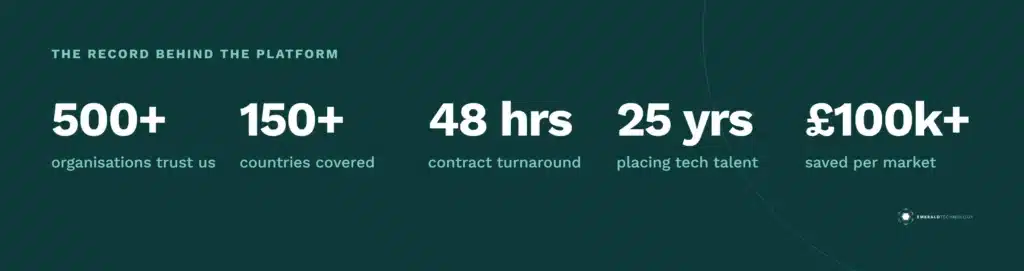
The providers that hold up under pressure combine the software with a named team who knows the account and can step in when something doesn’t fit the standard flow. Emerald pairs its platform with named account contacts for exactly this reason: 500+ organisations across 150+ countries, with contracts issued within 48 hours. If you’re evaluating options, compare EOR providers on that basis specifically, not just on feature lists.
Where to go from here
- If you’re HR/People Ops building the internal case: Explore Emerald’s Employer of Record solution to see how compliant hiring, payroll, and onboarding work together on one platform, then bring the cost side to Finance directly, rather than translating it yourself.
- If you’re Finance building the cost model: Use the employer cost calculator for a country-by-country comparison, and ask for Emerald’s CFO-ready business case, which models return across all four value levers: revenue acceleration, exit-cost savings, compliance risk avoided, and entity setup avoided.
- If you’re evaluating this across a portfolio: Talk to an EOR specialist about how this pattern plays out across multiple portfolio companies at once, rather than one at a time.
The bottom line
That first international hire is still simple. It’s the thirtieth one, spread across ten countries with inconsistent documentation, where a survivable gap turns into a genuine liability. At Series B–E or PE-backed scale, that liability sits with a named budget holder, not a founder’s best guess. Employer of Record software doesn’t remove the need for good HR and Finance judgment, but it does remove the guesswork around global expansion risk that a growing buying committee shouldn’t have to carry manually.