TL;DR
- An Employer of Record (EOR) platform lets you employ staff in a new country without setting up a local legal entity. The provider becomes the legal employer while you manage the person day to day.
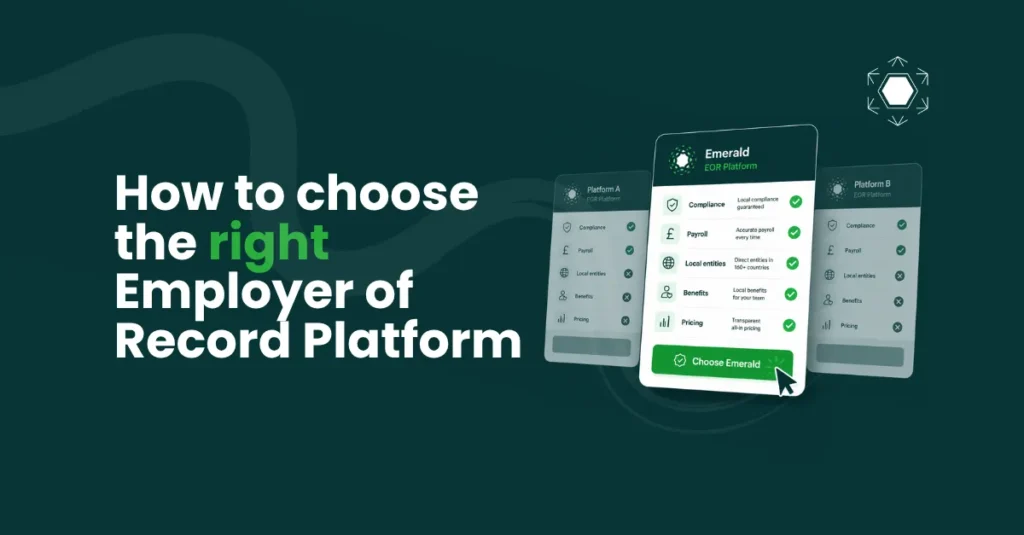
- Choosing between Employer of Record platforms comes down to five checks: true total cost, hidden fees, onboarding speed, local compliance expertise, and whether the provider employs people directly or through a partner network.
- Providers operating directly carry the employer liability themselves. Those relying on partners add a handoff, which usually means slower onboarding and less accountability if something goes wrong.
- A transparent platform shows the full cost breakdown, by country and by employee, before you sign a contract, not buried in the first invoice.
- Emerald Technology acts as your Employer of Record across 160+ countries, with local compliance rules and cost breakdowns built into the platform itself.
Tech firms hiring overseas are asking the same question in founder forums, HR Slack groups, and on Reddit threads comparing providers: how do you actually tell one Employer of Record platform from another once the sales calls all start to sound the same? The honest answer is that most of the differentiation is invisible until you are three months in, buried in an invoice, a delayed contract, or a compliance gap nobody flagged. This guide sets out the five things worth checking before you sign, and where the answers actually live.
The stakes are only getting bigger. Independent market research puts the global EOR sector at somewhere between £4.5bn and £7bn in 2026, with most estimates agreeing on annual growth of around 6 to 7%, as more scaling companies choose an employment platform over setting up their own local entities. More providers, more sales decks, and more room for the same headline fee to mean very different things once you are three months in.
What is an Employer of Record (EOR) platform?
An Employer of Record (EOR) is a company that becomes the legal employer of your staff in a country where you do not have your own entity. The EOR issues the local contract, runs payroll, pays statutory taxes and social contributions, and takes on the local employment liability. You keep full day-to-day control over what the person works on, who they report to, and their targets, while the EOR handles the parts of employment law that would otherwise require a lawyer in every country you hire in.
An EOR platform is the software layer on top of that service: the dashboard where you initiate onboarding, track contract status, manage expenses and time off, and see what you are actually being charged. The quality of that platform, not just the legal entity behind it, is what determines how much admin ends up on your desk every month.
Why UK tech firms are hiring overseas through EOR platforms
Tech firms expanding into the US, the EU, and APAC face a specific problem: entity setup in a new market can take months and tens of thousands of pounds before a single employee starts, and most scaling businesses do not have that runway to spare. An EOR platform turns an expansion decision into employed headcount in weeks rather than quarters, which is why it has become the default route for Series A to Series C and PE-backed tech companies moving into new markets one hire at a time, rather than one entity at a time.
The trade-off is that you are handing a critical function, legal employment, to a third party. That is exactly why the five checks below matter more than the sales deck.
True cost vs hidden fees: what to actually compare
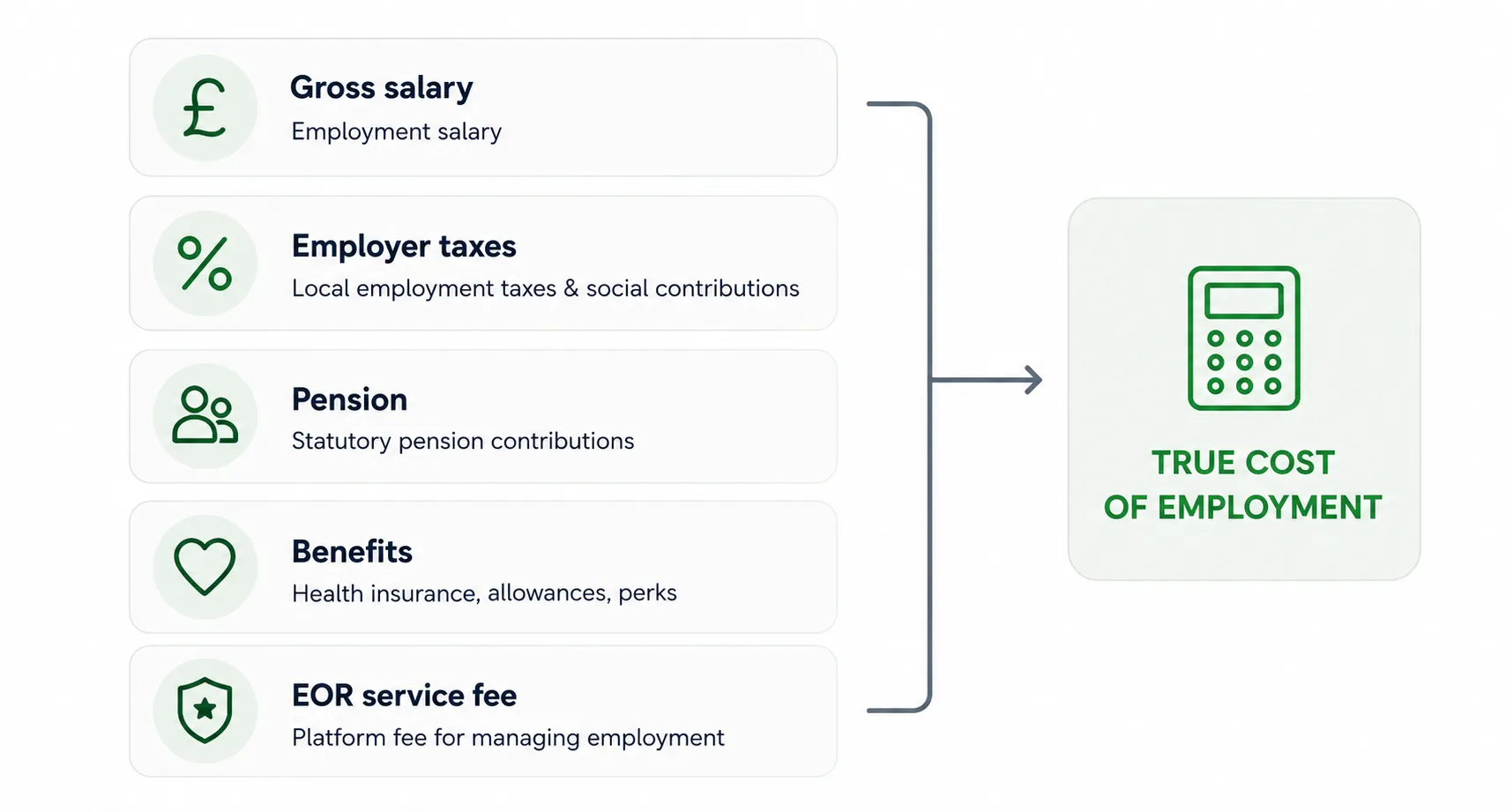
Every EOR platform will quote a headline monthly fee per employee. Few make it easy to see what sits underneath that fee until the first invoice lands. The number that matters is total cost of employment: gross salary, local statutory contributions, pension, benefits, and the provider’s service fee, added together and shown per country.
Employment costs on top of gross salary vary sharply by country. In some markets the uplift runs close to a quarter of salary, in others closer to a sixth. That gap compounds fast across a team, which is why a platform with a built-in cost calculator that lets you compare countries side by side, before you commit to a market, is worth more than a lower headline fee.
Beyond the headline number, hidden fees tend to cluster around the same handful of areas: contractual lock-in periods that keep you paying for headcount you no longer have, separate charges for onboarding and offboarding each employee, FX markup buried inside the payroll run, marked-up benefits and immigration costs, and uncontested termination payouts where the provider settles on your behalf and simply invoices you after. None of these show up in the first sales conversation. They show up on the invoice, usually a few months in, which is exactly why it pays to ask about them before you sign rather than after.
There’s also a pattern worth knowing before you get seduced by the cheapest quote on the table: a lower headline fee has to be funded from somewhere. Sometimes that’s the hidden costs above. Sometimes it’s service quality, since knowledgeable human support isn’t cheap to deliver. Increasingly, it’s self-serve infrastructure paired with AI-only support, leaving you to resolve escalations yourself over a support queue that runs for weeks. The lowest price on the page is rarely free of trade-offs; it just tells you where those trade-offs are hiding.
Questions to ask a provider directly:
- Can I see a full cost breakdown, by cost category, before I sign?
- Does the monthly fee change once the employee is live, or is it fixed?
- Is the pricing structure published, or only available after a sales call?
How Emerald Technology keeps costs predictable
Emerald’s monthly fee is genuinely all in. No lock-in penalties, no onboarding or offboarding fees, no FX markup, no hidden markups on benefits, insurance, or immigration, and no annual price escalation clauses. The fee you see is the fee you pay, for as long as you’re a customer.
Pricing is published, not hidden behind a sales call: the Entry package is £500 per employee per month and covers unlimited employees, compliant contracts in 150+ countries, global payments, and full platform access. The Growth package is £750 per month and adds tailored benefits, a dedicated onboarding specialist, and 24/7 support. Enterprise-scale needs, including immigration and visa support, are quoted separately. Where a cost genuinely varies by country or role, such as third-party benefits, insurance, or immigration costs, we bill it back to you at cost, with no undisclosed margin added on top, and we tell you upfront rather than after you’ve signed.
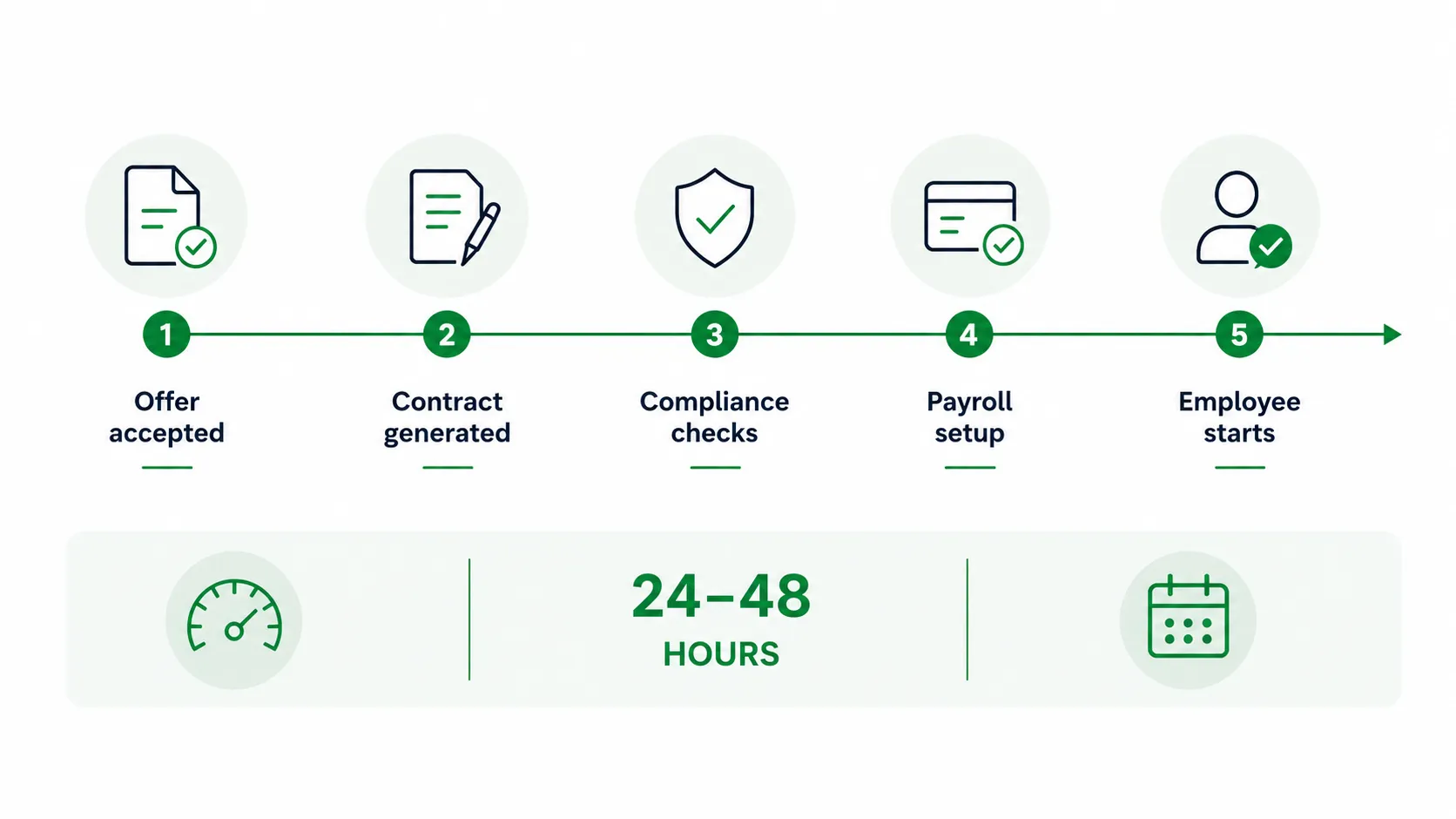
On average, customers save £100k versus setting up a local entity, and the whole process can be completed in as little as 48 hours. It’s no wonder companies are choosing EOR as the solution when they are looking to expand internationally.
With Emerald, it’s not just the entity costs where we drive major savings:
- Negotiated terminations, as standard. Emerald’s team negotiates exits on your behalf rather than paying out whatever a departing employee claims and invoicing you after. That protects you from the single biggest hidden cost in the table below: an uncontrolled termination payout.
- One month’s deposit, always. No matter how senior the hire, you’re never asked for two, three, or six months upfront the way some providers require for management-level employees.
- Faster talent placement. Use Emerald’s talent acquisition team to hire as well as employ, and placements land in four to six weeks, versus an industry average of twelve. That means boots on the ground in a third of the time, without running a separate hiring process alongside your EOR.
- Combined discount. Take both EOR and talent acquisition together, and the combined fee is discounted further, so the more of your hiring you run through Emerald, the more you save.
What to watch out for with other EOR providers
Most of the costs with other EOR platforms are invisible until you are three months in. Here is where they tend to surface, how it hits you, and how it impacts your budget. If the table below fills you with dread, talk to us: one fee, no hidden costs.
| Hidden cost | Typical charge | Cost impact |
|---|---|---|
| Onboarding / offboarding fees | £500–£1,000 per hire, charged again on exit. | Standard across the industry, but rarely front and centre in the sales conversation. Every hire and every exit costs more than the monthly rate suggested. |
| FX / currency conversion margin | Rarely itemised. One provider has disclosed FX fees equivalent to roughly 30% of a $700m revenue base. | Invisible on the invoice, but it scales with every payroll run across every employee, without you ever seeing it as a line item. |
| Benefits and immigration markup | Cost plus an undisclosed margin. | Healthcare, insurance, and work permit costs are sourced at a fixed rate, then marked up before reaching you, with no visibility into the original price. |
| Insurance fees | Billed as a separate line item. | Workers’ compensation, public liability, and similar statutory insurances are layered on top of the core fee rather than included in it. |
| Off-cycle payroll fees | Around £100 per off-cycle change. | Feels small at one employee. Miss the standard cutoff for a bonus or commission run across a growing team and it becomes a recurring, unbudgeted cost. |
| Statutory cost miscalculation | A flat percentage applied regardless of country. | Statutory contributions vary by salary and seniority in most countries. A generic model built for higher-cost markets can quietly overcharge you in a lower-cost one, such as Denmark, without you noticing. |
| Platform access fees | Often around £50 per month. | A fee for the privilege of logging in, separate from the core EOR fee, and it scales as you add employees and admin seats. |
| Long lock-ins and termination clauses | A 12-month commitment, sometimes billed upfront. | Discounted rates are often tied to a minimum headcount you keep paying for even if it drops. Volume deals work the same way: commit to seven EORs, keep paying for seven. |
| Multi-month deposits | 2 to 3 months’ costs, rising to 6 for senior hires. | Typically refundable, but it’s your cash sitting on someone else’s balance sheet, often slow to return when an employee leaves. |
| Annual price escalation clauses | 3 to 15% a year, often compounding. | Tied to CPI, “market conditions,” or provider discretion, usually with no cap and no requirement for your sign-off. |
| Uncontrolled termination and severance | The full amount an employee claims, unnegotiated. | The single largest exposure in this list, and the one with no ceiling. See below for what this looks like in practice. |
What uncontrolled termination actually costs
Uncontrolled severance is the sharpest edge of the hidden-cost problem, and the one buyers most underestimate. Senior salaries commonly run £150,000 to £400,000, so a single unplanned payout is a serious liability, and these stack: multiple exits add up fast against a default 12-month payout. Two real examples: in the UK, an employee with roughly three months’ tenure demanded a full year’s salary on termination; the provider paid it in full and simply invoiced the client, who had no part in the negotiation and no ability to dispute the charge. In Italy, a client was invoiced for a severance payment they had never agreed to, after the provider made no attempt to negotiate and paid the employee’s claim outright.
Modelled across a growing team, with severance calculated at 12 months’ salary per termination, the exposure compounds fast, and uncontrolled severance alone accounts for roughly three-quarters of it at every size:
| Team size | Terminations modelled | Total exposure |
|---|---|---|
| 5 employees | 1 termination | £79,950 |
| 10 employees | 2 terminations | £159,300 |
| 15 employees | 3 terminations | £238,650 |
Illustrative figures based on stated assumptions (severance modelled at 12 months’ salary per termination, plus the other hidden costs in the table above). Not a quote or a prediction of your actual costs. Long lock-in costs are excluded, since they are conditional on reducing headcount mid-term.
Two more costs compound quietly and don’t show up as a monthly invoice line, so they’re easy to miss entirely: a 5% annual escalation clause turns a £72,000 contract into £79,380 by year three, around £11,000 in creeping cost with no renegotiation. And a multi-month deposit ties up real capital: on a 10-employee team at £6,000 per employee per month, a 3-month deposit is £180,000 and a 6-month deposit is £360,000. It’s usually refundable, but it’s capital you can’t use while it sits on someone else’s balance sheet.
Direct employment vs partner networks: why it matters
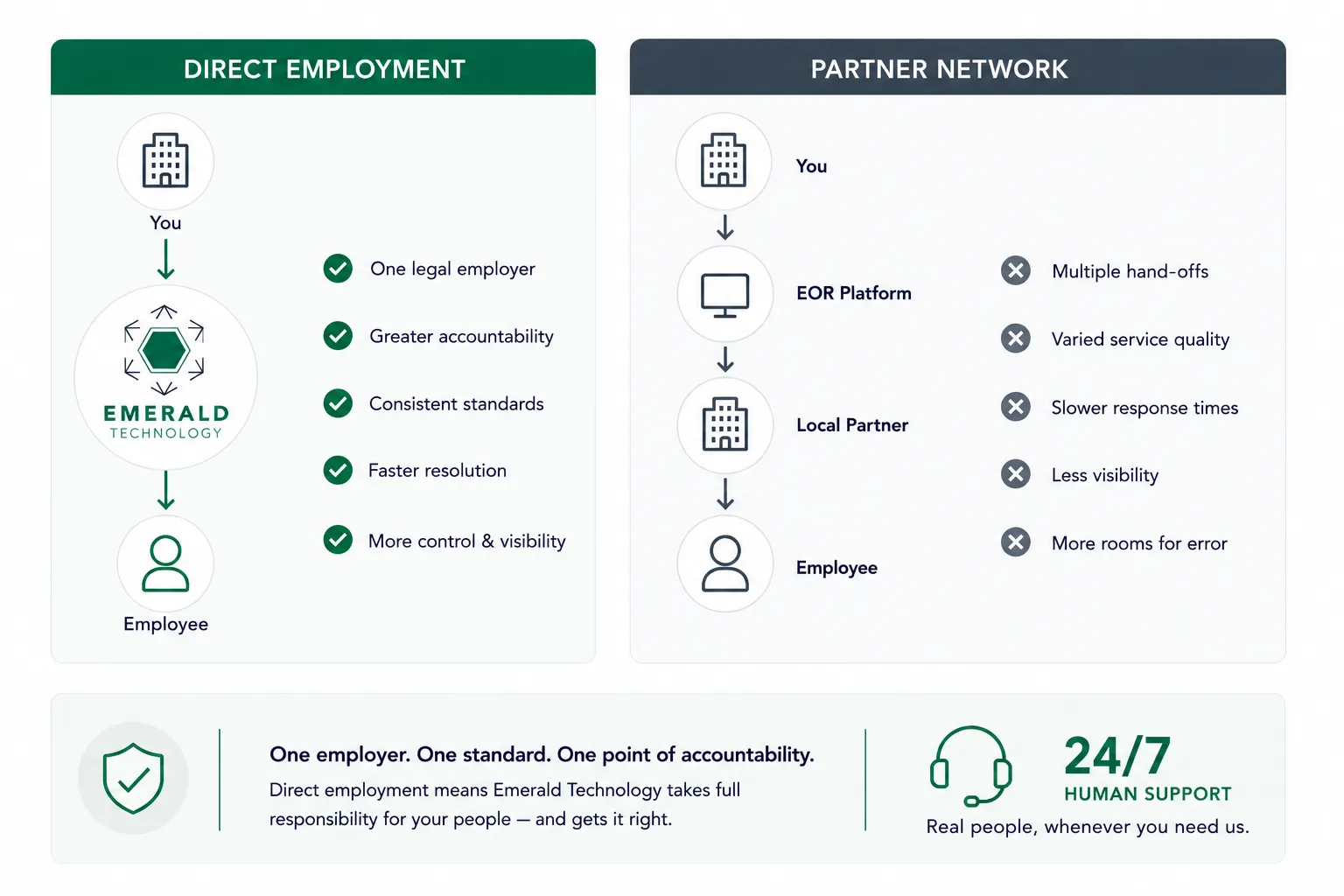
This is the check most buyers skip, and it is the one with the biggest downside if it goes wrong. Some EOR platforms employ your staff directly through their own local entities. Others operate through a network of third-party partners in countries where they do not have their own presence. The platform is the interface, but a separate local company is the actual legal employer.
The difference matters for three reasons:
- Accountability. If a provider employs directly, there is one company responsible for getting a termination, a contract, or a tax filing right. Through a partner, responsibility is split, and disputes take longer to resolve.
- Speed. Partner handoffs add a step to onboarding and offboarding. A direct employer can move a contract through its own systems; a partner relationship depends on a second company’s processes and response times.
- Compliance consistency. A platform that operates directly can enforce the same standard of legal review across every country. A patchwork of partners is only as reliable as the weakest partner in the network.
Ask any shortlisted provider a direct question: in the specific countries you are hiring in, do they employ people themselves, or through a partner? If the answer is vague, treat that as the answer.
Onboarding speed: what separates fast platforms from slow ones
Onboarding speed is not just a nice-to-have metric. It is often the reason the EOR conversation started in the first place. A commercial team that is about to lose a deal because they cannot get someone in-market, or a founder trying to convert a candidate before a competitor does, needs a platform that turns a signed offer into a compliant, live contract in days, not weeks.
The best platforms compress this by building compliance checks into the onboarding form itself, rather than relying on a lawyer to review each contract after submission. A platform that automatically applies the correct minimum notice period, probation length, and statutory contribution rate for the country you are hiring in, and simply will not let you submit a non-compliant contract, removes an entire review cycle from the process.
Global payroll and international compliance: what good looks like
Global payroll is where cost transparency and compliance intersect. A platform worth using should give you, at minimum:
- A monthly cost breakdown per country, per employee, and per cost category: salary, benefits, service fee, statutory costs, and anything else on the invoice
- Automatic enforcement of local employment law minimums during onboarding, so a non-compliant contract cannot be submitted in the first place
- A single source of truth that syncs to your existing HR system, rather than a second dataset you have to reconcile by hand
International compliance failures, such as misclassifying an employee, missing a statutory contribution, or getting a termination notice period wrong, are rarely caught until an audit, a dispute, or an unhappy employee raises it. The strength of an EOR platform is measured by how much of that risk it removes automatically, rather than how well its support team responds after the fact.
How Emerald Technology’s platform handles these checks
Emerald Technology acts as your Employer of Record across 160+ countries, giving you one accountable team from contract to payroll for every employee on the platform.
On compliance, the onboarding form surfaces the correct legal minimums for the employment country automatically: notice periods, probation length, statutory contributions, and blocks non-compliant inputs before the contract is generated. Background checks run through an integrated Veremark toggle inside the same form, rather than a separate vendor process.
On support, Emerald provides white-glove, human-centred service throughout, rather than the infrastructure-only model where the platform processes payroll and leaves you to resolve compliance questions, disputes, or edge cases on your own.
Questions to ask before you choose an Employer of Record platform
- What does total cost of employment look like in the specific countries we are hiring in, broken down by category?
- Do you employ staff directly, or through local partners, in those countries?
- How long does it take from a signed offer to a compliant, live contract?
- What happens automatically if we try to set a term that does not meet local legal minimums?
- Can we see a live cost breakdown that matches our monthly invoice?
- Are there separate onboarding, offboarding, FX, or platform access fees on top of the monthly rate?
- Does the contract include an annual price escalation clause, and is there a cap?
- What deposit do you require, and does it change based on seniority?
A provider that answers all of these without hesitation has probably built the compliance and cost transparency into the platform itself, rather than into the sales process.
Explore the EOR solution
If you are comparing Employer of Record platforms for a tech firm hiring overseas, the detail is in the platform, not the pitch. Explore Emerald’s Employer of Record solution to see how compliance enforcement and cost transparency work together, or read how EOR compares to setting up a local entity if you are still weighing up the two models.
Talk to a global expansion specialist to walk through the true cost of hiring in your target markets before you choose a provider.
Related reading:
- EOR vs local entity: which is better for your tech business
- Exploring EOR operating models for global expansion
- EOR compliance regulations: everything you need to know
- Payroll breakdown: wages and taxes explained
- How to switch Employer of Record providers without disruption
- United Kingdom hiring guide
- Emerald Technology pricing