Quick summary
Most UK tech startups and scale-ups do not delay international hiring because the opportunity is not real: a candidate is ready, a board-approved headcount plan already exists, a client win depends on someone being in-market. The delay comes from seven specific, recurring blockers: a mix of practical assumptions, financial hesitation, and compliance uncertainty that stall the decision before anyone evaluates a single Employer of Record (EOR) platform. This guide walks through each one, and what closes the gap.
| # | Reason for delay | Category |
|---|---|---|
| 1 | Assuming a local entity has to come first | Practical |
| 2 | The monthly fee looks like an unjustified markup | Financial |
| 3 | Nobody’s confident who carries the legal liability | Compliance |
| 4 | Employer of Record, Professional Employer Organisation (PEO), and contractor models look interchangeable | Practical |
| 5 | Onboarding is assumed to take months | Practical |
| 6 | One overseas hire doesn’t feel worth a new vendor relationship | Financial |
| 7 | Comparing providers takes longer than anyone has patience for | Practical |
Why UK tech startups delay Employer of Record platforms
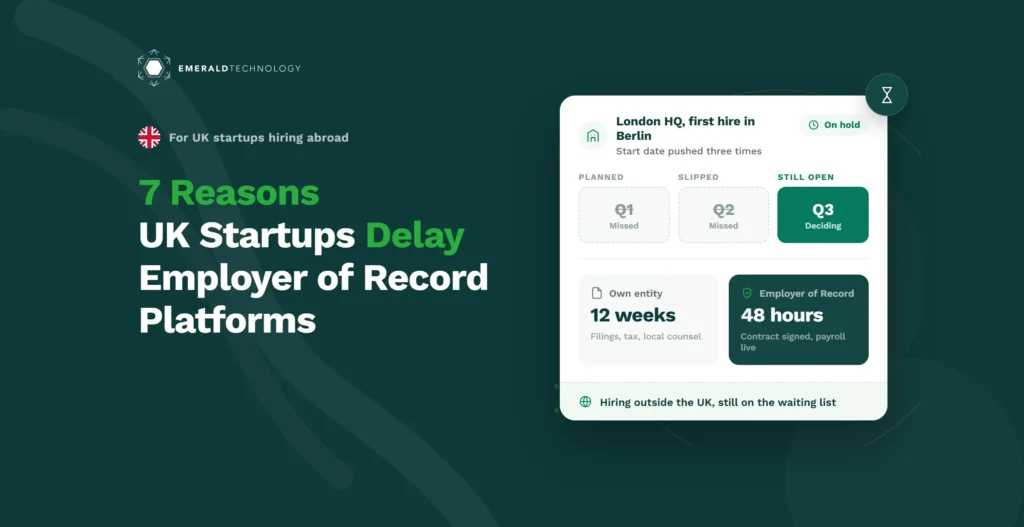
International hiring rarely starts as a strategic project. It starts as a specific, time-pressured problem: a strong candidate is based in a country where you have no legal entity, or a board-approved plan for global workforce expansion has no operational path to execute it. At that point, the realistic paths forward are to set up a local entity, which typically runs 12 to 20-plus weeks and well over £100,000 before a single person starts, or to use an Employer of Record platform, where the provider becomes the legal employer in that country and you keep day-to-day management of the employee. A contractor arrangement can look like a third shortcut, but it carries real misclassification risk if the role is really employee-shaped, which reason 4 below covers.
Using an Employer of Record is faster and cheaper on paper than standing up an entity. The delay happens anyway, because the decision gets stuck on one of seven specific points below, not because the underlying case for overseas employee hiring is weak.
This is also where Emerald’s Employer of Record solution fits in. It’s built specifically to remove the seven blockers below at the source, not to patch them over once a decision has already stalled.
Why trust us?
Emerald has placed technology talent for 25 years and has run Employer of Record and payroll for 500-plus organisations across 150-plus countries, issuing compliant contracts within 48 hours and saving clients £100,000-plus per market against the cost of standing up their own entity. Qualtrics is a good example of what that looks like in practice: the company grew from a single UK-based salesperson to a top-five global billing team, up 300% year on year, without ever opening a local entity to do it. We built the platform around the friction that actually stalls a hiring decision: entity setup, compliance liability, and cost visibility. These are the same three areas our own clients raise before they sign.
“Outstanding experience from start to finish” ⭐⭐⭐⭐⭐ 5.0/5
Anand G., Technical Manager, Small-Business (≤50 employees), 11 November 2025, via G2
“I have been working with Emerald for the past two and a half years. They are always very responsive and address any concerns I raise quickly.”
The 7 reasons UK startups delay Employer of Record adoption
1. Assuming a local entity has to come first
The most common blocker is not financial or legal. It is a straightforward misunderstanding of the category. Founders and HR leads who have not evaluated EOR before often assume that hiring in a new country means registering a company there first, then figuring out payroll and compliance afterwards. That assumption alone is enough to shelve a hire that would otherwise take weeks, because entity setup timelines feel incompatible with a live candidate or a live client deadline.
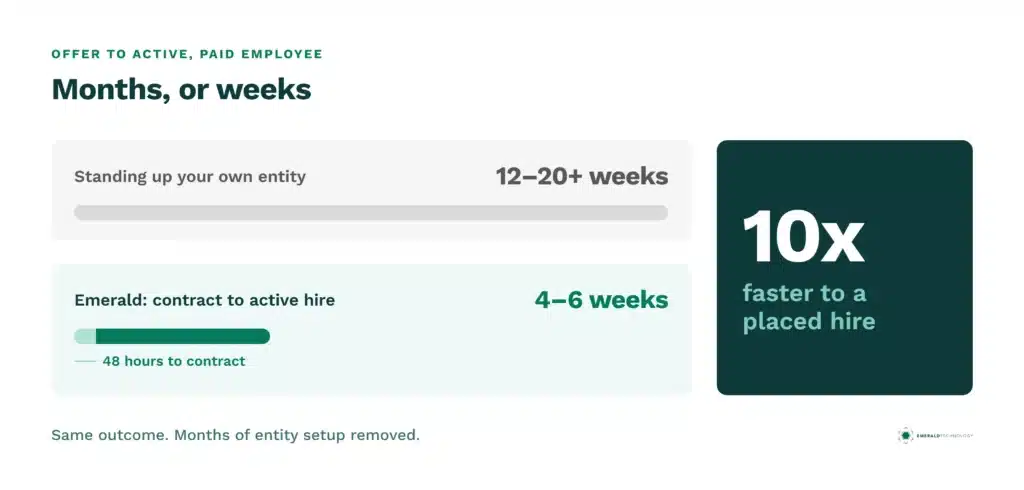
How Emerald closes this gap: You don’t need a legal entity to hire somewhere new. Emerald is the legal employer in 150-plus countries, handling local law, tax, and contracts as part of the service, so the entity-first assumption simply doesn’t apply. The time difference makes the case on its own: standing up a legal entity typically runs 12 to 20-plus weeks before a single person starts, while Emerald issues a compliant contract within 48 hours and places a specialist hire in four to six weeks, roughly 10 times faster to employed headcount in a new market. Read more in Emerald’s EOR vs local entity guide.
2. The monthly fee looks like an unjustified markup
Once you get past the entity question, the next blocker is usually financial. A per-employee monthly fee, viewed in isolation, looks like a markup on top of a direct hire’s salary, and a finance leader asked to sign off on that fee without a full comparison will often push back or park the decision. Cheaper-looking platforms can hide the real cost elsewhere: internal team hours, compliance errors, contract rework, and candidate dropout rarely show up on the pricing page.
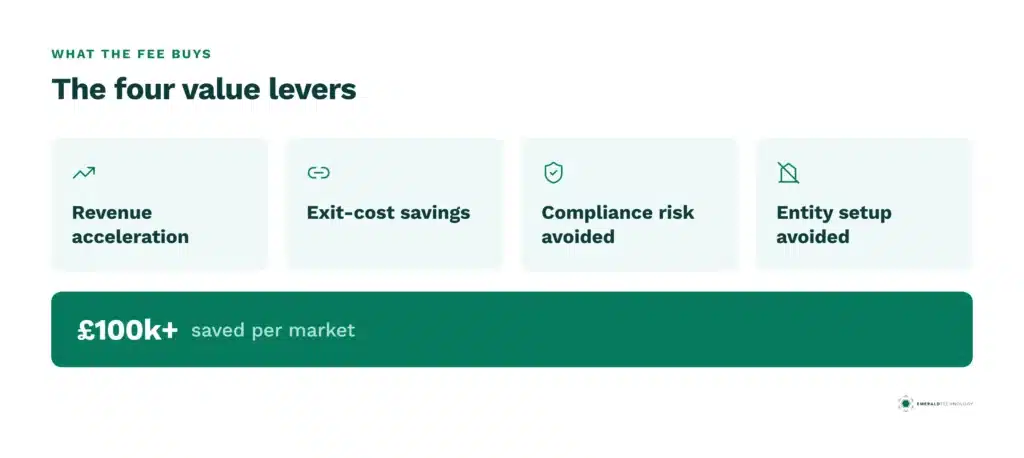
How Emerald closes this gap: Emerald’s return shows up across four value levers: revenue acceleration, exit-cost savings, compliance risk avoided, and entity setup avoided. That includes £100,000-plus saved per market on entity costs alone, with no hidden fees on top: the price you’re quoted is the price you pay. Fingerprint Cards used Emerald to cut administrative costs and simplify its structure without shifting that complexity somewhere else. For a finance leader who needs the comparison in writing rather than taking it on faith, Emerald’s EOR Business Case Tool models the full cost of EOR against standing up an entity using your own numbers.
3. Nobody’s confident who carries the legal liability
International hiring rarely gets far without someone in the room asking who is exposed if something goes wrong: a termination handled incorrectly, a tax filing missed, a worker misclassified. If the answer is not clear and documented, legal or a cautious founder will hold the decision rather than proceed on an assumption.
How Emerald closes this gap: As the legal employer, Emerald owns payroll, tax, contracts, and termination compliance in every country it operates in, and tracks every change in local employment law so your team doesn’t have to. Human Security hired across 11 countries through Emerald with zero compliance remediation required afterwards: no back-pay, no re-filing, no fixing contracts after the fact.
4. Employer of Record, PEO, and contractor models look interchangeable
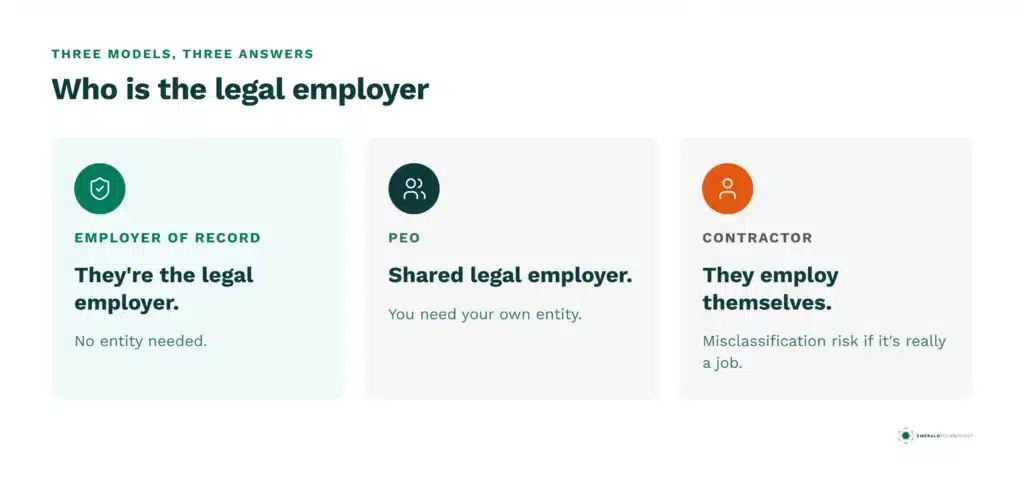
“EOR” gets used loosely, and teams that have not evaluated the category closely often cannot articulate the difference between an Employer of Record, a Professional Employer Organisation (PEO), and simply engaging someone as an independent contractor. That confusion is not harmless. It is usually what pushes a startup toward the contractor route by default, because it looks like the fastest option, when the working relationship is really employee-shaped and carries real misclassification risk.
How Emerald closes this gap: Because Emerald is the direct legal employer rather than a co-employer or a contractor arrangement, the platform’s onboarding form starts by capturing the employment country, then automatically surfaces the correct legal framework for that country (minimum notice periods, probation length, mandatory contributions) and blocks non-compliant entries at the point of data entry. The model is enforced in the workflow, not left for you to work out afterwards.
5. Onboarding is assumed to take months
Teams that associate international hiring with entity setup timelines carry that same expectation into EOR, and assume onboarding will be a similarly slow, document-heavy process. That expectation alone causes some startups to delay starting the process at all, even after deciding EOR is the right route, because nobody wants to open a multi-month project for one hire.
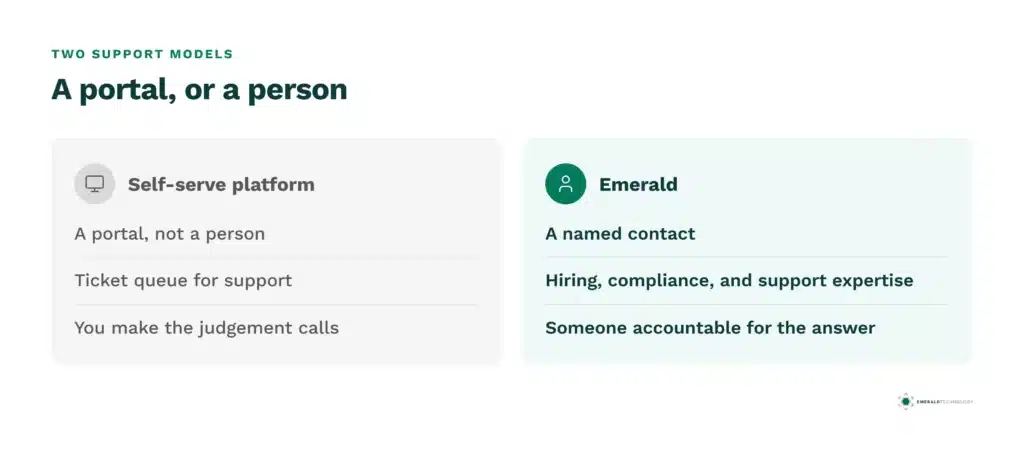
How Emerald closes this gap: Emerald issues compliant contracts within 48 hours and places specialist hires in four to six weeks, roughly 10 times faster than standing up a legal entity. Sciforma had a Denmark-based hire employed within 24 hours of starting through Emerald’s EOR solution. Onboarding itself runs as a five-step form with progress auto-saved as a draft, background checks running in parallel rather than as a separate manual step, and contracts generated and signed through DocuSign with white-glove onboarding from a named contact, not a self-serve portal you’re left to figure out alone.
6. One overseas hire doesn’t feel worth a new vendor relationship
Startups testing a single market with a single hire often talk themselves out of EOR on the basis that standing up a new vendor relationship is disproportionate to one person’s employment. A self-serve EOR platform can look like the lower-friction option here too: sign up, add the employee, no relationship to manage. This is usually a framing problem rather than a real cost problem: the alternative to “one small vendor relationship” is not “nothing.” It is either a contractor misclassification risk, a full entity setup for one employee, or a self-serve tool that leaves you making the compliance judgment calls yourself the first time something doesn’t fit the standard flow.
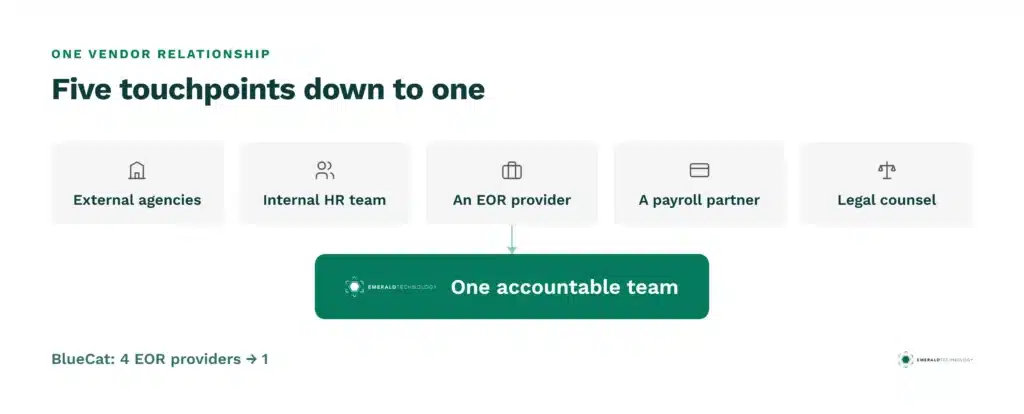
How Emerald closes this gap: EOR is commonly used specifically to validate a new market with one to three hires before committing capital to a local entity, and Emerald is built to be that one relationship rather than another vendor to add to a growing list, or a self-serve tool you’re left running alone. Talent acquisition, Employer of Record, and payroll sit under one accountable team, removing up to five separate touchpoints (external agencies, your own internal HR team, an EOR provider, a payroll partner, and legal counsel) down to one, with a named contact behind it rather than a portal you’re expected to figure out by yourself. BlueCat consolidated its EOR providers from four down to one when it moved to Emerald, and is now scaling to 12 times as many hires through that single relationship.
7. Comparing providers takes longer than anyone has patience for
The Employer of Record market is crowded, and a founder or HR lead who starts researching providers is quickly faced with long comparison guides, inconsistent country coverage claims, and pricing that is rarely published up front. Faced with that research burden on top of an already time-pressured hiring decision, some teams simply defer the whole project rather than work through it.
How Emerald closes this gap: Emerald publishes its pricing tiers directly rather than gating them behind a sales call, so there’s less manual comparison work needed before you can move. Where other providers hand you a portal and step back, Emerald pairs the platform with a named account team and subject-matter experts at the three points automated platforms consistently fall down (hiring, compliance, and support), so the evaluation itself takes less digging to get a straight answer.
The cost of staying stuck
Every one of the seven reasons above is a reasonable thing to want clarity on. None of them is a reason to lose the hire. A candidate with options will take the offer that materialises fastest, and a board-approved plan for global workforce expansion that never moves past the entity question is not a cautious decision. It is a stalled one. Getting from “we should hire in [country]” to a signed, compliant offer takes four to six weeks with the right partner, not months of research: working through the seven points above with real numbers and a documented liability answer is what closes that gap.
If a specific market is already on your roadmap, the hiring guide for the United States and hiring guide for Germany go deeper on what compliant hiring looks like there.
And once you’re ready to evaluate providers directly, 10 questions to ask before choosing EOR software covers exactly what separates a platform built to scale from one that just looks the part on a sales call.
Frequently asked questions
What is an Employer of Record (EOR)?
An Employer of Record is a company that becomes the legal employer of a worker in a country where the client business has no legal entity. The EOR carries the compliance and liability for that employment, while the client directs the employee’s day-to-day work.
Is EOR more expensive than hiring directly?
The monthly fee looks higher than a direct salary line on its own. The full comparison is EOR cost against entity setup, local legal fees, and the hidden costs many providers don’t disclose upfront: onboarding fees, foreign exchange (FX) margins, benefits markups, and multi-month deposits among them. Read the full breakdown in the Hidden Costs of EOR Platforms guide.
How do I build an internal business case for EOR?
Model it against your own numbers rather than taking a vendor’s word for it. Emerald’s EOR Business Case Tool calculates total cost across four levers (revenue acceleration, exit-cost savings, compliance risk avoided, and entity setup avoided), so you have a case your own finance team can sign off on. Try the EOR Business Case Tool.
Can a UK startup use an EOR to make just one overseas hire?
Yes. Using an EOR to validate a new market with one to three hires before deciding whether to set up a local entity is one of the most common use cases for the category.
Who is legally liable if something goes wrong with an EOR-employed worker?
This depends on the individual provider’s contract terms, so it is worth confirming in writing before signing. As the legal employer, Emerald owns payroll, tax, contracts, and termination compliance in every country it operates in, and tracks every change in local employment law so your team doesn’t have to.
How long does Employer of Record onboarding actually take?
With Emerald, compliant contracts are issued within 48 hours and specialist hires are placed in four to six weeks, roughly 10 times faster than the 12 to 20-plus weeks it typically takes to stand up a legal entity. Ask any provider you’re evaluating for their actual turnaround rather than assuming a timeline based on entity setup speed.
Who has Emerald actually done this for?
Start with independent proof: G2 reviews are third-party and low-friction. Once you’re seriously comparing options, named case studies are matched to a similar company profile where possible: BlueCat (consolidated four EOR providers down to one and is scaling to 12 times as many hires), Netcracker (switched across 13 countries with zero disruption), Human Security (11 countries, zero compliance remediation), and Qualtrics (grew from one UK salesperson to a top-five global billing team). Browse the full case studies page for more. Reference calls with existing customers are available once you’re down to a shortlist and ready to move.
Ready to stop delaying?
If one of the seven reasons above is the thing holding up an international hire, the fastest way past it is a direct conversation, not another comparison guide. Talk to Emerald about your next international hire and get a straight answer on cost, liability, and timeline for the specific country you’re hiring in. Prefer to run the numbers yourself first? The EOR Business Case Tool models the full cost against standing up an entity, using your own figures.