Published on 20 August 2026
Quick Summary
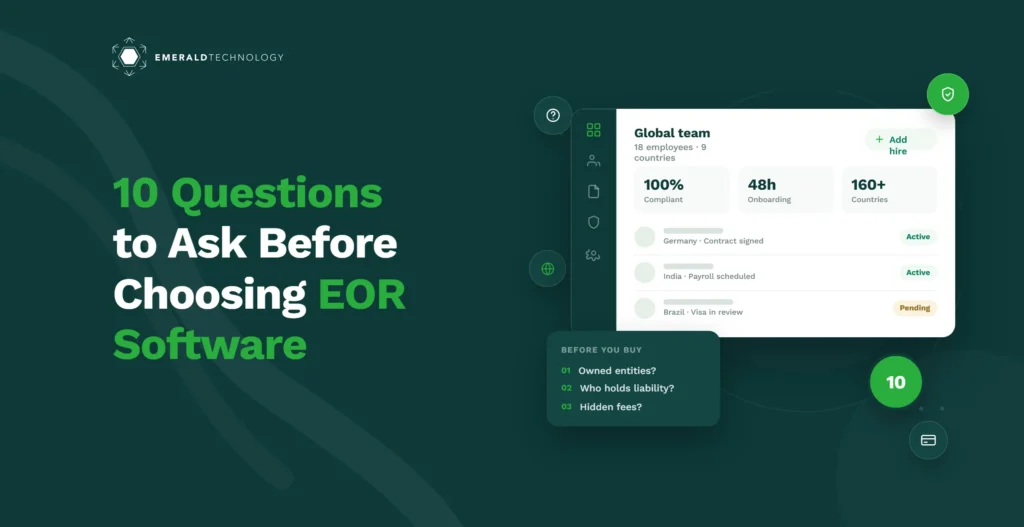
Picking employer of record software is a decision your legal, finance, and HR teams all have to live with — get it wrong and you inherit compliance risk, hidden costs, and a platform your team routes around instead of relying on. This guide breaks the decision into the 10 questions that actually separate a platform built for scaling tech companies from one that just looks the part on a sales call, based on what we see startup and scale-up hiring leaders get wrong most often when evaluating international hiring compliance and remote team management tools.
Use this as your evaluation checklist:
| # | Question | Why it matters |
|---|---|---|
| 1 | Who actually carries the employer liability? | Determines who’s exposed if something goes wrong in-country |
| 2 | How many countries do they cover, and how transparent is that coverage? | Coverage gaps — or coverage you don’t fully understand — force you back to entity setup or a second vendor |
| 3 | How fast can they turn an offer into an active, paid employee? | Slow onboarding costs you the candidate and the deal it was tied to |
| 4 | Is the pricing genuinely all-in? | Hidden fees erode the cost case your CFO signed off on |
| 5 | Does the platform enforce local employment law automatically? | Manual compliance checking doesn’t scale past your first few markets |
| 6 | What happens when an employment relationship ends? | Offboarding done badly is where compliance risk and cost surprises concentrate |
| 7 | Does it integrate with your existing HR and finance stack? | A platform that doesn’t sync becomes a second source of truth |
| 8 | Is support a named team or a ticket queue? | Automated-only platforms fall down on exactly the moments that matter |
| 9 | How is employee data handled? | Cross-border employee data comes with real privacy obligations, not just IT hygiene |
| 10 | Will it still fit at your next funding stage? | Re-platforming mid-scale costs more than picking right the first time |
First, Make Sure You’re Evaluating the Right Category
“EOR” gets used loosely, and it’s worth 30 seconds of clarity before you evaluate anything, because the three models solve different problems:
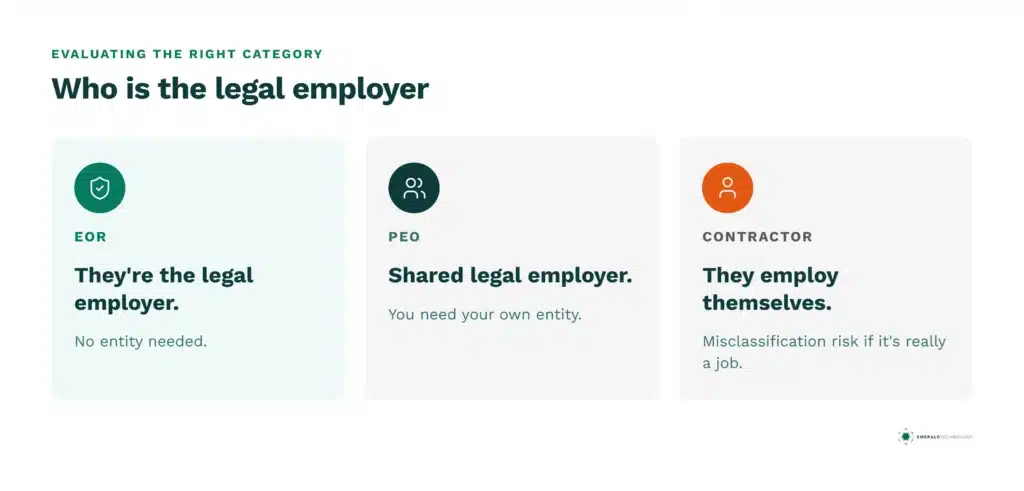
If you already have an entity in the country you’re hiring in, you likely need a PEO, not an EOR. If the relationship looks like a full-time job in every way except the paperwork, a contractor model is a compliance risk, not a shortcut. The 10 questions below assume you’ve landed on EOR because you’re hiring somewhere you don’t have an entity — which is the situation most startup and SaaS hiring leaders are actually in when they start this search.
Why International Hiring Breaks Down Without the Right Platform
Most startup and SaaS leaders don’t go looking for employer of record software because they’re curious about global hiring — they go looking because a specific hire is stuck. A candidate in a country where you have no legal entity. A board-approved international headcount plan with no operational path to execute it. A finance team that’s just realised entity setup takes months and tens of thousands of pounds before a single person starts. The gap isn’t awareness of EOR as a category — it’s knowing which platform actually closes that gap versus which one just adds a fourth vendor to a process that already has too many.
That’s where the evaluation usually goes wrong. Teams compare EOR software the same way they’d compare a payroll tool — by feature list and price per seat — when the real differentiators sit underneath: who carries legal liability, how the platform behaves the first time a termination doesn’t go to plan, what actually happens to your employee data once it crosses a border. Employment compliance, remote team management, and workforce expansion all live or die on details a demo rarely surfaces.
The 10 questions below are built around exactly those details — not generic RFP boilerplate, but the specific things that separate EOR software that scales with a growing SaaS or tech company from a platform you’ll be re-evaluating again in 12 months.
Why Trust Us?
We’re Emerald Technology — a go-to-market specialist recruitment and Employer of Record business that’s placed technology talent since 2000, and we built our EOR platform specifically for venture- and PE-backed companies scaling from Seed through Series E. We sit on both sides of this problem: we recruit the talent and we employ it, so the questions below are the ones our own clients ask us during procurement, not a theoretical checklist.
“Effortless Hiring in APAC with Emerald Technology”
⭐⭐⭐⭐ 4.5/5Zane L. — Mid-Market (51–1,000 employees) — November 18, 2025, via G2
“I like the fact that Emerald Technology provides prompt assistance whenever we need it. This level of support is crucial for our operations, especially as we use their EOR service to hire employees in the APAC region without needing to establish a business entity there. Additionally, I found the initial setup of Emerald Technology to be very easy, which made the process of getting started with their services smooth and hassle-free.”
1. Who Carries the Employer Liability?
Every EOR platform will tell you it handles compliance. Far fewer will tell you, in writing, who’s exposed if a termination, a tax filing, or a worker classification call goes wrong in a country you don’t have local expertise in. This is the single most important question on this list, and it’s the one legal and compliance leaders push hardest on once they’re brought into the buying process — usually late, and usually as a near-blocker if the answer is vague.
Ask for the specific indemnification language, not a summary of it. A platform that’s confident in its compliance model will show you the contract clause; one that isn’t will point you back to a FAQ page. It’s also worth asking how long the provider has actually been operating — indemnification is only as strong as the company standing behind it.
What good looks like: the provider is the named legal employer in-country, carries full employer liability and indemnification, and can point to a specific clause rather than marketing copy. Emerald’s model, for reference: we’re the legal employer across 150+ countries and the liability sits with us — not your legal team — backed by audit-ready employment records and a track record of supporting 500+ organisations since 2000.
Red flag: any answer that starts with “it depends” or routes you to a local law firm you’d need to engage separately.
2. How Many Countries Do They Cover, and How Transparent Is That Coverage?
Country count is the headline number every EOR vendor leads with, and it’s also the easiest number to misread. Some providers own a legal entity in every market they list; others work through local partners in some countries and directly in others. Both models can work well — plenty of well-run EOR platforms, including ours, use a mix of owned entities and vetted local partners depending on the market. The actual risk isn’t which model a provider uses; it’s discovering after you’re live that you didn’t know which one you had.
Ask directly, market by market, for the countries you’re actually hiring in: are you the direct employer here, or do you work with a partner? And if it’s the latter — does liability, response time, and account ownership stay the same, or does it change? A provider that answers this plainly, for the specific markets you asked about, has done the underlying work; one that gets vague or defensive is asking you to take coverage on faith.
What good looks like: clear, market-by-market transparency about who’s the direct employer versus where a partner is involved, with a straight answer on how liability and service levels hold up either way. Emerald covers 150+ countries through a mix of owned entities and vetted partners, and the same liability commitment and named account team sit behind a hire regardless of which structure applies in that market — the relationship with you doesn’t change.
Red flag: a provider that won’t specify which of your target markets are owned versus partner-supported, or implies the distinction “doesn’t matter” without explaining why.
3. How Fast Can They Turn an Offer Into an Active, Paid Employee?
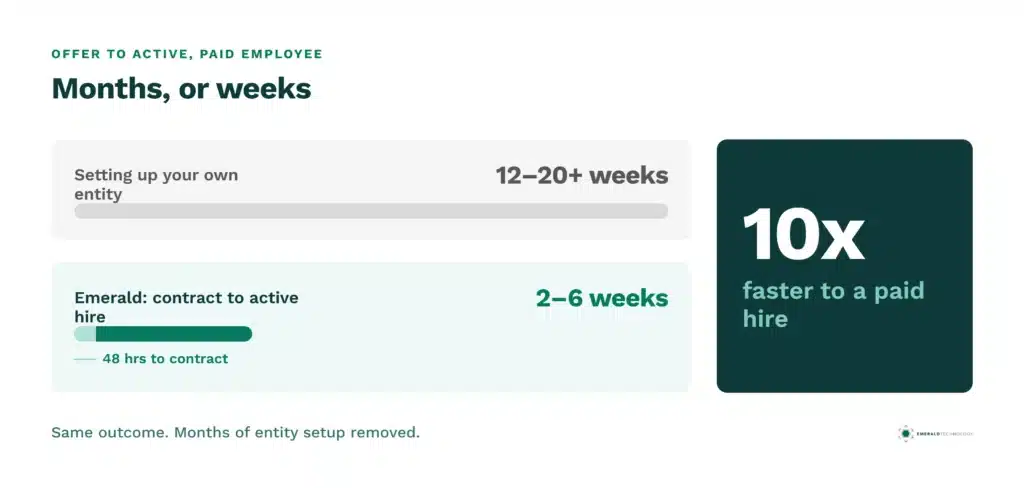
Speed to headcount is where international hiring most often loses deals and candidates. Standing up a legal entity to hire abroad typically runs 12 to 20+ weeks. If your EOR platform’s onboarding pipeline isn’t dramatically faster than that, you haven’t solved the problem you came here to solve — you’ve just moved the delay.
Ask for real numbers: average contract turnaround, and average time from signed onboarding form to the employee’s first day. Walk through what happens at each step — background checks, document collection, contract generation — and where the bottlenecks typically sit.
What good looks like: contract turnaround measured in days, not weeks, and a visible, trackable onboarding pipeline rather than a black box. Emerald issues compliant contracts within 48 hours and places specialist hires in 2–6 weeks — roughly 10x faster than standing up a local entity — with every step of onboarding tracked against status in the platform.
Red flag: a provider that can’t give you a specific turnaround number, or whose stated timeline doesn’t account for background checks and document collection at all.
4. Is the Pricing Genuinely All-In?
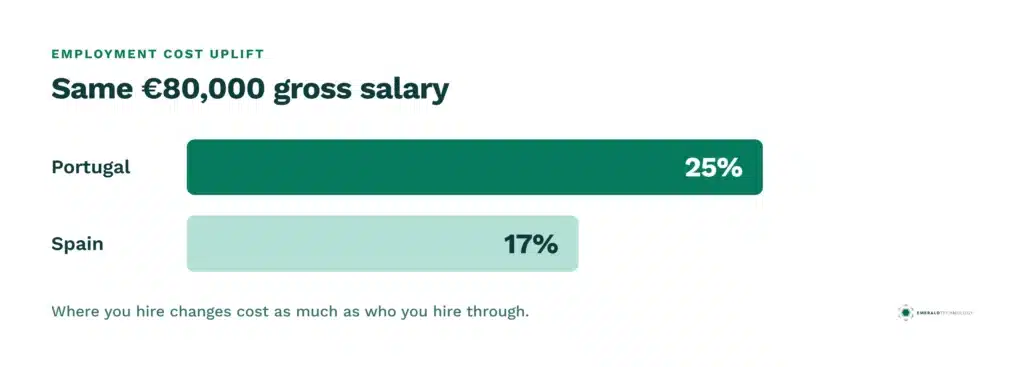
This is the question finance leaders care about most, and it’s usually where EOR software disappoints after the contract is signed. The headline monthly fee per employee is rarely the full story — local statutory contributions, benefits administration, FX handling, and “premium support” add-ons can all sit outside the quoted price. And because where you hire changes the cost as much as who you hire through, pricing transparency and cost modelling are really the same question.
Ask for a full sample invoice, not a pricing page. Ask specifically what’s included versus billed separately, how FX is handled on international payroll disbursements, and whether you can model the total employment cost of a role in a specific country before you commit to hiring there.
What good looks like: transparent, published pricing tiers with a clear breakdown of what’s included, plus a way to see the real cost before you decide where to base a hire. Emerald publishes three tiers — Entry, Growth, and Enterprise — with the platform recommending the right one based on your organisation size, a monthly cost breakdown (salary, local employment costs, benefits, service fee, expenses) designed to reconcile line-for-line against your invoice, and a built-in employer cost calculator. As a concrete example: for an identical €80,000 gross salary, Portugal carries roughly a 25% employment cost uplift versus Spain’s 17% — a difference worth knowing before you decide where to base a role, not after.
Honest limitation to watch for in yourself, not just the vendor: EOR pricing will often look more expensive per head than a direct hire on paper. The real comparison is total cost of employment against entity setup, legal fees, and the compliance risk you’re not pricing in — not the invoice line alone.
5. Does the Platform Enforce Local Employment Law Automatically?
Minimum notice periods, probation length limits, mandatory pension contributions — these vary by country and change over time. A platform that documents these rules in a help centre is doing less than one that actively enforces them at the point of data entry, before a non-compliant contract can be generated.
Ask to see the onboarding flow itself. Specifically: what happens if you try to enter a termination or probation period that’s shorter than the local legal minimum?
What good looks like: the system blocks non-compliant inputs in real time rather than relying on a human to catch the error later. In Emerald’s platform, if you try to set a notice period that’s too short for the employment country, it simply won’t let you continue — the compliance rule is built into the workflow, not left to a checklist.
Red flag: a platform that lets you enter anything and relies on a compliance team to review it after the fact, rather than preventing the error at the source.
6. What Happens When an Employment Relationship Ends?
Onboarding gets most of the attention in an EOR demo; offboarding is where compliance risk and cost surprises actually concentrate. Notice periods, statutory severance, and termination costs vary by country just as much as hiring rules do — and a provider that’s vague here is telling you something about how the rest of the platform will behave under pressure.
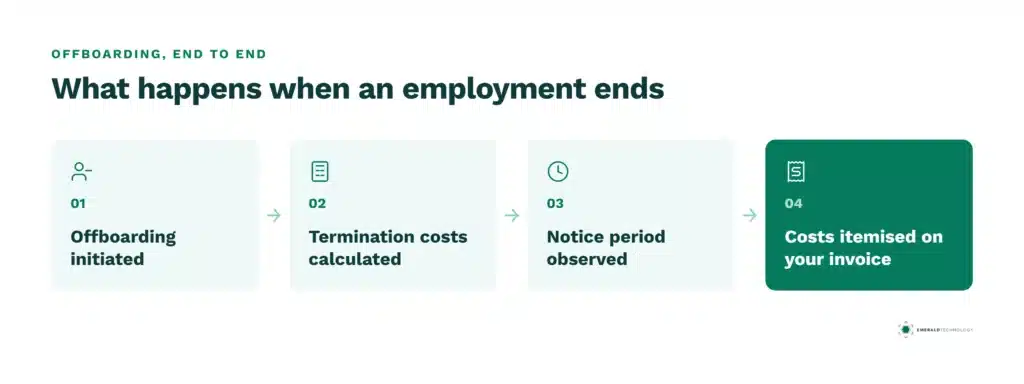
Ask what the offboarding process looks like end to end: who initiates it, how termination costs are calculated and disclosed, and how much of the process is visible to you versus handled as a black box.
What good looks like: a documented, trackable offboarding process with country-specific termination costs disclosed up front, not discovered on the final invoice. Emerald tracks every offboarding request in a dedicated tab, initiated directly from the employee’s profile, and any termination costs that apply under local law are broken out as their own line item in the monthly cost breakdown — visible before it hits your invoice, not after.
Red flag: a provider that can talk in detail about onboarding speed but goes vague the moment you ask about termination costs or process.
7. Does It Integrate With Your Existing Stack?
The whole point of EOR software is to remove a source of manual admin, not add one. If your team ends up maintaining employee data in the EOR platform and separately in your HRIS, you’ve created exactly the “two sources of truth” problem the platform was supposed to solve. The same logic applies to the day-to-day workflows employees actually touch — expenses, benefits, background checks — which is where adoption quietly succeeds or fails regardless of how clean the admin dashboard looks.
Ask what syncs automatically versus what requires manual export/import, and ask to see the actual employee-side experience for submitting an expense report or running a background check, not just the admin view.
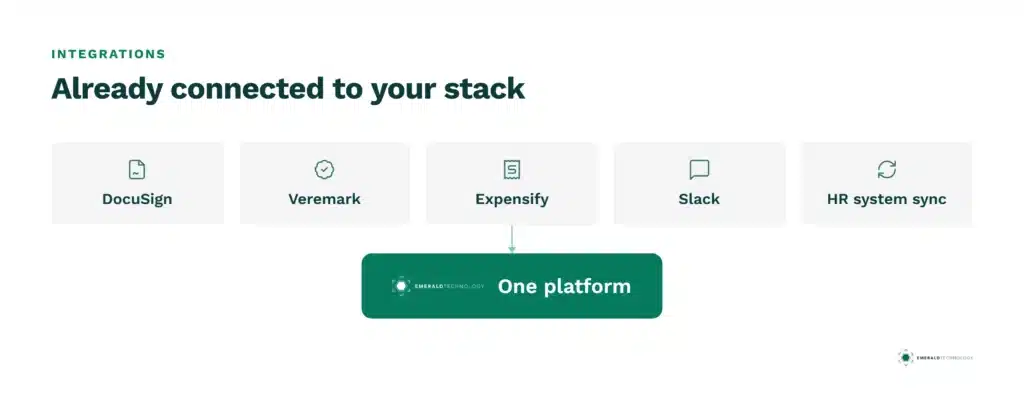
What good looks like: native sync to your HR system so data populates automatically, direct integrations with tools your team already uses, and self-service workflows for the things employees do every week. Emerald syncs to external HR management systems, integrates with Expensify for expense management and DocuSign for e-signature, triggers Veremark background checks with a single toggle during onboarding, and can push notifications into Slack at key onboarding milestones. Employees submit expense line items with receipts against named reports, and managers approve or must give a written reason to decline — so your team isn’t logging into a fifth system, and isn’t fielding process questions employees could self-serve.
Red flag: a platform that requires manual data re-entry into your HRIS, or where “integration” turns out to mean a CSV export.
8. Is Support a Named Team, or a Ticket Queue?
Automated platforms are efficient right up until something needs judgment — a declined expense that needs a written reason, a termination that doesn’t fit the standard template, a country-specific benefits question. That’s precisely where software-only providers fall down, and it’s the difference startup HR leads notice fastest once they’re live on a platform rather than evaluating one.
Ask who you’ll actually be talking to after the contract is signed: a named account contact, or a support ticket routed to whoever’s available.
What good looks like: a dedicated point of contact for your account, not just a self-serve portal. Emerald pairs the platform with a named account team — the platform handles the day-to-day workflow (expense approvals, time off, document signing) while real people are behind the moments that need judgment, not just automation.
Red flag: a sales process where you never get a name — just a generic support email or chatbot — before you’ve signed.
9. How Is Employee Data Handled?
Hiring internationally means your employees’ personal data — bank details, national ID numbers, home addresses — moves across borders and through a third party’s systems. That comes with real privacy obligations, not just IT hygiene, and it’s a specific concern legal and compliance leaders flag when EOR software is reviewed properly rather than rubber-stamped.
Ask how employee data is segregated — can one employee ever see another’s records, or an EOR employee see admin-level data they shouldn’t? Ask what authentication is enforced by default, and ask directly for the provider’s data protection and cross-border transfer documentation rather than assuming GDPR compliance because they operate in Europe.
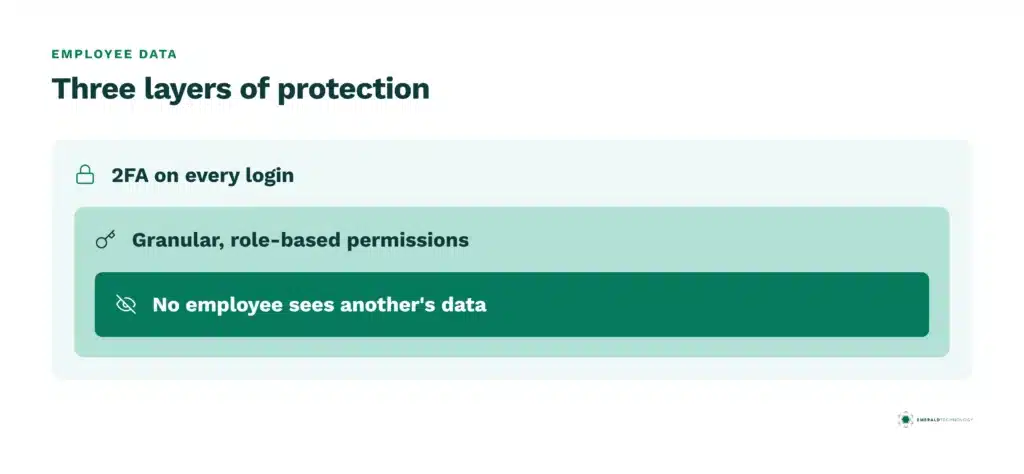
What good looks like: enforced authentication on every account, granular permissions so access is scoped to what a role actually needs, and a straight answer — with documentation — when you ask about data protection compliance. On Emerald’s platform, two-factor authentication is enforced by default on every login for both clients and employees, and access is controlled through granular, category-level permissions rather than blanket admin rights — an EOR employee can only ever see their own data, never another employee’s or the organisation’s admin tools. Ask your account team for the specific data protection documentation relevant to your markets; a provider confident in its practices will have it ready.
Red flag: a vague “yes, we’re compliant” with no documentation offered, or a platform where any admin user can see every employee’s full record by default.
10. Will It Still Fit at Your Next Funding Stage?
The EOR platform that works for a five-person Series A team evaluating its first international hire is not automatically the one that works once you have a full buying committee, a formal budget process, and pre-IPO audit requirements. Re-platforming mid-scale is expensive and disruptive, and so is discovering you’re locked into a plan or contract structure that doesn’t flex as your needs change — it’s worth asking about both now, not once you’ve outgrown the answer.
Ask directly: what does support and reporting look like for a company at 5 employees versus 50 versus 500? Has the provider actually worked with companies at your next stage? And separately — if you need to change plans, add markets, or eventually move a role to your own entity, does that require renegotiating the relationship, or is it handled within it?
What good looks like: a provider with a track record across the stages you’re planning to grow through — Seed through Series E and PE-backed — pricing tiers that scale with you rather than forcing a switch, and flexibility to change plans without a fresh negotiation. Emerald has worked with 500+ organisations from Seed through Series E and PE-backed businesses specifically in technology and SaaS, offers three pricing tiers that can be changed at any time from Settings, and Enterprise-tier features (visa support, a dedicated customer success manager, reference and security checks) are built for exactly the point where audit-readiness starts to matter.
Red flag: a provider that can only speak credibly to one company size, or where changing your plan requires a full contract renegotiation.
Red Flags at a Glance
If you only have time to listen for warning signs on a vendor call, these are the ones worth interrupting the pitch for:
- Liability language that’s vague, verbal, or deferred to “the T&Cs”
- Can’t tell you which of your specific target markets are owned entities versus partner-supported
- No firm number on contract turnaround or time-to-onboard
- Pricing that can’t be shown as a full sample invoice
- Onboarding forms that accept clearly non-compliant inputs (e.g., a notice period below the legal minimum) without warning you
- Goes quiet or vague specifically when you ask about termination costs and offboarding
- “Integration” turns out to mean a manual CSV export
- No named contact before you’ve signed — just a shared inbox or chatbot
- Can’t produce data protection documentation on request, or lets any admin see every employee’s full record
- Only has credible experience at one company size, or locks you into a plan that’s expensive to change
Frequently Asked Questions
What is employer of record software?
Employer of record software is a platform that lets a company legally employ staff in a country where it has no local entity. The EOR provider becomes the legal employer of record — handling contracts, payroll, tax, and statutory compliance — while your company directs the employee’s day-to-day work.
What’s the difference between an EOR and a PEO?
An EOR becomes the legal employer in a country where you don’t have an entity. A PEO enters a co-employment arrangement in a country where you already have your own entity, typically to simplify HR and payroll administration. If you don’t have a local entity yet, you need an EOR, not a PEO.
How is EOR different from using a contractor model?
Contractors work under a different legal and tax classification than employees, and misclassifying an employee as a contractor is one of the more common — and costly — international hiring compliance mistakes. EOR software lets you employ someone properly, with statutory benefits and protections, without needing a local entity.
How long does it typically take to hire someone through an EOR platform?
This varies significantly by provider and country. As a benchmark, setting up a legal entity to hire directly typically takes 12–20+ weeks; EOR platforms built for speed can get a compliant contract issued within 48 hours and a new hire onboarded within 2–6 weeks.
Does EOR software replace our HR system?
It shouldn’t need to. A well-integrated platform syncs employee data to your existing HRIS rather than becoming a second system you maintain manually — that’s one of the questions worth asking directly during evaluation.
Is EOR compliant in every country?
Compliance depends on the individual provider’s coverage and setup in each specific market, not on the EOR model in general — which is exactly why asking about direct-employer versus partner-supported coverage, market by market, matters more than a total country count.
Can we use an EOR to hire just one employee in a new market?
Yes — this is one of the more common use cases. EOR is often used specifically to validate a new market with one to a handful of hires before deciding whether the volume justifies setting up a local entity.
What happens if we eventually want to set up our own entity in a market?
This varies by provider, so it’s worth asking directly during evaluation what the transition looks like — whether employees can be transferred to your new entity cleanly, and whether that requires renegotiating your existing contract or is handled as a natural next step within it.