Quick summary
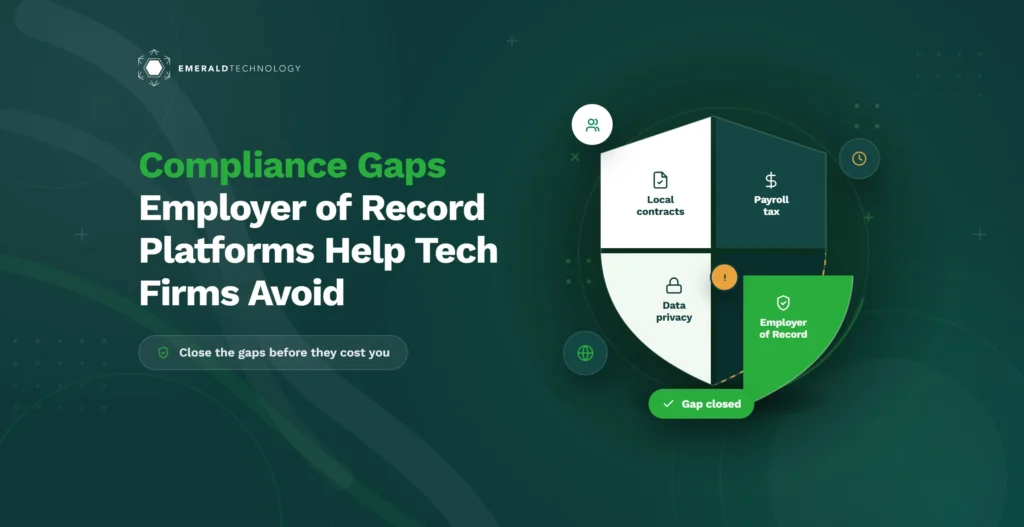
Most mid-market technology companies do not discover an international hiring compliance gap on purpose. It surfaces during a funding round, a security review, or the exact week a fast-growing team realises a contractor in another country has quietly been acting like an employee for the past eight months. This guide sets out the eight compliance gaps that show up most often once a mid-market tech firm is hiring across several countries at once, and how Employer of Record platforms are built to close each one before it turns into back-pay, penalties, or a stalled deal.
| # | Compliance gap | Risk area |
|---|---|---|
| 1 | Worker misclassification turning a good hire into a legal liability | Classification |
| 2 | Employment contracts missing a country’s legal minimums | Contract compliance |
| 3 | Permanent establishment risk building up through ordinary remote work | Cross-border exposure |
| 4 | Payroll and statutory contribution miscalculations across markets | Payroll & tax |
| 5 | Termination and severance costs nobody negotiated on your behalf | Exit costs |
| 6 | Employment records that do not survive due diligence | Record-keeping |
| 7 | Local employment law changes going untracked after the hire is made | Regulatory tracking |
| 8 | Background checks and onboarding documents handled inconsistently by country | Onboarding & documentation |
Why global hiring compliance breaks down without Employer of Record platforms
A mid-market technology company rarely sets out to get international hiring compliance wrong. The pattern is almost always the same: a first overseas hire gets made quickly to close a client deal or fill a specialist role the domestic market cannot supply, using whatever arrangement is fastest at the time, usually a contractor agreement or a freelancer platform. That decision is reasonable in isolation. It becomes a problem once it repeats across five, ten, or twenty markets without anyone formally checking each one against that country’s employment law, tax code, and data protection rules.
International employment compliance spans several separate risk areas at once: whether a worker is legally an employee or a genuine contractor, whether a contract meets a country’s statutory minimums for notice and probation, whether ordinary business activity has created a taxable presence in a country the company never intended to operate in, and whether payroll and termination costs have been calculated correctly against local rules that change constantly. A mid-market tech firm hiring across multiple countries at once is carrying all of these risks simultaneously, usually without a dedicated in-house employment lawyer in every jurisdiction to check them.
This is exactly the gap Employer of Record platforms are built to close. An Employer of Record (EOR) is a company that becomes the legal employer of a worker in a country where the client business has no legal entity of its own. The EOR carries the compliance obligations tied to that employment (contracts, payroll, tax filings, and termination rules), while the client continues to direct the person’s day-to-day work. Employer of Record platforms are the software layer on top of that arrangement: the system a talent acquisition and HR team actually uses to onboard, pay, and manage employees compliantly across every market at once, rather than relying on a spreadsheet and a rotating cast of local advisors. Emerald’s Employer of Record solution is built specifically around the eight gaps below, since they are the same ones that come up most often once a growing tech company starts hiring in multiple countries in parallel.
Why trust us?
Emerald has placed technology talent for 25 years and has run Employer of Record and payroll for 500-plus organisations across 150-plus countries, issuing compliant contracts within 48 hours and placing specialist hires in four to six weeks. That track record sits specifically with venture-backed and private equity-backed technology and software as a service (SaaS) companies scaling from Series A through Series E, which is the profile most likely to be juggling the eight compliance gaps below across several markets at once.
“Stellar support and reliable service”
⭐⭐⭐⭐⭐ 5.0/5Jean C., Mid-Market (51–1,000 employees), 4 February 2026, via G2
“They go out of their way to provide support and solutions when needed, ensuring that I was fully supported throughout my placement tenure.”
The 8 compliance gaps Employer of Record platforms help tech firms avoid
1. Worker misclassification turning a good hire into a legal liability
“We’ll bring them on as a contractor for now” is the most common shortcut in international hiring, and it is the one most likely to create a real compliance problem later. If someone works fixed hours, reports to a line manager, uses company equipment, and has done so for months, tax authorities in many countries will look past the contract label and treat them as an employee. Getting this wrong is worker misclassification, and it typically surfaces as back-pay, penalties, and benefits owed retroactively, usually well after anyone on the team has stopped thinking about it as a risk. What employee misclassification actually looks like and the risks sets out the specific triggers in more depth.
How Employer of Record platforms close this gap: Because Emerald is the direct legal employer rather than party to a contractor arrangement, the onboarding form captures the employment country first, then automatically surfaces the correct legal framework for that country (minimum notice periods, probation length, mandatory contributions) and enforces it: it will not let you continue with a non-compliant input. Human Security hired across 11 countries through Emerald with zero compliance remediation required afterwards.
2. Employment contracts missing a country’s legal minimums
Notice periods, probation length, and mandatory statutory contributions vary significantly by country, and they rarely match the template a fast-moving HR team has used for every hire so far. A contract drafted against home-country assumptions, or copied from the last international hire in a different country, can miss a legal minimum without anyone noticing until the employee (or a regulator) points it out.
How Employer of Record platforms close this gap: The same onboarding form enforces country-specific minimums at the point of data entry rather than relying on someone to catch the error later. As the platform’s own walkthrough puts it: if you try to set a notice period that is too short, it will not let you continue. EOR compliance regulations covers what varies most between markets.
3. Permanent establishment risk building up through ordinary remote work
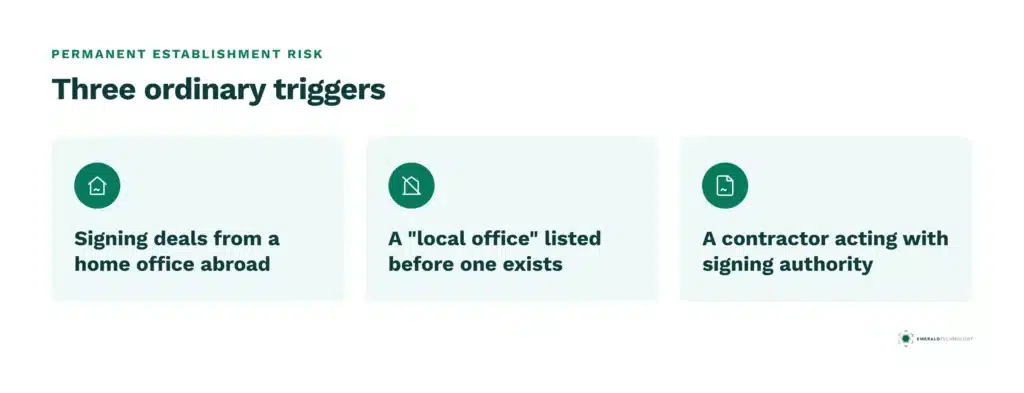
This is the gap most mid-market tech leaders do not know to look for. Permanent establishment (PE) risk is the exposure a company creates when its activity in a country crosses from occasional into “a fixed place of business” or “a person with authority to conclude contracts there,” even without an office lease or a local entity. A remote hire who regularly negotiates and signs deals from their home office, a “local office” address published on a website before anyone has actually set one up, or a contractor who behaves like an employee with signing authority can all trigger it. None of these require a large team to happen; they only require nobody in the company knowing where the line sits. Permanent establishment for founders: 10 everyday triggers to avoid walks through the specific, easy-to-miss scenarios.
How Employer of Record platforms close this gap: As the legal employer, Emerald owns payroll, tax, contracts, and termination compliance in every country it operates in, and staying current on local law changes is part of that role rather than something left to your team alone. Netcracker switched to Emerald across 13 countries with zero disruption to that coverage.
4. Payroll and statutory contribution miscalculations across markets
Statutory employer contributions (the payments a business is legally required to make on top of salary, such as social security or pension contributions) vary a lot by country and sometimes by salary band within a country. A flat contribution rate applied across every market instead of the correct country- and salary-specific one means a company can over-pay or under-pay without knowing it, and the second of those is the one that creates a compliance problem.
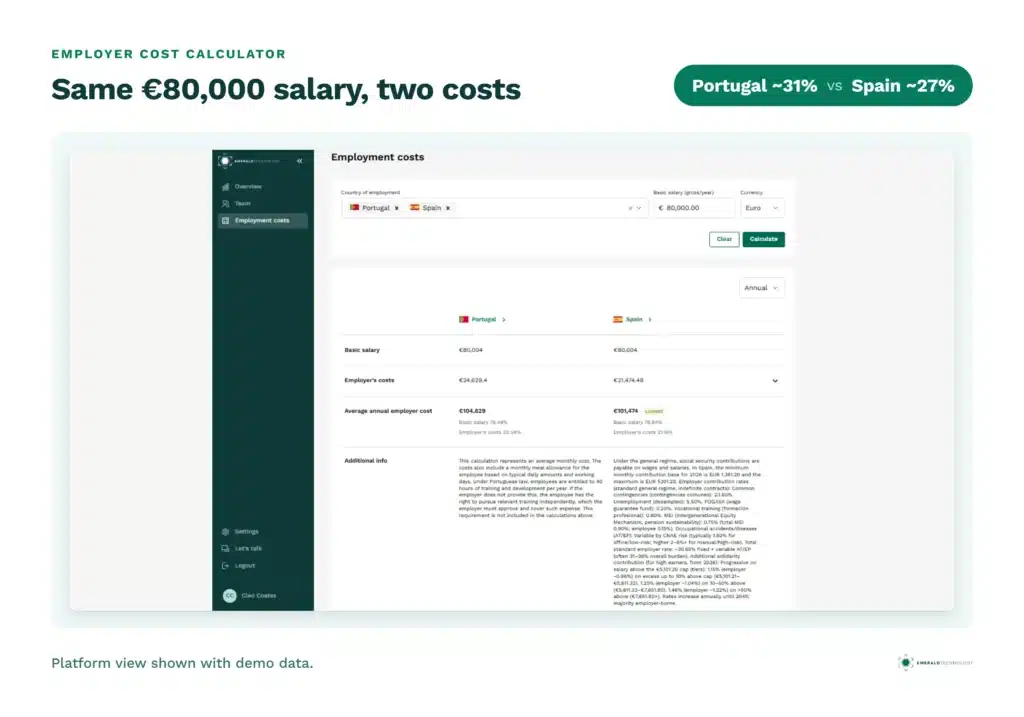
How Employer of Record platforms close this gap: A built-in employer cost calculator models the full cost of a salary in a given country, including local taxes and contributions, and compares two countries side by side. As a concrete example, for an identical €80,000 gross salary, employer costs run roughly 31% above the gross figure in Portugal, versus around 27% in Spain, a difference worth knowing before payroll runs, not after. A Payroll Breakdown dashboard then shows cost per country, per employee, and per cost category, designed to reconcile line for line against the monthly invoice.
5. Termination and severance costs nobody negotiated on your behalf
When an international hire does not work out, the termination process is where compliance risk turns directly into cash cost. Several EOR providers default to paying whatever the departing employee claims and simply invoicing the client, with no negotiation and no right to dispute it, which is a very different outcome to a termination handled properly under local law from the start.
How Employer of Record platforms close this gap: Emerald negotiates termination and severance on the client’s behalf as one of its four measurable value levers (alongside revenue acceleration, compliance risk avoided, and entity setup avoided), rather than passing whatever is claimed straight through as an invoice. How to terminate an employee properly is worth reading before any termination conversation starts, regardless of which provider is involved.
6. Employment records that do not survive due diligence
A company that has been hiring internationally through a patchwork of contractor agreements, informal advice, and inconsistent documentation can operate for a surprisingly long time without anyone noticing the gap, right up until a funding round, an audit, or a security review asks for clean, consistent employment records across every market and finds the paper trail does not hold together. At that point the fix is not a policy change; it is retroactively reconstructing records that should have existed from day one.
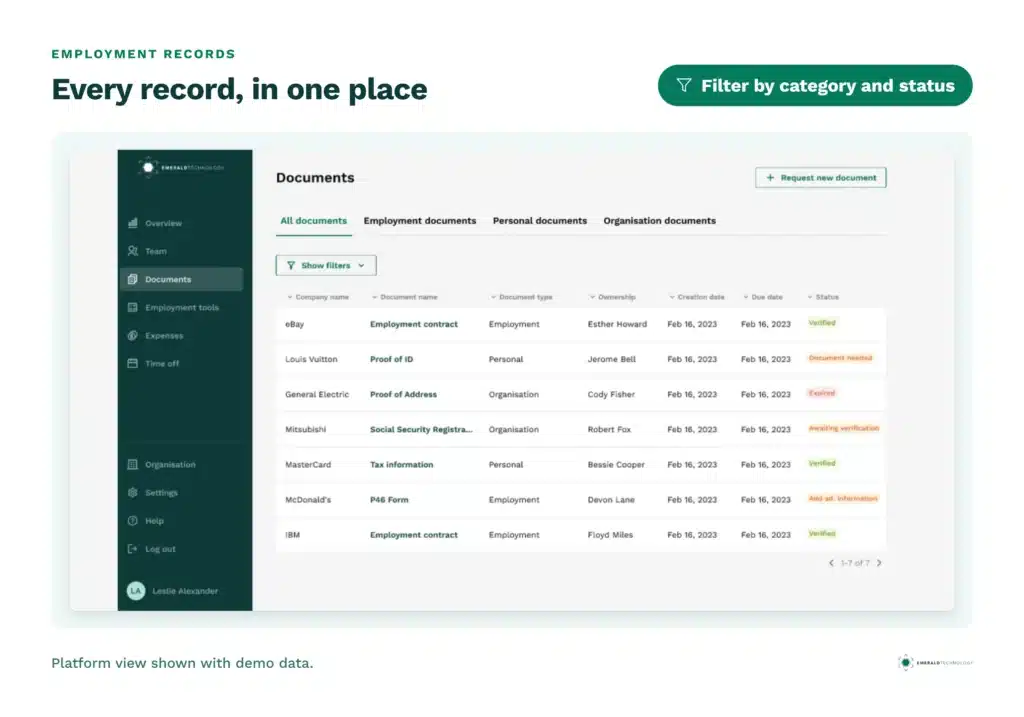
How Employer of Record platforms close this gap: Every contract, onboarding document, and compliance record sits in one place per employee, filterable by category and status, so audit-ready employment records are a by-product of using the platform properly, not a separate project to run before a review. If this is the gap that applies to your team right now, what founders need to prove before hiring for growth after a raise is worth reading alongside this one.
7. Local employment law changes going untracked after the hire is made
Getting a hire compliant on day one is only half the problem. Employment law changes constantly and unevenly across jurisdictions, and a notice period, contribution rate, or termination rule that was correct when someone was hired eighteen months ago can quietly become out of date without anyone’s job being to notice. This is overseas hiring risk management at its most common failure point: not one dramatic error, but a slow accumulation of assumptions nobody had time to revisit.
How Employer of Record platforms close this gap: Staying current with employment law is part of what Emerald does as the legal employer in each country, rather than something left solely to your own team to monitor market by market as your headcount grows. The legal survival kit for scaling global teams, a guide produced with Founders Law, is a useful checklist of where legal risk tends to build up while scaling globally: non-compliant contracts, worker misclassification, unclear IP ownership, and cross-border tax.
8. Background checks and onboarding documents handled inconsistently by country
Background checks, right-to-work verification, and onboarding documentation requirements differ by country, and running them through separate local vendors and manual handoffs creates exactly the kind of inconsistency that makes it hard to prove, later, that every hire was verified to the same standard.
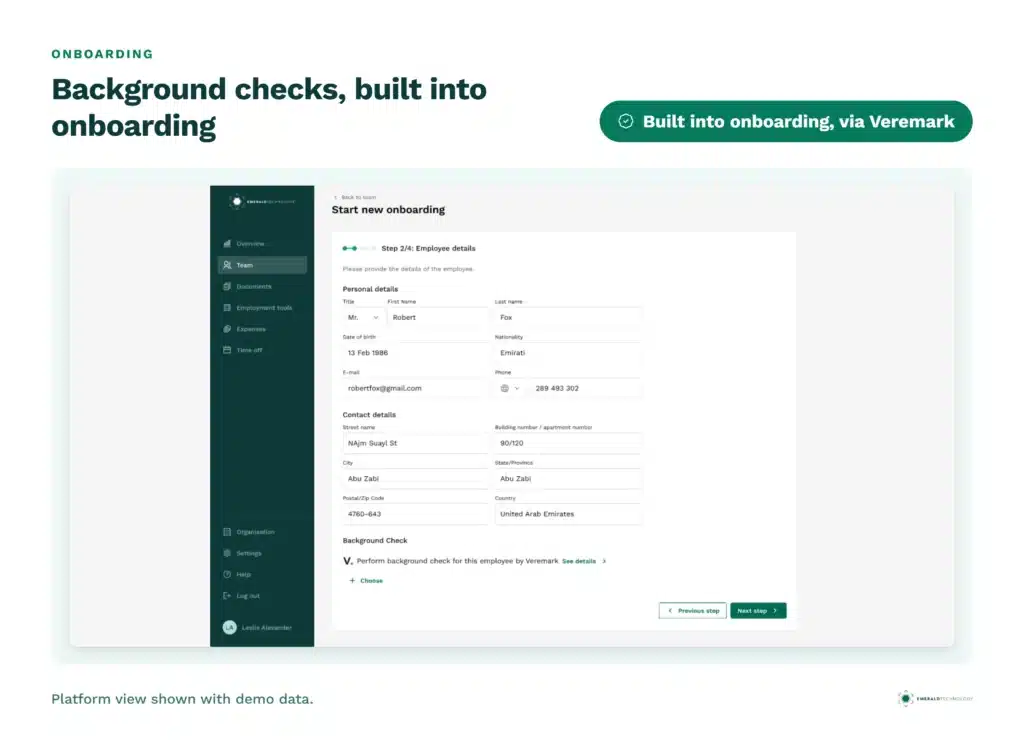
How Employer of Record platforms close this gap: Background checks are triggered with a single toggle inside the onboarding form, handled through Emerald’s integration with Veremark. The employee is contacted directly, completes their own information, and results load automatically back into the platform, with onboarding resuming without a manual handoff. Sciforma had a Denmark-based hire fully employed within 24 hours of starting through Emerald’s EOR solution, background check included. How companies can do international background checks covers what varies most by country.
Closing the gaps before they cost you
None of the eight gaps above require a large company or a large number of markets to show up. Several appear hardest at the exact moment a mid-market technology firm is growing fastest, which is usually the worst possible time to discover one by accident. The pattern across all eight is the same: a decision that felt reasonable and fast in the moment (a contractor agreement, a copied contract template, a termination handled without local advice) compounds quietly until a funding round, an audit, or a regulator asks a direct question the paper trail cannot answer.
Recognising a gap is not the same as having closed it, and closing all eight one at a time with a different fix each time is slower and riskier than building the underlying process (hiring, employing, and paying people internationally) as one system from the start. If any of the eight gaps above already sound familiar, talk to Emerald about your next international hire and get a straight answer on compliance, cost, and timeline for the specific market you are hiring in. If the gap sitting in front of you is on the talent side rather than the employment side, Emerald’s talent acquisition solution covers sourcing specialist hires in the same markets. Prefer to build the internal case first? The EOR business case tool models total cost of employment against standing up a legal entity, using your own numbers.
Frequently asked questions
What is an Employer of Record platform?
An Employer of Record (EOR) platform is the software a company uses to hire, onboard, and pay employees in countries where it has no legal entity, while a third party such as Emerald becomes the legal employer of those staff and carries the compliance obligations tied to that employment. The client company continues to direct the employee’s day-to-day work.
How do Employer of Record platforms reduce compliance risk for growing tech firms?
They enforce country-specific legal minimums (notice periods, probation length, mandatory contributions) at the point a contract is created rather than relying on a person to catch an error later, centralise employment records so they hold up under due diligence, and track ongoing changes to local employment law after the hire is made, closing the eight gaps set out above at the source rather than after something has already gone wrong.
What happens if a company misclassifies a contractor working internationally?
Getting worker classification wrong typically surfaces as back-pay, penalties, and benefits owed retroactively once a tax authority or regulator looks past the contract label at how the person actually works: fixed hours, a line manager, company equipment, and an ongoing relationship rather than a one-off engagement. What employee misclassification actually looks like and the risks covers the specific triggers.
Can a company create compliance exposure overseas without opening a legal entity there?
Yes. This is called permanent establishment risk, and it can be triggered by ordinary remote work, such as a hire who regularly signs deals from their home office in another country, without any office lease or formal entity ever being set up.
Are Employer of Record platforms more expensive than hiring directly?
The monthly fee looks higher than a direct salary line on its own. The full comparison is EOR cost against entity setup, local legal fees, and the hidden costs several providers do not disclose upfront, including onboarding fees, foreign exchange (FX) margins, benefits mark-ups, and multi-month deposits. Read the full breakdown in the hidden costs of EOR platforms guide.
How do I build an internal business case for adopting an Employer of Record platform?
Model it against your own numbers rather than taking a vendor’s word for it. Emerald’s EOR business case tool calculates total cost across four levers (revenue acceleration, exit-cost savings, compliance risk avoided, and entity setup avoided), so your finance team has a case it can sign off on directly.
Who has Emerald actually done this for?
Start with independent proof: G2 reviews are third-party and low-friction. Once you are seriously comparing providers, named case studies are matched to a similar company profile where possible: Human Security (11 countries, zero compliance remediation), Netcracker (switched across 13 countries with zero disruption), and Sciforma (a Denmark-based hire fully employed within 24 hours). Browse the full case studies page for more. Reference calls with existing customers are available once you are down to a shortlist and ready to move.
Ready to close these gaps before they surface?
If more than one or two of the eight gaps above already sound familiar across your current international hires, the underlying issue is process, not effort. Talk to Emerald about your next international hire and get a straight answer on compliance, cost, and timeline for the specific market you are hiring in. Prefer to run the numbers yourself first? The EOR business case tool models the full cost against standing up an entity, using your own figures.