TL;DR
- An employer of record (EOR) is a company that becomes the legal employer of your staff in a country where you have no local entity, handling payroll, tax, benefits, and employment law compliance on your behalf.
- You keep full day-to-day control of the person’s work; the EOR handles the local employment contract, payroll, and statutory compliance.
- Using an EOR typically gets someone employed in days rather than the months it takes to set up a foreign entity, and avoids six-figure entity setup costs per market.
- An EOR is not the same as a PEO (professional employer organization, which co-employs staff you already have a local entity for) or a payroll platform (which processes pay but isn’t the legal employer of record in the country).
- Emerald’s EOR platform enforces local legal minimums automatically during onboarding, so a contract can’t go live with a notice period or probation length that breaks local law.
An EOR is a third-party organisation that becomes the legal employer of a worker on your behalf, in a country where your company has no registered entity. The EOR issues the employment contract, runs payroll, pays local taxes and social contributions, and administers benefits. Your company keeps full control of the person’s day-to-day work: what they do, who they report to, and how they’re managed.
That split between legal employer and operational manager is the whole mechanism. It’s what lets a company in London put someone on payroll in Lisbon or São Paulo this month, without spending six figures and six months opening a Portuguese or Brazilian entity first.
For a Series A–C or private equity (PE)-backed technology company under pressure to hire in a new market, that difference is the entire business case, and it’s exactly the gap Emerald’s employer of record solution is built to close.
Why companies use an employer of record (EOR) instead of opening a local entity
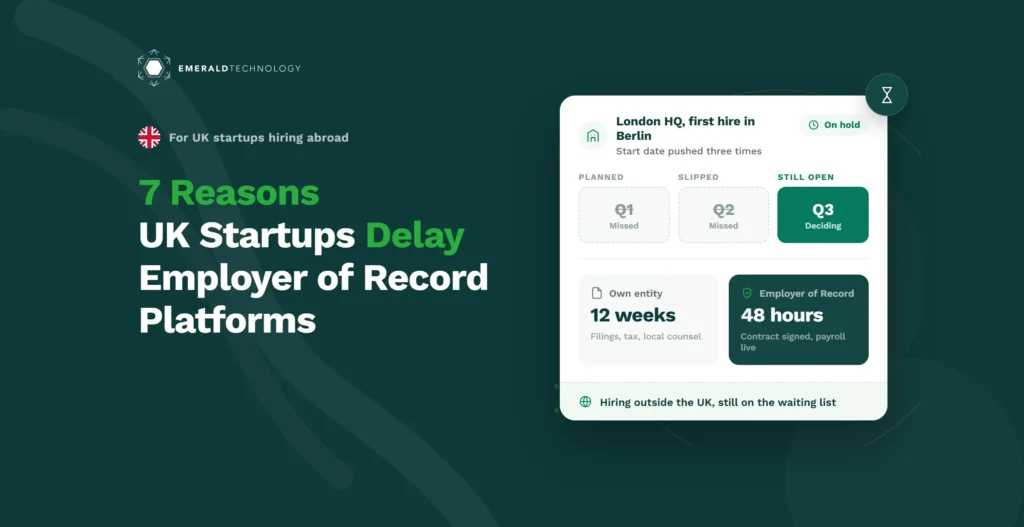
Opening a legal entity in a new country is slow and expensive: tens of thousands of pounds in legal, accounting, and registration costs, before a single employee starts, and months of lead time most growth-stage companies don’t have. An EOR removes that step entirely: there’s no entity to open in any of the countries the EOR covers.
The cost gap is easy to underestimate until you model it against a real salary. Emerald’s employer cost calculator does exactly this: comparing an €80,000 gross salary in Portugal against the same role in Spain shows Portugal running roughly 25% above gross salary in employment costs, versus about 17% in Spain, a difference of around €14,000 a year once local taxes and statutory contributions are factored in. That’s the kind of number a finance leader needs before signing off on a market, and it’s the same modelling an EOR makes visible for any country you’re considering.
Beyond cost, there are three problems an EOR is built to solve for a scaling, funded company:
- Employment law complexity. Notice periods, probation length, statutory contributions, and termination rules vary by country and change without warning. Getting them wrong creates real legal exposure for your company.
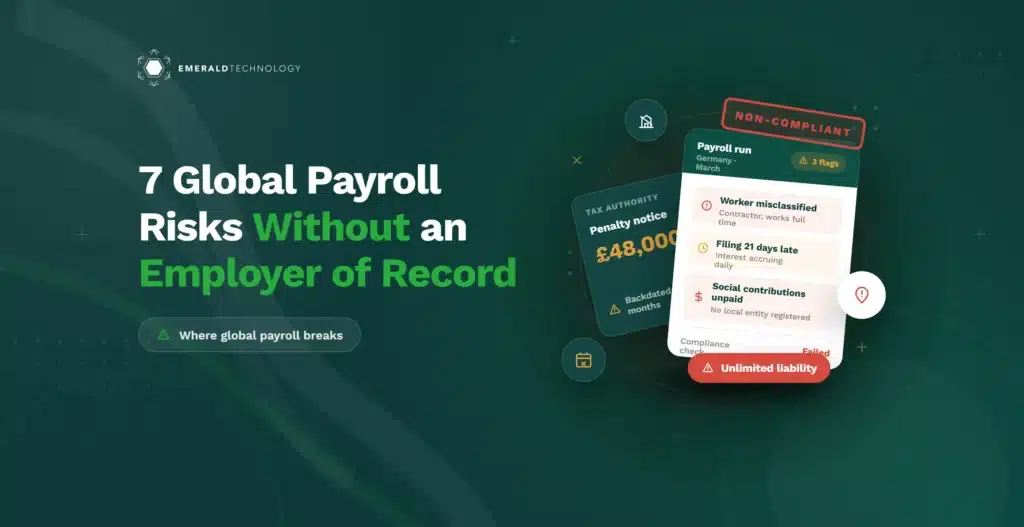
- Contractor misclassification. Treating someone who should legally be an employee as a contractor is one of the most common and most expensive international hiring mistakes, particularly once tax authorities start asking questions.
- Uncontrolled termination and exit costs. Severance and termination rules are strict and vary sharply by country. Getting this wrong when a hire doesn’t work out, or when you exit a market, is one of the largest and least predictable costs in international employment.
There’s a related risk worth flagging on its own: hiring or operating in a country the wrong way can also create a permanent establishment, an unplanned taxable presence that brings local corporate tax obligations your company never intended to take on. It’s a bigger risk for founders than most expect. See our guide to the everyday triggers that cause it.
None of this makes EOR adoption complicated in practice. Most of the hesitation companies feel comes from unfamiliarity with the cost and timeline rather than the mechanics themselves. See our breakdown of what actually delays employer of record adoption for the most common sticking points.
How does an EOR work?
The mechanics are the same regardless of which EOR you use, though the speed and quality of execution vary a lot between providers:
- You choose the country and the role. The EOR confirms the legal employment framework that applies: minimum notice, probation, statutory benefits, and termination rules for that country.
- The EOR issues a compliant employment contract. Salary, benefits, probation, and termination terms are drafted to meet local legal minimums, then signed electronically.
- The employee is onboarded. Personal details, tax information, and any required documents (passport, local ID, background checks) are collected and verified.
- The EOR runs payroll and benefits. Salary, statutory contributions, tax filings, and elected benefits are processed monthly, with full cost visibility for your finance team.
- The EOR manages ongoing compliance and, eventually, offboarding. Local law changes are tracked and applied automatically; if the employment ends, termination is handled in line with local requirements.
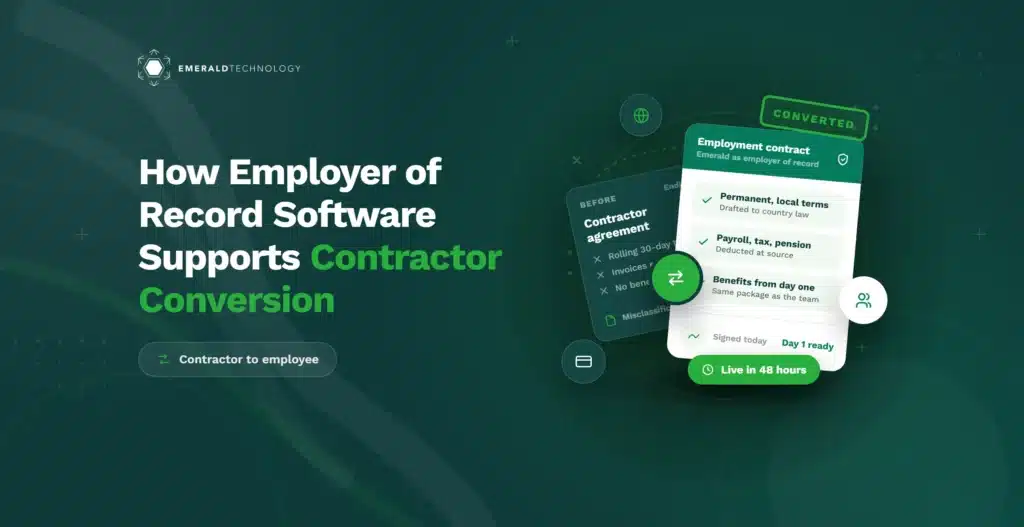
Explaining a general onboarding process in the abstract is one thing. What matters is whether the platform behind it actually prevents mistakes. Emerald’s onboarding form enforces this by design: if an admin tries to set a notice period or probation length shorter than the country’s legal minimum, the platform simply won’t let the form proceed. The same compliance logic applies to termination periods, which removes the most common way EOR employment goes wrong: someone getting a contract term that looked fine on a template but was never legal in that country.
EOR vs PEO vs setting up your own entity: what’s the difference?
These three routes to employing someone are often confused, but they solve different problems:
- Employer of record (EOR): you have no entity in the country. The EOR becomes the legal employer; you don’t need one. Fastest and lowest-commitment route into a new market.
- Professional employer organization (PEO): you already have an entity in the country, and the PEO co-employs your staff to share HR and compliance administration. A PEO can’t help you hire somewhere you have no legal presence. See our full comparison of PEOs and EORs if you’re weighing the two.
- Your own local entity: full control and, eventually, lower marginal cost at high headcount, but months of setup time and tens of thousands in upfront cost per country. Right for a market you’re permanently committed to at volume; rarely right for a first hire. Our EOR vs local entity breakdown covers the trade-offs in more detail.
What a good EOR provider should include
Not every provider of employer of record services is built the same way, and the gaps only show up once something goes wrong. Before choosing one, look for:
- Price transparency. The quoted price should be the price paid: no onboarding fees, currency conversion markups, or termination penalties buried in the contract.
- Genuine country coverage. Coverage claims are easy to make and hard to verify; ask how many active employees the provider actually runs in the countries that matter to you, not just how many countries appear on a map.
- Compliance that’s enforced, not just promised. The platform itself should stop a non-compliant contract from being issued, rather than relying on someone catching the error manually.
- A named point of contact. Not a ticket queue: someone accountable for your account and your employees’ experience.
- A track record with companies like yours. A funded, scaling tech company has different needs to an enterprise with a single overseas outpost.
For the fuller checklist covering total cost, compliance, support model, and switching risk, see our 10 questions to ask before choosing EOR software.
Emerald’s EOR platform is built around this list directly: transparent monthly per-employee pricing with no hidden fees, employment support across 150+ countries, a named account contact rather than a ticket queue (just ask Proofpoint), and compliance checks enforced automatically inside the onboarding form rather than left to a checklist. Clients including Human Security (11 countries, zero compliance remediation required) and Netcracker (a 13-country provider switch, zero disruption) show what that looks like in practice.
How Emerald’s platform makes this practical
Everything above describes what an EOR does in principle. In practice, most of that value comes down to how good the software and the team behind it actually are.
Emerald’s platform handles the employer-of-record process end to end from a single dashboard: contract generation, a five-step onboarding form, document signing through DocuSign, and background checks through a single toggle that hands off to Veremark and imports the results automatically. Specialist hires are typically placed in 4–6 weeks, with compliant contracts issued within 48 hours, roughly 10 times faster than standing up a new entity. Sciforma, for example, had a Denmark-based hire employed within 24 hours of choosing Emerald’s EOR solution.
Two features are particularly useful before you’ve even hired anyone. The employer cost calculator lets you model the full cost of a salary in any country, including local taxes and statutory contributions, and compare two countries side by side: the Portugal-versus-Spain example above is exactly this tool in use. See the full range of country-specific hiring guides for the legal and cost detail behind any market you’re evaluating. Alongside it, AI (artificial intelligence) hiring guides, built into the platform’s employee map, answer plain-language questions about any country, such as “what are the pros and cons of hiring in Portugal?”, with instant answers on cost, regulation, and market norms, without leaving the platform.
Frequently asked questions
Is an EOR the same as a PEO?
No. An EOR becomes the legal employer where you have no entity; a PEO co-employs staff in a country where you already have one. If you have no local entity, a PEO isn’t an option: only an EOR or setting up the entity yourself.
How long does it take to hire someone through an EOR?
With Emerald, compliant contracts are typically issued within 48 hours of the onboarding form being submitted, and specialist hires are placed in 4–6 weeks, against an industry-standard contract turnaround closer to 14 days and months for entity setup.
What does an EOR cost?
Pricing is usually a monthly fee per employee on top of their salary and statutory costs, rather than a percentage-of-salary placement fee. Ask any provider to show the full cost breakdown, including tax, benefits, and service fee, before you compare quotes. A lower headline rate can hide markups elsewhere. See Emerald’s pricing for an example of what that breakdown looks like in practice.
Does using an EOR reduce compliance risk?
It reduces the risk of getting local employment law wrong, provided the platform enforces compliance rather than just documenting it. Emerald’s onboarding form checks notice periods, probation length, and termination terms against each country’s legal minimums automatically, before a contract can be issued, rather than relying on someone to catch a non-compliant term after the fact.
Hire your first international employee without opening an entity
An EOR turns “we want to hire in this country” into an employed, compliant person on payroll in weeks, not months, without the cost or risk of opening a foreign entity to do it.
Explore Emerald’s EOR platform to see the full solution, or talk to an Emerald specialist about your first international hire.