Quick summary
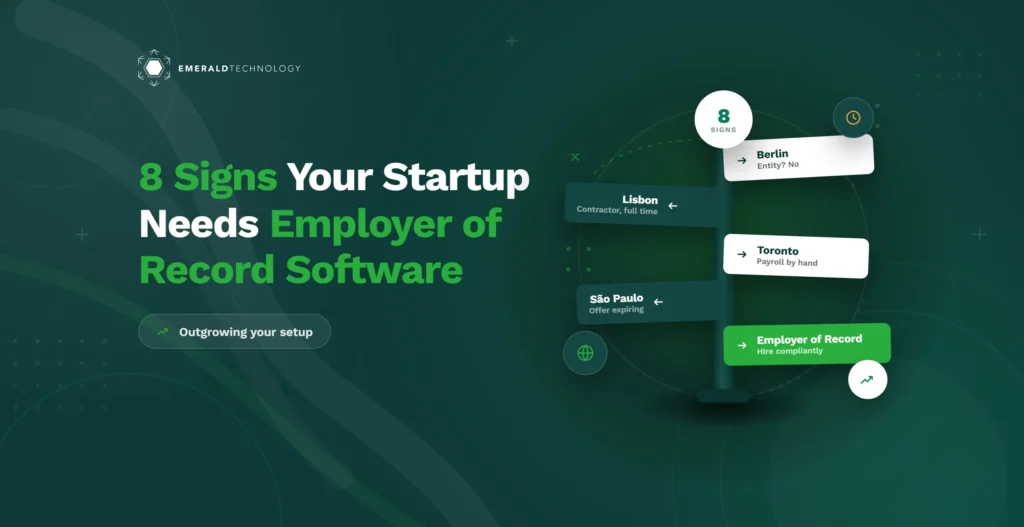
Most tech startups do not go looking for employer of record software out of curiosity about the category. They go looking because a strong candidate is based in a country where the company has no legal entity, a board-approved international headcount plan has no operational path to execute it, or a compliance question nobody can answer confidently has just landed on someone’s desk. This guide sets out eight practical, financial, and compliance signals that mean manual international hiring, spreadsheets, and ad hoc legal advice have stopped scaling with you, and what closes the gap once you recognise them.
| # | Sign | Category |
|---|---|---|
| 1 | A candidate is ready to start in a country where you have no legal entity | Practical |
| 2 | Your board approved international headcount, and now someone has to execute it | Practical |
| 3 | Contractor agreements are starting to look like disguised employment | Compliance |
| 4 | Everyday business activity is quietly creating permanent establishment risk | Compliance |
| 5 | Compliance tracking still lives in a spreadsheet, and hiring has outgrown it | Compliance |
| 6 | Multi-country payroll reconciliation is consuming days your team doesn’t have | Operational |
| 7 | Nobody can give a straight answer on the real cost of hiring in a new market | Financial |
| 8 | Your next funding round or audit needs employment records that don’t exist yet | Financial |
Why manual international hiring breaks down before you reach for employer of record software
An employer of record (EOR) is a company that becomes the legal employer of a worker in a country where the client business has no legal entity of its own. The EOR carries the compliance and liability for that employment (contracts, payroll, tax, and statutory obligations), while the client directs the person’s day-to-day work. Employer of record software is the platform layer on top of that arrangement: the system a hiring team actually uses to onboard, pay, and manage those employees across every market at once.
Most startups do not adopt this category early, and for good reason. At five or 10 employees, one hire in one new country is a manageable, one-off problem: a contractor agreement, a favour from a lawyer, a spreadsheet to track the details. The trouble is that international hiring rarely stays a one-off problem. A single funding round, a board-approved expansion plan, or one client win that depends on someone being in-market can turn “we might hire in Germany one day” into “we need three people employed compliantly in three countries by next quarter.” That is the point where the informal approach (a mix of contractor agreements, one-off legal advice, and a shared spreadsheet) stops being a workaround and starts being the thing that is actually slowing hiring down.
The eight signs below are the specific, recurring points where that shift becomes visible: some are practical (a hiring decision with no operational path forward), some are compliance-driven (risk building up quietly in the background), and some are financial (a cost picture nobody can see clearly). None of them require a large company to show up. Several show up hardest at the exact moment a startup is growing fastest, which is usually the worst possible time to discover them by accident.
Why trust us?
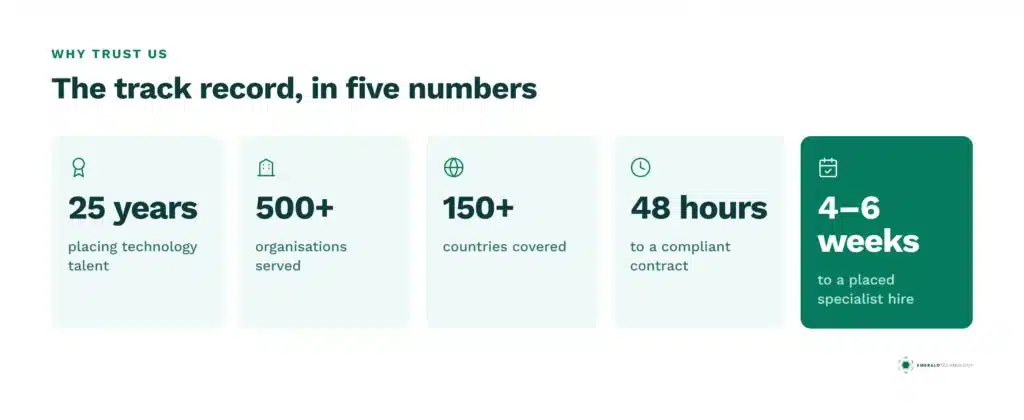
Emerald has placed technology talent for 25 years and has run employer of record and payroll for 500-plus organisations across 150-plus countries, issuing compliant contracts within 48 hours and placing specialist hires in four to six weeks. That track record sits specifically with venture-backed and private-equity-backed technology companies scaling from seed through Series E, which is the profile that hits most of the eight signs below first and hardest.
“Seamless hiring experience with quick visa processing” ⭐⭐⭐⭐⭐ 5.0/5
Bibinu A., Regional Sales Manager, Small-Business (≤50 employees), 2 June 2025, via G2
“Emerald made the hiring process incredibly smooth. All the paperwork was handled online, which made everything easy and transparent.”
The 8 signs your startup needs employer of record software
1. A candidate is ready to start in a country where you have no legal entity
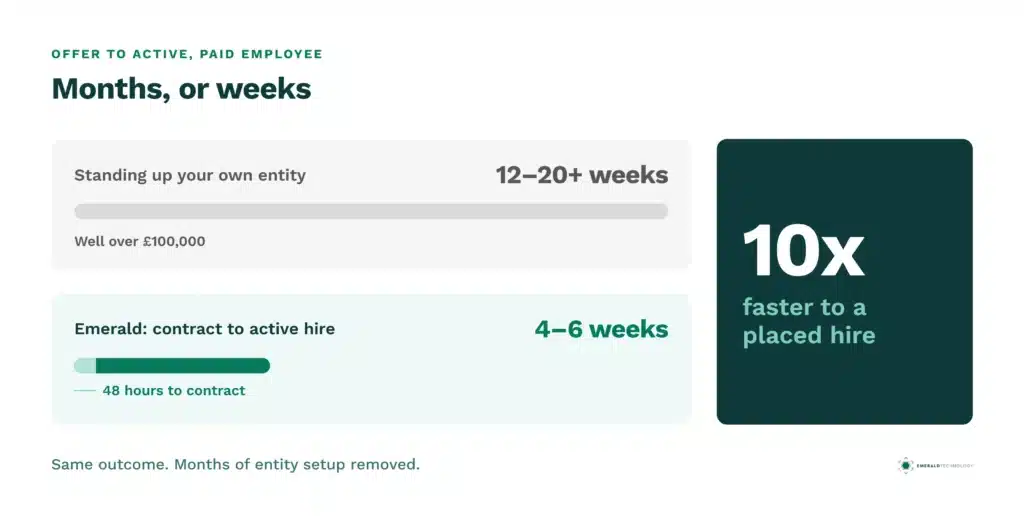
This is the most common trigger, and it rarely announces itself as a strategic decision. A talent acquisition specialist finds the right person, they happen to be based somewhere the company has no legal entity, and the hiring manager assumes the options are: open an entity, lose the candidate, or engage them as a contractor and hope the role stays contractor-shaped. Standing up a legal entity to hire abroad typically runs 12 to 20-plus weeks and well over £100,000 before a single person starts. A candidate with other offers will not wait that long, and a contractor arrangement carries real misclassification risk if the role is really employee-shaped (sign 3 covers this in more depth).
How employer of record software closes this gap: You do not need a legal entity to hire somewhere new. Emerald is the legal employer across 150-plus countries, issuing compliant contracts within 48 hours and placing specialist hires in four to six weeks, roughly 10 times faster than standing up an entity. Sciforma had a Denmark-based hire employed within 24 hours of starting through Emerald’s EOR solution.
2. Your board approved international headcount, and now someone has to execute it
There is a specific, recognisable gap between a slide that says “expand into Germany and Southeast Asia next year” and an operational process that actually gets people hired, contracted, and paid in those markets. Rapid headcount growth plans are easy to approve and hard to execute manually, because the work fans out across talent acquisition, legal, payroll, and finance, all of whom now need a country-by-country answer they didn’t need last quarter. If nobody owns that end-to-end, the plan stalls in exactly the gap between approval and action.
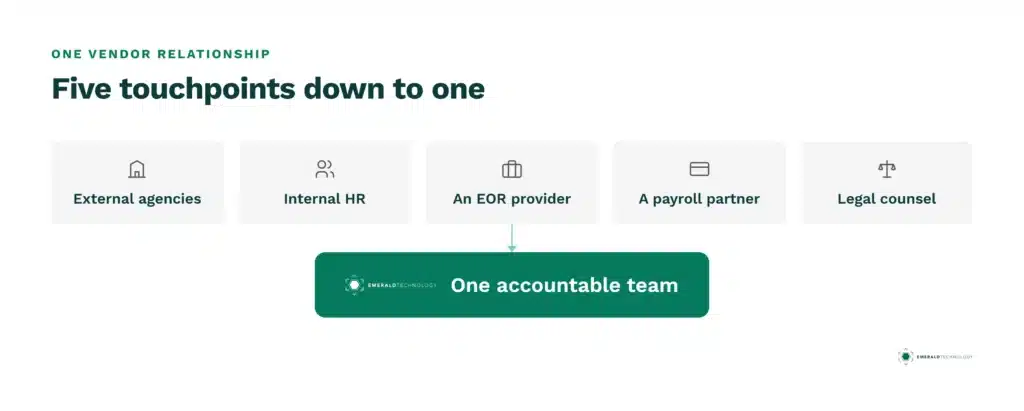
How employer of record software closes this gap: Talent acquisition, employer of record, and global payroll sitting under one accountable team removes up to five separate touchpoints (external agencies, internal HR, an EOR provider, a payroll partner, and legal counsel) down to one. Qualtrics grew from a single UK-based salesperson to a top-five global billing team, up 300% year on year, without ever opening a local entity to do it. If the plan on your roadmap is where to hire first rather than which vendor to use, that decision framework is worth working through before the headcount plan stalls further.
3. Contractor agreements are starting to look like disguised employment
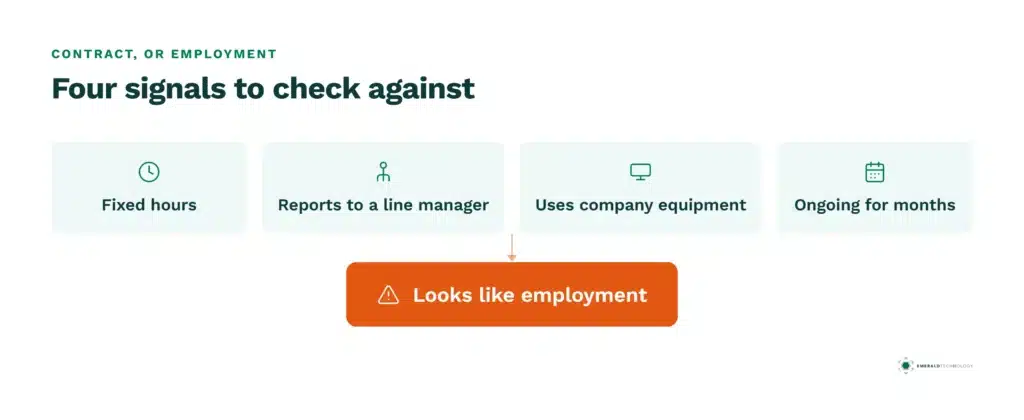
“We’ll just engage them as a contractor” is a common workaround for a first international hire, and it is the workaround most likely to create a real compliance problem later. If someone works fixed hours, reports to a line manager, uses company equipment, and has done so for months, tax authorities in many countries will look past the contract label and see an employee. Getting this wrong is called worker misclassification, and it typically surfaces as back-pay, penalties, and benefits owed retroactively, usually well after the company has stopped thinking about it as a risk.
How employer of record software closes this gap: Because Emerald is the direct legal employer rather than a contractor arrangement, the onboarding form captures the employment country first, then automatically surfaces the correct legal framework for that country (minimum notice periods, probation length, mandatory contributions) and enforces it: it will not let you continue with a non-compliant input. If you are still working out whether a specific role is contractor-shaped or employee-shaped, what employee misclassification actually looks like and the risks is worth reading before the next contractor agreement goes out.
4. Everyday business activity is quietly creating permanent establishment risk
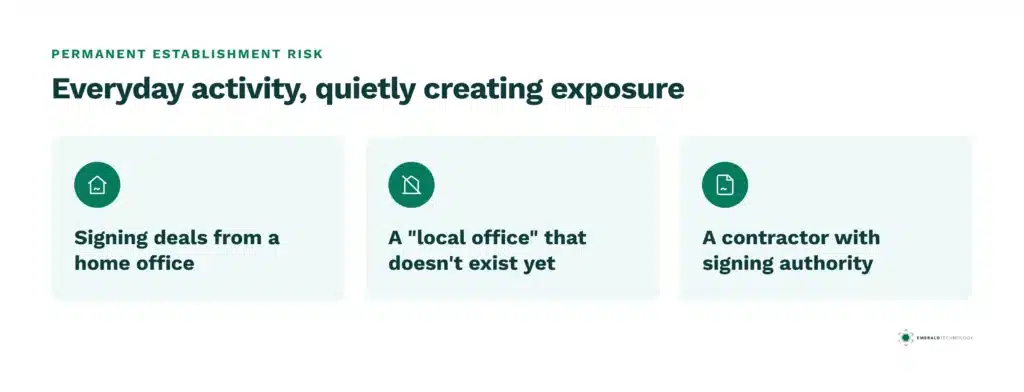
This is the sign most UK tech companies do not know to look for. Permanent establishment (PE) risk is the exposure a company creates when its activity in a country crosses from “occasional” into “a fixed place of business” or “a person with authority to conclude contracts there,” even without an office lease or a local entity. A remote hire who regularly negotiates and signs deals from their home office, a “local office” address published on a website before anyone has actually set one up, or a contractor who behaves like an employee with signing authority can all trigger it. None of these require a legal entity or a large team to happen; they only require nobody in the company knowing where the line sits.
How employer of record software closes this gap: As the legal employer, Emerald owns payroll, tax, contracts, and termination compliance in every country it operates in, and tracks every change in local employment law so your team doesn’t have to. Human Security hired across 11 countries through Emerald with zero compliance remediation required afterwards. If any of the scenarios above sound familiar, permanent establishment for founders: 10 everyday triggers to avoid walks through the specific, easy-to-miss ones.
5. Compliance tracking still lives in a spreadsheet, and hiring has outgrown it
A spreadsheet tracking notice periods, probation lengths, and statutory contributions country by country works fine when there are three employees in two markets. It stops working the moment hiring accelerates, because employment law changes constantly and unevenly across jurisdictions, and nobody’s job is to notice when a rule shifts in a country you hired in 18 months ago. This is startup compliance risk in its most common form: not one dramatic failure, but a slow accumulation of outdated assumptions nobody had time to revisit.
How employer of record software closes this gap: The onboarding form surfaces the correct legal requirements for each employment country automatically and blocks non-compliant entries at the point of data entry, rather than relying on a person to catch the error later. Netcracker switched to Emerald across 13 countries with zero disruption, which is the outcome that manual tracking is least equipped to guarantee at speed.
6. Multi-country payroll reconciliation is consuming days your team doesn’t have
Once a company is running payroll across even four or five countries, reconciling every invoice against every local cost line, in every local currency, against what finance actually expected to pay, becomes a recurring monthly task rather than an occasional one. This is where remote team employment quietly gets expensive in hours rather than fees: someone on the team is spending days chasing down why a Portugal invoice looks different from a Spain invoice, instead of doing anything else.
How employer of record software closes this gap: A payroll breakdown dashboard that shows cost per country, per employee, and per cost category (salary, local employment costs, benefits, service fee, expenses), designed to reconcile line for line against the monthly invoice, with a raw invoices tab for direct checking, turns that reconciliation from a manual chase into a filtered view.
7. Nobody can give a straight answer on the real cost of hiring in a new market
A finance leader asked to approve a new-market hire needs more than a salary figure. Employer costs (social contributions, pension, statutory benefits) vary significantly by country, and that variance is exactly the number that is hardest to get quickly without either specialist local advice or a tool built to model it. Without it, decisions about where to base a role get made on assumption rather than fact, and the gap between assumed and actual cost shows up as a surprise later.
How employer of record software closes this gap: A built-in employer cost calculator models the full cost of a salary in a given country, including local taxes and contributions, and compares two countries side by side.
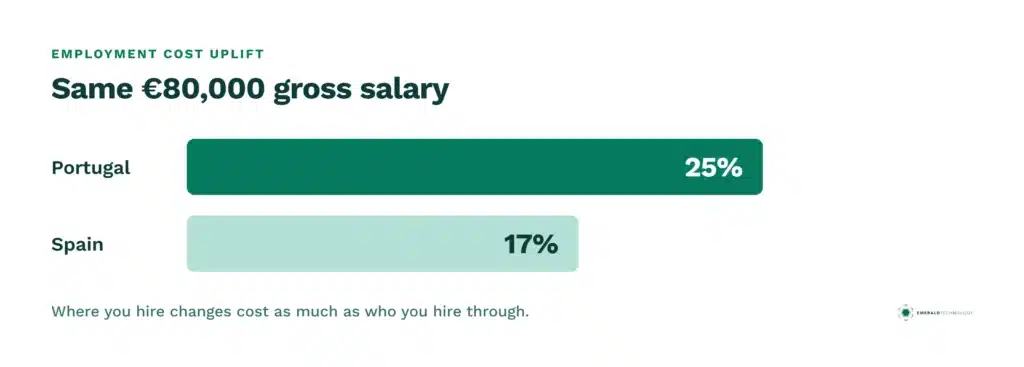
As a concrete example: for an identical €80,000 gross salary, employer costs in Portugal run roughly 25% above the gross figure, versus around 17% in Spain, a difference worth knowing before deciding where to base a role, not after. For a comparison your own finance team can sign off on, the EOR business case tool models total cost of employment against standing up an entity, using your own numbers, and the hidden costs of EOR platforms guide is worth a read if a competing quote looks suspiciously cheap.
8. Your next funding round or audit needs employment records that don’t exist yet
This sign shows up latest and hits hardest. A company that has been hiring internationally through a patchwork of contractor agreements, informal advice, and inconsistent documentation can operate for a surprisingly long time without anyone noticing the gap, right up until a due diligence process, an audit, or a pre-IPO review asks for clean, consistent employment records across every market and finds the paper trail does not hold together. At that point, the fix is not a policy change; it is retroactively reconstructing records that should have existed from day one.
How employer of record software closes this gap: Audit-ready employment records are generated as a by-product of using the platform properly from the start, not a separate project to run before a review. Every contract, onboarding document, and compliance record sits in one place per employee, consistently, across every market. If this is the sign that applies to you right now, it is worth reading what founders need to prove before hiring for growth after a raise alongside this one.
What to do once you recognise one of these signs
Recognising a sign is not the same as having solved it, and the signs above rarely show up one at a time. A board-approved headcount plan (sign 2) usually surfaces a cost question (sign 7) and a compliance question (sign 4 or 5) within the same quarter. The useful next step is not to solve each one separately with a different fix, but to look at whether the underlying process (hiring, employing, and paying people internationally) is built to handle all of it as one system, rather than as a set of one-off exceptions.
If the signs above are still hypothetical for your team, the employer of record solution is where to start: it is built specifically to remove these gaps at the source. If you are further along and actively comparing providers, 10 questions to ask before choosing EOR software covers what separates a platform built to scale from one that just looks the part on a sales call, and 7 reasons UK startups delay employer of record platforms covers the objections that tend to stall the decision even after the signs are obvious.
Frequently asked questions
What is employer of record software? Employer of record software is the platform a company uses to hire, onboard, and pay employees in countries where it has no legal entity, while an employer of record (EOR), a third party such as Emerald, is the legal employer of record for those staff and carries the compliance and liability. The client company continues to direct the employee’s day-to-day work.
How do I know if I need EOR software instead of setting up a legal entity? If you are hiring one to a handful of people in a market you have not committed to long-term, EOR is typically faster and cheaper: standing up a legal entity runs 12 to 20-plus weeks and well over £100,000 before anyone starts, versus a compliant contract in 48 hours and a placed hire in four to six weeks through an EOR. A legal entity tends to make sense once headcount in a single market is large and sustained enough that the fixed cost of the entity is lower than the ongoing per-employee EOR fee.
Is employer of record software more expensive than hiring directly? The monthly fee looks higher than a direct salary line on its own. The full comparison is EOR cost against entity setup, local legal fees, and the hidden costs several providers do not disclose upfront, including onboarding fees, foreign exchange (FX) margins, benefits markups, and multi-month deposits. Read the full breakdown in the hidden costs of EOR platforms guide.
How do I build an internal business case for EOR software? Model it against your own numbers rather than taking a vendor’s word for it. Emerald’s EOR business case tool calculates total cost across four levers: revenue acceleration, exit-cost savings, compliance risk avoided, and entity setup avoided, so finance has a case it can sign off on directly.
What’s the difference between an EOR and a professional employer organisation (PEO)? An EOR becomes the legal employer in a country where you have no entity. A PEO enters a co-employment arrangement in a country where you already have your own entity, typically to simplify HR and payroll administration. If you do not yet have a local entity in the market you are hiring in, you need an EOR, not a PEO.
Can a startup use EOR software to make just one international hire? Yes. Using an EOR to validate a new market with one to three hires before deciding whether to set up a local entity is one of the most common ways startups use the category.
Who has Emerald actually done this for? Start with independent proof: G2 reviews are third-party and low-friction. Once you are seriously comparing providers, named case studies are matched to a similar company profile where possible: Human Security (11 countries, zero compliance remediation), Netcracker (switched across 13 countries with zero disruption), Sciforma (a Denmark-based hire employed within 24 hours), and Qualtrics (grew from one UK salesperson to a top-five global billing team). Browse the full case studies page for more. Reference calls with existing customers are available once you are down to a shortlist and ready to move.
Ready to check these signs against your own hiring plan?
If more than one or two of the eight signs above already sound familiar, the underlying problem is process, not effort. Talk to Emerald about your next international hire and get a straight answer on cost, liability, and timeline for the specific market you are hiring in. Prefer to run the numbers yourself first? The EOR business case tool models the full cost against standing up an entity, using your own figures.