
Quick summary
Hiring a salesperson in another country is harder than it looks. Your company usually can’t employ someone in a country where it has no local company set up, and salespeople come with extras that other hires don’t: commission that changes every month, contracts that include allowances and non-competes, and a job (signing deals) that can create tax problems for your business abroad. Employer of Record platforms solve the employment part. This guide explains how they work, what matters specifically for sales hires, and how five platforms compare on commission pay, deposits, tax risk, sales contract terms, and speed.
Our top three picks:
| Platform | Best for |
|---|---|
| Emerald Technology | Finding, employing, and paying sales talent through one team |
| Remote | Recurring commission payments with no extra deposit on incentive plans |
| Deel | Paying late-closing deals outside the normal payroll, for a published fee |
What is an Employer of Record platform, and how does it help you hire salespeople abroad?
To employ someone directly in another country, your company normally needs a legal entity there: a registered local company or branch with its own tax and payroll set-up. Setting one up takes 12 to 20-plus weeks before anyone can start, which is too slow when you want a salesperson in a new market this quarter.
An Employer of Record (EOR) solves this. The EOR already has the legal set-up in that country, so it becomes your salesperson’s official employer on paper. It issues a contract that meets local law, runs their payroll, pays local taxes, and provides the benefits the law requires. Your company still decides what the salesperson works on, sets their targets, and manages them day to day. You pay the EOR a monthly fee on top of the employee’s salary and employment costs.
An Employer of Record platform is the software you use to do all of this. For most human resources (HR) and talent teams, it’s where the day-to-day work happens.
Here’s how a typical sales hire runs through an EOR platform:
- You choose the country and enter the role, salary, commission plan, and start date.
- The EOR drafts a local employment contract that meets that country’s rules, and the salesperson signs it electronically.
- The salesperson is onboarded: they upload documents, add bank details, and choose benefits.
- Each month, the EOR pays them in local currency, deducts tax, and pays the employer contributions the law requires. It then invoices you for salary, employer costs, and its fee.
- Throughout, you use the platform to submit commission, approve expenses and leave, and see what each hire costs.
- If the role ends, the EOR handles the exit under local employment law.
Key EOR and sales terms explained
- Legal entity: a registered company or branch in a country, which you normally need before you can employ people there directly.
- Employer of Record (EOR): a company that legally employs staff on your behalf in a country where you have no legal entity, while you manage their work.
- Rep: short for sales representative, meaning a salesperson.
- Territory: the country or region a salesperson is responsible for selling into.
- Account executive: a salesperson who handles deals from first meeting to signed contract.
- Commission: extra pay based on the sales a rep closes, usually on top of a base salary. “Variable pay” covers commission and bonuses together.
- On-target earnings (OTE): what a salesperson earns if they hit their sales target, meaning base salary plus expected commission.
- Payroll cut-off: the last date you can submit changes, such as commission, for this month’s pay.
- Off-cycle payment: a payment made outside the normal monthly payroll run.
- Deposit: money an EOR holds before a hire starts, as security in case you can’t pay. It’s usually refundable when the employment ends.
- Permanent establishment (PE): when a country decides your company is doing business there and owes local corporate tax, for example because someone there regularly signs contracts for you.
- Non-compete clause: a contract term that limits a salesperson from joining a competitor for a set time after they leave. Whether it can be enforced varies by country.
- Notice period and probation: how much warning each side must give to end employment, and the trial period at the start of a job. Both have legal minimums that vary by country.
- Severance: money owed to an employee when their employment is ended, set by local law or their contract.
- G2: an independent website where software users post reviews and ratings.
What international sales hiring demands from Employer of Record platforms
Every EOR platform in this guide can employ someone legally in another country. The differences that matter for sales hires show up in five places.
1. How commission gets paid
Salespeople are usually paid a base salary plus commission, and the commission changes every month depending on what they close. Because the EOR is the legal employer, commission has to go through the EOR’s payroll so the right local tax is deducted. You can’t simply pay the rep directly.
What to look for in the software: a clear way to submit commission each month, either as a one-off amount or a recurring one; a published payroll cut-off date; and the option (and cost) to pay a late-closing deal off-cycle instead of waiting a month.
2. How the deposit is calculated
Most EOR providers ask for a deposit before your hire starts. Some base it on everything you pay each month, including commission. For salespeople, where commission can be a large share of pay, that means more of your cash is tied up before the rep has sold anything.
What to look for: a written explanation of what the deposit is based on. Ask whether it uses base salary only or includes commission, and when you get it back.
3. Tax risk when salespeople sign deals abroad
If someone working for you in another country regularly negotiates and signs contracts on your company’s behalf, that country’s tax authority can decide your company is doing business there and owes corporate tax, even with no office. This is called permanent establishment (PE). Salespeople are exactly the kind of role that can trigger it, because closing deals is their job. An EOR makes the salesperson’s employment compliant, but it doesn’t change what they do each day, so on its own it doesn’t remove PE risk.
What to look for: a provider that explains this plainly instead of promising the risk away. Then decide, with local tax advice, who is allowed to sign contracts on your behalf.
4. Sales contract terms and expenses
Sales contracts often include things other roles don’t: a non-compete clause, a car or travel allowance, and a way to claim back the cost of client travel and meals. Because the EOR issues the contract and runs payroll, these have to be supported in its contract and its platform.
What to look for: whether you can add a non-compete and allowances when you set up the hire, and how the salesperson submits expenses and who approves them.
5. Speed to territory
This is the time from deciding you need a salesperson in a market to that person talking to customers. It includes finding the right candidate, issuing a contract, and getting them onboarded. EOR providers issue contracts far faster than you can set up a legal entity, but if you don’t have a candidate yet, finding one is usually the longest step.
What to look for: how quickly the provider issues a compliant contract and onboards a hire, and whether it can help you find the salesperson in the first place.
“You could spend months on an entity, or have a rep hired, employed, and being paid in weeks. For a sales role, that speed is pipeline you’d otherwise lose.”
— Adam DeSanges, Director, Emerald Technology
This guide focuses on sales hiring only. For a general comparison of hidden fees and direct employment versus partner networks, read how to choose the right Employer of Record platform. If you’re a US company comparing providers across all roles, see the six best EOR software tools for US tech companies.
Why trust our guide to global employment solutions for sales teams?
Emerald has placed go-to-market (GTM) talent in growth-stage technology companies for 25 years: sales, marketing, customer success, and revenue operations. We also run Employer of Record and global payroll for 500-plus organisations across 150-plus countries. That means we see international sales hiring from both ends, sourcing the rep and then employing and paying them. For Qualtrics, that meant building a seven-person UK sales team from a single salesperson into one of Qualtrics’ top five billing teams worldwide, up 300% year on year.
“Great experience”
⭐⭐⭐⭐⭐ 5.0/5Francisco Javier G. — Senior Named Account Manager, Mid-Market (51–1,000 employees) — 30 June 2025, via G2
What do you like best?
“All the time I got guidance and great support during all the process and also once I got hired.”
The 5 best Employer of Record platforms for international sales hiring: full comparison table
“Entity model” shows whether the provider employs people through local companies it owns or through partner companies in some countries. Pricing is the provider’s monthly fee per employee, on top of the employee’s salary and employment costs.
| Platform | Best for | Entity model | G2 rating | EOR pricing (per employee per month) |
|---|---|---|---|---|
| Emerald Technology | Finding, employing, and paying sales talent through one team | Owned entities and vetted partners | ⭐ 4.5 | From £500 |
| Remote | Recurring commission with no extra incentive-plan deposit | 100% owned entities | ⭐ 4.5 | $699 |
| Deel | Paying late-closing deals outside the normal payroll | Not stated by provider | ⭐ 4.7 | $599, month to month |
| Multiplier | Named commission pay types and a named success manager | Owned entities | ⭐ 4.7 | From $459 billed annually |
| Oyster | Published PE guidance on sales roles | Not stated by provider | ⭐ 4.4 | $699, annual discounts available |
Competitor details come from each provider’s own website, help centre, pricing page, or terms, and from G2, all accessed in September 2026. Sources are linked at the end of each platform’s section.
1. Emerald Technology: best EOR for building international sales teams end to end
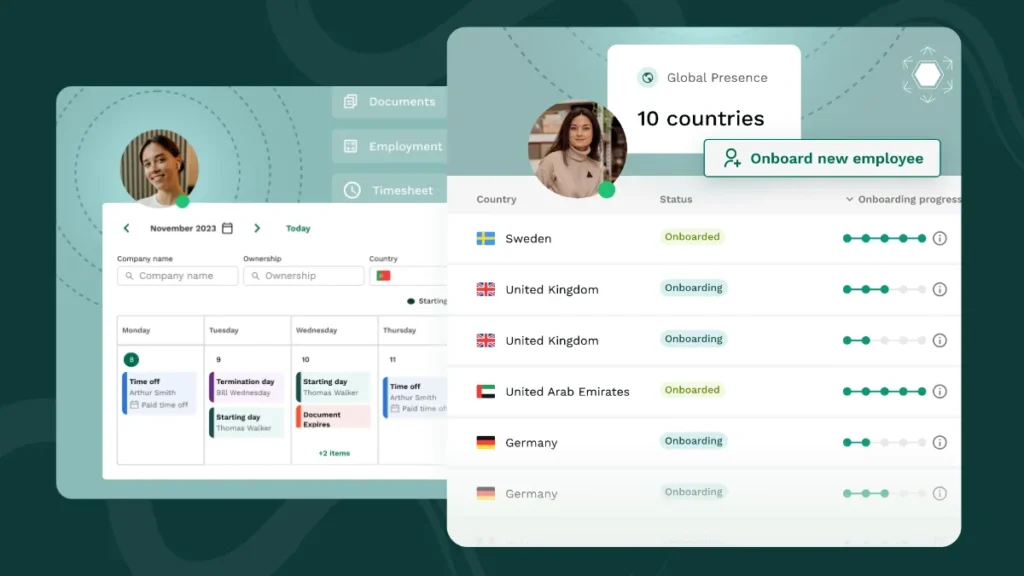
Emerald is a talent acquisition partner and an Employer of Record in one, so we cover the whole journey: from the moment you need to find a rep to the day they’re signed, onboarded, and selling. Say you want your first account executives in Germany. Because we’re the Employer of Record in 150-plus countries, our talent acquisition specialists search a global talent pool, not just the markets where you already have an entity. We issue compliant contracts in 48 hours, onboard the rep on the platform, and run payroll, commission included, from the first month. Specialist hires are placed in four to six weeks, with no handover between the partner that finds the rep and the one that employs them.
Not sure which market to open first? Model the full employer cost of a sales hire in up to three countries side by side with the employee cost calculator, or read where to hire first and why.
Sourcing is where sales hires succeed or fail. The right first seller in a new market speaks the technical language, understands the buyer’s problem, and has already sold into the same kind of market, for a company at the same stage, using the same kind of sales process. That’s the difference between a strong rep and someone who only looks fine on paper. We approach strong candidates who aren’t actively job hunting, instead of only screening people who apply, and we’ll tell you when a profile doesn’t fit your company’s stage.
“The right first seller in a new market has already done this journey: the same buyer, the same stage, the same motion. We’ll tell you when a profile doesn’t match your stage, not just fill the brief as written.”
— Michael Convery, Partner, Emerald Technology
Once the salesperson is employed, here’s how Emerald’s platform handles the sales-specific checks above:
- Commission and bonuses. Admins submit an additional payroll request on the rep’s profile with the amount, currency, and a description. Emerald’s finance team adds it to the next payroll cycle, and every request is tracked by status.
- Commission reporting. Bonus or commission appears as its own line in the Payroll Breakdown dashboard, which you can filter by country, rep, and month and match line for line against your Emerald invoice.
- Deposit. One month of employment costs, regardless of how senior the hire is.
- Contract terms. The onboarding form includes a non-compete clause toggle and a free-text field for extras such as a car or travel allowance, alongside benefits like health insurance and a work-from-home allowance. Custom benefits and allowances are included from the Growth plan up.
- Expenses on the road. Reps file expense reports with receipts in any currency under categories such as travel and meals and entertainment. Their line manager approves or declines with a written reason. Teams already using Expensify, an expense management tool, can keep using it.
Compliance is built into the same onboarding form. Select the rep’s country and the platform applies that country’s legal minimums for notice periods, probation, and the contributions employers must pay on top of salary. If you set a notice period that is too short, it won’t let you continue. Background checks run through Veremark, a screening provider, with a single toggle in the same form.
Territories don’t always work. Emerald lets you test a new market with one to three hires before you spend money setting up a legal entity, saving £100k-plus per market on entity setup. If a territory doesn’t perform, Emerald negotiates termination and severance on your behalf instead of paying whatever is claimed and passing on the invoice.
“Most clients test a new territory with one to three reps before they commit to an entity. If the market works, you scale. If it doesn’t, we negotiate the exit on your behalf, so a closed territory doesn’t turn into an open-ended bill.”
— Adam DeSanges, Director, Emerald Technology
The results come from sales leaders. At Qualtrics, Emerald built a seven-person UK sales team and filled leadership roles for Europe, the Middle East, and Africa (EMEA) in presales (the technical specialists who support deals before they close) and sales operations (the team that runs sales processes and systems), with 92% candidate retention across 40-plus placements. Ian McVey, Head of Enterprise Sales, Northern Europe at Qualtrics, said: “When I read the shortlists presented, it showed me what a great job the team at Emerald have done for Qualtrics.” At HashiCorp, Josh Garcia said Emerald’s “efforts have been instrumental in our sales growth and success throughout EMEA”.
A sales rep who signs deals from a home office can still create PE exposure, whichever EOR you use. Read permanent establishment for founders: 10 everyday triggers to avoid before deciding whether your salesperson can sign contracts on your behalf.
Key features
- In-house GTM talent acquisition, Employer of Record, and global payroll under one team, from first search to final payslip
- Compliant contracts in 48 hours and specialist hires placed in four to six weeks, about 10 times faster than standing up a legal entity
- Additional payroll requests for commissions, bonuses, and one-off allowances, paid in the next payroll cycle
- A non-compete toggle and custom allowances such as car or travel allowance in the onboarding form
- Expense reports in any currency, with manager approval and an Expensify integration
- A Payroll Breakdown dashboard with bonus or commission shown as its own cost line
- A one-month deposit, regardless of seniority
Pros
- One team finds, employs, and pays your reps, so candidates don’t drop out between vendors.
- Commission has a defined, trackable workflow and its own line in reporting.
- The deposit stays at one month, whatever the rep’s seniority.
- Every account and every rep has a named contact at Emerald, and a team member guides you through setup (white-glove onboarding).
Cons
- Talent acquisition is priced separately from the EOR plans and needs a conversation with the team.
- Work visa services are only included on the Enterprise plan, which matters if you relocate reps.
- Emerald has fewer G2 reviews than the largest self-serve platforms.
Pricing
Entry is £500 per employee per month and covers payroll and employment management, compliant contracts, global payments, and user permissions. Growth is £750 per employee per month and adds tailored benefits, a dedicated onboarding specialist, and 24/7 online support. Enterprise is custom and adds work visa services, employee engagement, and reference and security checks. See the full pricing page.
G2 rating
⭐ 4.5/5
Talk to a talent acquisition specialist about your next sales territory, or explore the Employer of Record solution if you already have your rep.
2. Remote: best for recurring commission with no extra deposit on incentive plans
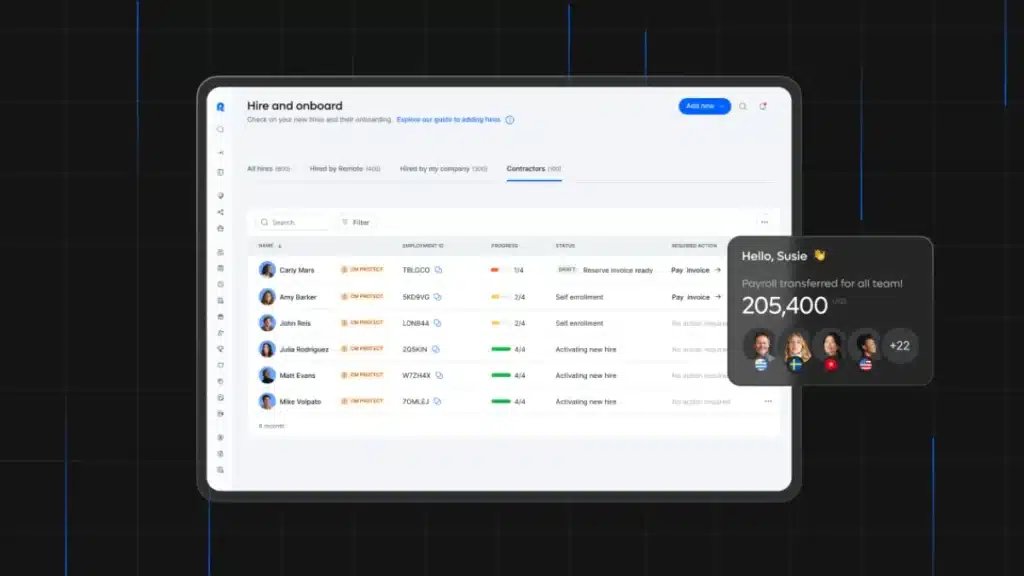
Remote pays variable compensation as “incentives”. Its help centre says you can set an incentive as a one-time payment or a monthly recurring one, and choose whether the amount is paid gross or net (before or after tax). One-time incentives can be uploaded in bulk; recurring incentives can’t. Changes are accepted until 11:59 PM Coordinated Universal Time (UTC) on the payroll cut-off date, or the Friday before if the cut-off falls on a weekend or holiday.
On deposits, Remote’s pricing page says it doesn’t charge additional deposits for incentive plans, paid time off above the legal minimum, removed probation periods, or monthly severance accruals. Instead, it says: “We collect reserve payments in rare, high risk circumstances.” A reserve payment is money held as security, similar to a deposit. Remote says it owns and operates 100% of its entities, with “no handoffs to third-parties”, and lists EOR coverage in 90-plus countries.
Remote’s guide to permanent establishment uses a sales agent who closes deals and signs contracts as its example of agency PE, meaning PE created by someone acting on your company’s behalf. The same article says an EOR “eliminates permanent establishment risk” and, elsewhere, that an EOR “does not directly affect permanent establishment risk”.
Key features
- One-time and monthly recurring incentive payments, paid gross or net
- Bulk upload for one-time incentives
- Employment through entities Remote owns and operates in every market it covers
Pros
- Remote says it doesn’t charge an additional deposit for incentive plans.
- Recurring incentives can be set to pay monthly.
- Remote states that it has no third-party EOR partners.
Cons
- Remote lists 90-plus EOR countries, fewer than Deel (130-plus), Oyster (120-plus), or Multiplier (150-plus).
- Recurring incentives can’t be bulk uploaded.
- G2 reviewers mention support gaps, slow response times, and processing delays.
Pricing
$699 per employee per month, according to Remote’s pricing page. Remote doesn’t publish an annual rate.
G2 rating
⭐ 4.5/5
Sources: Remote incentives help article, Remote pricing, Remote EOR page, Remote PE guide, G2. Accessed September 2026.
3. Deel: best for paying late-closing deals off-cycle
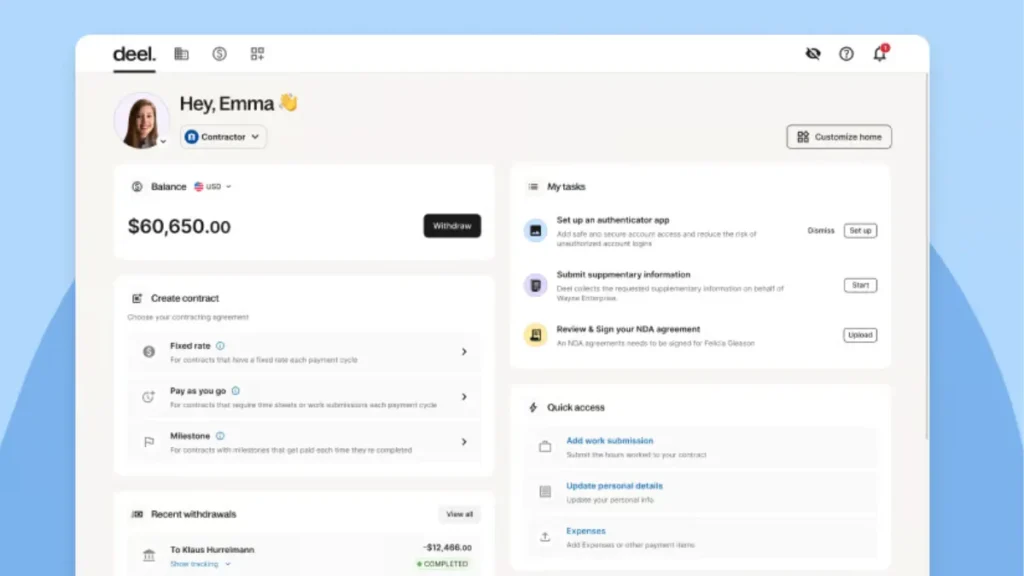
Deel’s help centre handles commission as a payroll adjustment (an extra amount added to that month’s pay), alongside bonuses, allowances, and expenses. Bonuses and allowances can be set as recurring; expenses can’t. Adjustments must be submitted and approved before the payroll cut-off, and “any adjustments approved after the cut-off date will appear on the following payroll.” For EOR employees, Deel adds a compliance review within 72 business hours of client approval. Amounts entered in another currency are converted at the real-time exchange rate when the adjustment is created.
If a deal closes after the cut-off, Deel’s on-demand payroll can pay the commission off-cycle instead of waiting for the next month. Deel charges “a $29 fee for each employee impacted”, and payment to an EOR employee takes five business days.
Deel’s standard EOR deposit is “between 1 – 1.5 all monthly charges, including employee salary, employer costs, fixed allowances, and management fees.” Deel reviews incentive and variable pay above $100k case by case, and for Israel, France, Germany, and the Netherlands, it requires a deposit for the full incentive plan and variable compensation amount.
On PE, Deel says an EOR “significantly reduces PE risk” and lists “revenue-generating activity by employees in a host country” as a trigger. Deel’s pricing page lists full legal employment in 130-plus countries.
Key features
- Payroll adjustments for commission and bonuses, with recurring bonuses available
- On-demand off-cycle payroll at $29 per employee affected
- Adjustments in any currency, converted at the real-time rate
Pros
- A late-closing deal can be paid off-cycle for a published fee.
- Pricing is published and billed month to month, with no long-term commitment.
- Deel’s PE guidance names revenue-generating activity as a trigger.
Cons
- In Israel, France, Germany, and the Netherlands, the deposit covers the full variable pay amount.
- Adjustments approved after the cut-off move to the following payroll unless you pay the off-cycle fee.
- G2 reviewers mention high fees, unfavourable currency conversion, and payment delays.
Pricing
$599 per EOR employee per month, billed month to month, according to Deel’s pricing page.
G2 rating
⭐ 4.7/5 (on the G2 listing named “Deel Payroll”)
Sources: Deel adjustments help article, Deel on-demand payroll, Deel EOR deposit calculations, Deel PE guide, Deel pricing, G2. Accessed September 2026.
4. Multiplier: best for named commission pay types and a named success manager
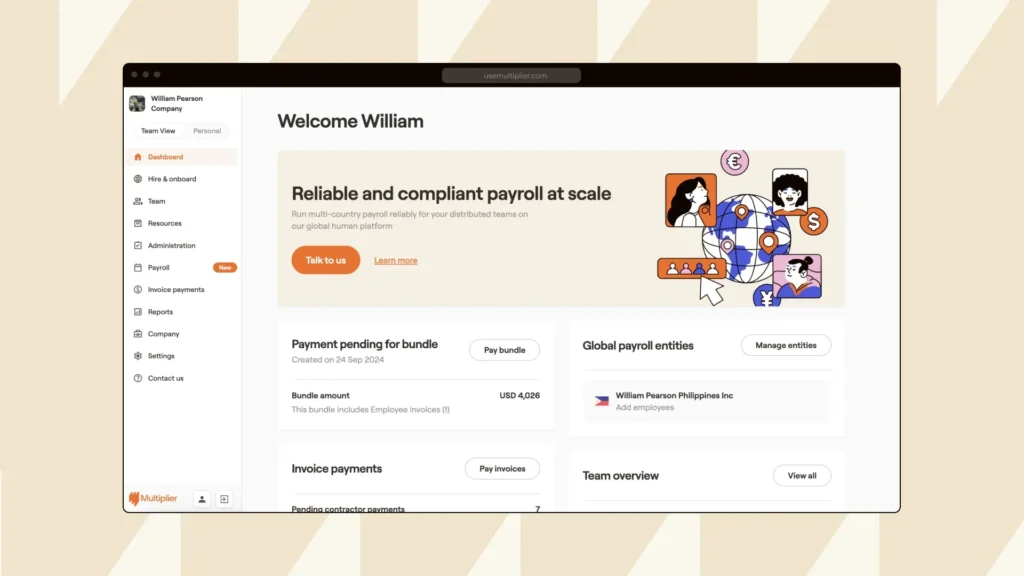
Multiplier’s help centre lists “Sales Commission” and “Commission” among its variable allowance types (its categories for pay that changes from month to month), alongside “Variable Performance Bonus” and several other bonus types. If an admin doesn’t enter a bonus amount before the cut-off, “the bonus will not be processed in the upcoming pay cycle.”
Multiplier’s FAQ says every customer gets “a named Customer Success Manager from day one”, on every tier. It also says employment contracts generate in under five minutes and that most customers have their first employee onboarded within 48 to 72 hours. Its EOR page describes “Multiplier’s vast network of owned entities” and coverage in 150-plus countries, and lists multi-currency expense reimbursement.
Multiplier’s EOR terms say the deposit is calculated “based on the Resource Costs, Service Fees, termination notice periods, any additional leaves and notice period days granted by Client, the Client’s credit standing, and other variables”, at Multiplier’s sole discretion. (“Resource” is Multiplier’s term for the employee.) The deposit is refunded within 60 days of the employee’s last working day.
Key features
- “Sales Commission” and “Commission” as named variable pay types
- A named customer success manager on every tier
- Multi-currency expense reimbursement
Pros
- Commission has its own named pay types.
- Pricing is published, with “no setup, onboarding, or offboarding fees on any tier”.
- Every customer gets a named customer success manager, not only enterprise accounts.
Cons
- A bonus amount not entered before the cut-off isn’t paid in that cycle.
- The deposit is set at Multiplier’s discretion, so the amount isn’t known until you get a quote.
- G2 reviewers mention invoicing errors, support delays, and payment delays.
Pricing
Core is $459 per employee per month billed annually, or $499 billed monthly. Growth is $519 billed annually, or $559 billed monthly.
G2 rating
⭐ 4.7/5
Sources: Multiplier variable allowance types, Multiplier FAQ, Multiplier EOR page, Multiplier EOR terms, G2. Accessed September 2026.
5. Oyster: best for published PE guidance on sales roles
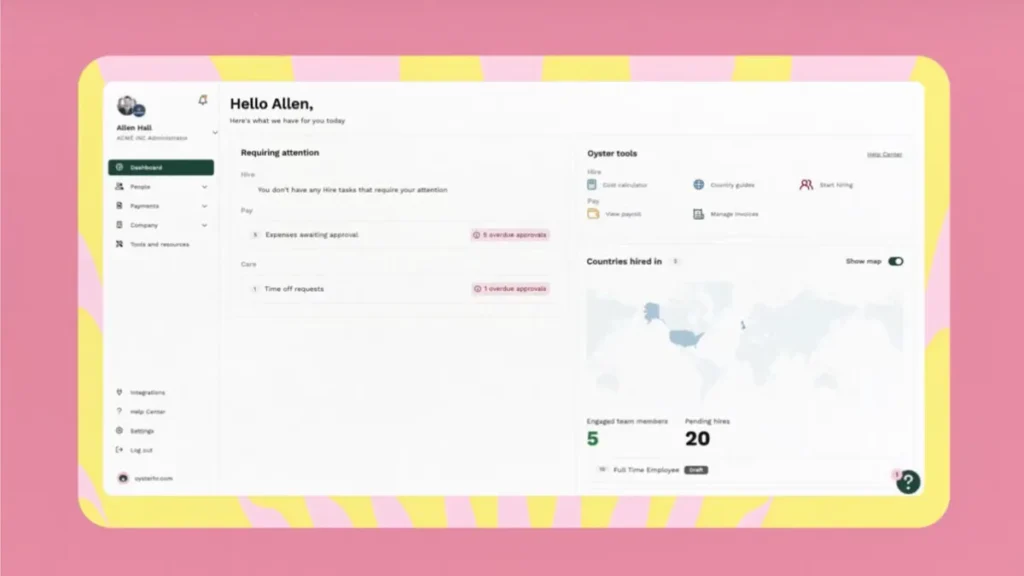
Oyster’s guide to EOR and permanent establishment addresses sales roles directly: “Roles that are directly tied to revenue-generating activities, such as sales or contract negotiation, are much more likely to create PE risk.” It lists running the sales process from another country as a case where an EOR’s protection “isn’t absolute”.
Commission is paid as an additional payment on top of salary, set as “One time” or “Monthly recurring” and entered in the team member’s local currency or your account currency. Oyster’s help centre gives a commission or bonus as an example, and you can’t change the current month once the cut-off date has passed.
Oyster normally requires “a 1-month fully-refundable deposit”, roughly one month of the hire’s total cost of services. Its help centre says that total includes “recurring bonuses, commissions, and allowances introduced during the hiring process”, as well as salary, employer costs, and the platform fee. Oyster’s pricing page lists EOR in 120-plus countries, visa sponsorship as an add-on, and no extra charges for setup, onboarding, or offboarding.
Key features
- One-time and monthly recurring additional payments for commission
- Published guidance on PE risk for sales and contract-negotiation roles
- Visa sponsorship as an add-on
Pros
- Oyster’s PE guidance names sales roles as a higher PE risk, even with an EOR.
- Additional payments can be set to recur monthly.
- There are no extra charges for setup, onboarding, or offboarding.
Cons
- The deposit includes recurring commissions agreed at hiring.
- Once the cut-off passes, you can’t change the current month’s pay.
- G2 reviewers mention slow support, processing delays, unclear tax information, and rigid reporting.
Pricing
$699 per employee per month, with annual discounts available, according to Oyster’s pricing page.
G2 rating
⭐ 4.4/5
Sources: Oyster PE guide, Oyster additional payments help article, Oyster deposit help article, Oyster pricing, G2. Accessed September 2026.
Frequently asked questions about EOR services for international sales hiring
Can an Employer of Record pay sales commission?
Yes. The EOR runs commission through local payroll with the correct tax and contributions. What varies is the mechanics: whether recurring commission is supported, when the payroll cut-off falls, and what an off-cycle payment costs. On Emerald’s platform, admins submit commission on the rep’s profile, and it’s paid in the next payroll cycle.
How do EOR deposits work for commission-heavy sales roles?
It depends on the provider. Some calculate the deposit on total monthly cost, including recurring commission, and some require a deposit for the full variable amount in certain countries. Emerald’s deposit is one month of employment costs, regardless of seniority. For other costs that sit outside the headline fee, read the hidden costs of EOR platforms guide.
Does an EOR remove permanent establishment risk for sales reps?
No. An EOR handles employment compliance, but a rep who habitually negotiates and concludes contracts in a country can still create PE for your company. Get local tax advice on who is allowed to sign contracts for your company, and read 10 everyday PE triggers to avoid.
Can I include a non-compete clause in an EOR sales contract?
On Emerald’s platform, yes: the onboarding form includes a non-compete toggle. Whether a non-compete is enforceable, and on what terms, varies by country, so check local rules for each market.
Should my first sales hire in a new country be a contractor?
A full-time salesperson with a quota (a sales target), a manager, and fixed working patterns looks like an employee to most tax authorities, whatever the contract says. What employee misclassification looks like and the risks covers the triggers.
How fast can I get a salesperson selling in a new market?
Standing up a legal entity takes 12 to 20-plus weeks. With an EOR, the contract is the quick part: Emerald issues compliant contracts within 48 hours. The longer part is finding the right rep, which is why Emerald places specialist hires in four to six weeks through the same team that employs them.
How do I justify a new sales territory to finance?
Use your own numbers. The EOR business case tool models four things: revenue you gain by getting salespeople selling sooner, money saved on exit costs, compliance risk avoided, and the cost of the legal entity you don’t have to set up. That gives finance a case it can sign off.
Who has Emerald built international sales teams for?
Start with independent reviews on G2. For named proof, read the Qualtrics case study, or browse all case studies, including HashiCorp. Once you’re down to a shortlist, we can arrange reference calls with existing customers.
Plan global hiring for your next sales territory
If you already have your rep, compare the platforms above on commission cut-offs, deposit basis, and PE guidance, and get each answer in writing. If you still need to find them, Emerald can source, employ, and pay your reps through one team. Talk to a talent acquisition specialist about your next sales territory, or explore the Employer of Record solution.